Modern Indigenous cuisine is not a simple revival of old recipes; it is a powerful economic and cultural movement actively defining Canada’s future.
- It is built on the principle of food sovereignty, which involves reclaiming ancestral ingredients and sustainable land stewardship practices.
- It drives tangible economic reconciliation by creating opportunities for Indigenous-owned businesses that celebrate authentic cultural expression.
Recommendation: The conscious culinary traveler’s role is to look past stereotypes, seek out operators with verified community ties, and use their dining choices to support this vital movement.
For many, Indigenous cuisine in Canada conjures a familiar, rustic image: smoked salmon, wild berries, and of course, bannock fried over an open fire. While these elements are part of the story, they represent only a single chapter in a much larger, more dynamic narrative that is currently unfolding across the country. A new wave of Indigenous chefs, producers, and entrepreneurs is pushing the boundaries of gastronomy, moving far beyond the expected. This movement is not about recreating a static past; it’s a vibrant, modern expression of cultural identity and resilience.
This culinary resurgence is rooted in a profound concept: food sovereignty. It’s the right of peoples to healthy and culturally appropriate food produced through ecologically sound and sustainable methods, and their right to define their own food and agriculture systems. This is more than a food trend; it is a form of culinary reconciliation. It challenges diners to rethink the very notion of Canadian “terroir” by connecting them to ingredients, flavours, and histories that have been stewarded on this land for millennia. The focus shifts from colonial staples to a decolonized plate, celebrating the immense biodiversity of the continent.
This guide is for the culinary traveler who wants to look deeper. We will explore the foundational ingredients, the sustainable philosophies, and the economic principles driving this movement. Most importantly, we will provide the tools to distinguish between genuine cultural celebration and superficial “Indigenous-themed” tourism, ensuring your experience is not only delicious but also genuinely supportive of the communities at the heart of this exciting culinary renaissance.
To help you navigate this rich culinary landscape, this guide explores the key pillars of modern Indigenous cuisine, from its agricultural roots to its most sophisticated expressions. Discover the ingredients, philosophies, and practical tips for an authentic dining experience.
Summary: The New Canadian Terroir: A Guide to Modern Indigenous Cuisine
- Corn, Beans, and Squash: How the Three Sisters Sustain a Menu
- Bison and Elk: Why Game Meat Is the Ultimate Sustainable Protein
- Salmon n’ Bannock vs. Tourist Traps: Where to Eat Authentic in Vancouver
- Spruce Tips and Fiddleheads: Identifying Boreal Flavours on Your Plate
- What Wine Pairs Best with Smoked Salmon and Frybread?
- Killaloe Sunrise or Classic Cinnamon: Which BeaverTail Is the Original?
- Indigenous-Owned vs. Indigenous-Themed: Which Operator Benefits the Community?
- Eating the Ocean: A Seasonal Guide to Canadian Seafood
Corn, Beans, and Squash: How the Three Sisters Sustain a Menu
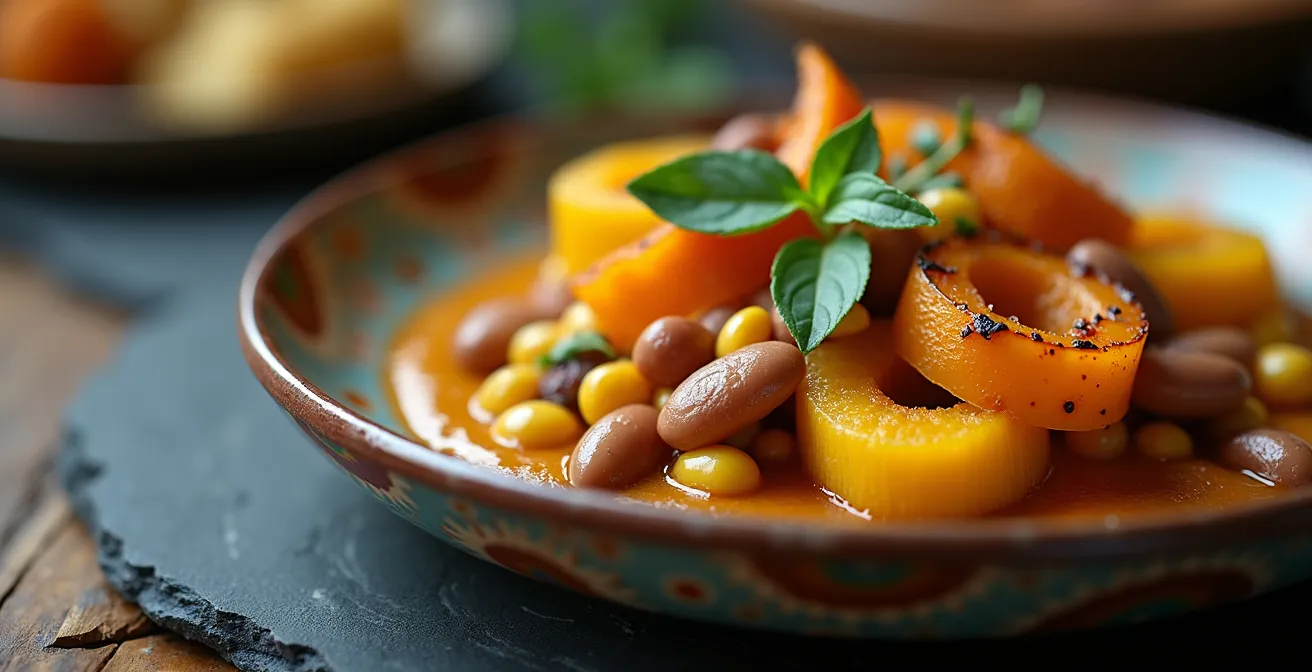
Long before the term “sustainable agriculture” entered the modern lexicon, Indigenous peoples across North America perfected a model of ecological harmony and nutritional synergy: the Three Sisters. This trio of corn, beans, and squash forms the agricultural bedrock of many Indigenous cultures and is now a cornerstone of the modern Indigenous culinary revival. This isn’t just about ingredients; it’s a complete food system. The corn provides a natural trellis for the beans to climb, the beans fix nitrogen in the soil to fertilize their companions, and the broad leaves of the squash create a living mulch that retains moisture and suppresses weeds.
On the modern plate, chefs are reinterpreting this ancient wisdom with incredible creativity. You might find Haudenosaunee white corn, with its distinct nutty profile, ground into flour for delicate breads or used in a rich hominy stew. Heritage beans, cultivated and preserved by initiatives like the Mohawk Seedkeepers Garden, offer a depth of flavour far beyond their supermarket counterparts. Squash appears not just in soups, but roasted, pureed, and even infused into desserts. According to Canadian Food Focus, traditional Indigenous ingredients like the Three Sisters offer unique flavours and health benefits that have sustained communities for generations.
For the culinary traveler, understanding the Three Sisters is the first step toward appreciating the depth of Indigenous cuisine. It demonstrates a philosophy where food is not just sustenance, but a relationship between the land, the community, and the plate. When you see these ingredients on a menu, you are tasting a story of resilience, innovation, and perfect ecological design that has been thousands of years in the making.
Bison and Elk: Why Game Meat Is the Ultimate Sustainable Protein
The resurgence of modern Indigenous cuisine is reintroducing North Americans to their original red meats: bison and elk. These animals are more than just a source of protein; they are a symbol of the plains and a powerful engine for both ecological restoration and economic sovereignty. Unlike cattle, bison are perfectly adapted to the Canadian prairies. They graze on native grasses, require less water, and their grazing patterns can actually improve grassland health. This makes them an inherently sustainable choice that aligns perfectly with a philosophy of working with the land, not against it.
Chefs are celebrating the rich, slightly sweet flavour of bison in everything from hearty stews and braised ribs to sophisticated tartares. Elk, with its leaner profile and milder taste, offers a versatile alternative that pairs beautifully with the boreal flavours of juniper and wild berries. This focus on game meat is a direct expression of food sovereignty, connecting communities back to a vital ancestral food source. Furthermore, supporting Indigenous-owned bison ranches is a direct act of culinary reconciliation.

The economic impact is significant. Indigenous-led enterprises in agriculture and food are creating jobs, building wealth, and revitalizing local economies. As a case in point, the National Indigenous Economic Development Board reports that closing the economic gap could add $27.7 billion to Canada’s GDP. By choosing a dish featuring sustainably raised bison or elk from an Indigenous supplier, you are not just enjoying a meal; you are investing in a system that honours ecological balance and empowers communities.
Salmon n’ Bannock vs. Tourist Traps: Where to Eat Authentic in Vancouver
For culinary travelers in Vancouver, the desire to experience authentic Indigenous food often leads them to one iconic name. As a testament to the slow but steady growth of this sector, a major Canadian city has a surprisingly small number of dedicated Indigenous restaurants.
As noted by a prominent food publication, this reality highlights both the opportunity and the challenge for Indigenous culinary entrepreneurs. Eat North magazine points this out specifically:
Salmon n’ Bannock remains Vancouver’s only First Nations restaurant, specializing in wild fish, free range game meat and of course, bannock, baked fresh daily
– Eat North, The long-overdue rise of Indigenous cuisine brings Canada back to its roots
This exclusivity makes it a must-visit, but it also underscores the importance of knowing what to look for when seeking authenticity. The key is to look for operators with deep, verifiable roots in the local First Nations—in Vancouver’s case, the Musqueam, Squamish, and Tsleil-Waututh peoples. An authentic establishment will reflect the local terroir not just with salmon, but with specific regional ingredients like oolichan (candlefish), tart salal berries, and crisp sea asparagus. To help you make an informed choice, consider these points:
- Ownership: Is the business Indigenous-owned? Look for the “Original Original” seal from the Indigenous Tourism Association of Canada (ITAC).
- Community Connection: Does the restaurant have stated partnerships with or employ members from local First Nations?
- Sourcing: Does the menu highlight ingredients from Indigenous suppliers, fishers, and foragers?
- Specificity: Does the restaurant identify the specific Nation or culture that inspires its menu, rather than using generic “pan-Indian” motifs?
Navigating the scene means looking beyond the obvious. While a place like Salmon n’ Bannock is an essential starting point, true support comes from applying these principles to find and champion the next wave of Indigenous culinary enterprises.
Spruce Tips and Fiddleheads: Identifying Boreal Flavours on Your Plate
The true essence of modern Indigenous cuisine—its unique “Indigenous terroir”—is often found in the subtle, powerful flavours foraged from the land itself. Moving beyond the farm, chefs are drawing inspiration from the boreal forests and wild meadows of Canada, introducing diners to a palette of tastes that are at once ancient and thrillingly new. Two of the most emblematic of these are spruce tips and fiddleheads.
In the spring, the bright green new growth of spruce trees is harvested. These spruce tips carry a surprising and delightful citrusy tang, with notes of pine and resin. Chefs use them to infuse vinegars, cure fish, flavour syrups for cocktails, or even dust them over dishes as a finishing “salt.” It’s a taste of the forest, concentrated and bright. Similarly, fiddleheads—the coiled young fronds of the ostrich fern—are a seasonal delicacy. Harvested for a fleeting period in the spring, they have a unique flavour reminiscent of asparagus, green beans, and a hint of the forest floor.

Identifying these flavours on your plate is like discovering a secret language. It’s a connection to the seasons and to the intimate knowledge of the land held by Indigenous communities. When you taste the bright zest of a spruce tip or the earthy crunch of a fiddlehead, you are experiencing more than a novel ingredient. You are tasting a practice of sustainable harvesting, a deep understanding of botany, and a culinary tradition that sees the entire landscape as a potential pantry. These are the notes that compose the symphony of a truly decolonized plate.
What Wine Pairs Best with Smoked Salmon and Frybread?
The sophistication of modern Indigenous cuisine is perhaps best expressed in its thoughtful approach to beverage pairings. The question is no longer just *what* to eat, but how to elevate the experience. This has led to a fascinating dialogue between traditional Indigenous ingredients and the worlds of viticulture and craft distilling, often led by Indigenous producers themselves.
A shining example is Nk’Mip Cellars (pronounced “in-ka-meep”), North America’s first Indigenous-owned and -operated winery, located in British Columbia’s Okanagan Valley. They operate on the simple but profound principle of “what grows together, goes together.” This deep-rooted understanding of Indigenous terroir means their wines are crafted with the local ecosystem in mind, making them natural partners for the region’s food. The smokiness of West Coast salmon finds a perfect counterpoint in the crisp acidity and slight sweetness of a Riesling, while the richness of game meats can be matched by the winery’s bold Meritage blends.
This philosophy extends beyond wine. Indigenous-owned distilleries are using wild botanicals to create gins that echo the flavours of the boreal forest, and craft meaderies on the Prairies are producing honey wines that harmonize with local bison. When pairing with a dish like frybread, the context matters. A simple, savoury frybread might pair with a crisp lager, while a sweet version topped with berries could be elevated by a sparkling wine, whose bubbles cut through the richness. The following table offers a starting point for exploring these exciting pairings.
| Traditional Dish | Recommended Pairing | Why It Works |
|---|---|---|
| Smoked Salmon | Off-dry Riesling from Nk’Mip Cellars | Wine’s sweetness balances smoke and salt |
| Frybread with Berries | Sparkling wine from Indigenous producer | Bubbles cut through richness |
| Bison Stew | Saskatchewan craft mead | Regional terroir harmony |
| Wild Game | Wild-botanical gin from Indigenous distiller | Complementary forest notes |
Killaloe Sunrise or Classic Cinnamon: Which BeaverTail Is the Original?
The question seems playful, a nod to a famous Canadian pastry. But to understand the soul of modern Indigenous cuisine, we must pivot from this commercial treat to its cultural ancestor: bannock. And here, the story becomes complex, challenging our most common assumptions. Many consider bannock the quintessential Indigenous food, but its history is deeply intertwined with the colonial project. As Chef Rich Francis, a leading voice in decolonizing Canadian cuisine, states:
Bannock isn’t even Indigenous, in the truest sense. It was what we made when our land was taken, our movement limited, and our provisions reduced to a sack of flour. It was taught to us—it’s Scottish traditionally—it’s colonization food.
– Chef Rich Francis, How an Indigenous Chef Is Decolonizing Canadian Cuisine
This powerful statement reframes bannock not as a purely ancestral food, but as a symbol of resilience and adaptation in the face of immense hardship. It was born of necessity from government-issued rations of flour, lard, and sugar. This context is crucial for the conscious traveler to understand. The debate around bannock within Indigenous communities reflects the broader conversation about what constitutes “authentic” cuisine.
Case Study: The Complex Legacy of Bannock
Despite its colonial origins, bannock holds immense cultural significance. It has different names and forms across the country: ‘Palauga’ for the Inuit, ‘luskinikn’ for the Mi’kmaq, and ‘Ba’Wezhiganag’ for the Ojibwés. For generations, it was a reliable food source that sustained families. Today, some chefs and restaurants, like Tea N Bannock in Toronto, celebrate this legacy with creative adaptations like “Indian tacos,” embracing it as part of their modern identity. Others, like Chef Francis, are focused on a pre-colonial palate, deliberately moving away from ingredients like wheat flour to recenter their cuisine on the foods that were present before contact. Both approaches are valid and vital parts of the modern Indigenous food story.
So, while a BeaverTail is a simple pastry, bannock is a food loaded with history, pain, and pride. Understanding this distinction is key to appreciating the thoughtful choices today’s Indigenous chefs are making about which stories they want to tell on the plate.
Indigenous-Owned vs. Indigenous-Themed: Which Operator Benefits the Community?
As the popularity of Indigenous cuisine grows, so does the risk of cultural appropriation. The line between appreciation and exploitation can be thin, and for the culinary traveler, it’s vital to know the difference between an “Indigenous-owned” business and one that is merely “Indigenous-themed.” The former directly contributes to community wealth and self-determination, while the latter can perpetuate stereotypes and divert economic benefits away from the communities that created the culture.
Supporting genuinely Indigenous-owned businesses is a direct form of economic reconciliation. It’s an acknowledgment of past harms and a tangible action to support a more equitable future. The impact is real; according to the National Indigenous Economic Development Board, economic reconciliation could increase Canada’s GDP by 1.5% or more. Your dining dollars become a vote for a system where Indigenous peoples are the primary beneficiaries of their own cultural heritage.
But how do you verify authenticity? Look for clear signals. The most reliable is the “Original Original” certification mark from the Indigenous Tourism Association of Canada (ITAC), which guarantees a business is at least 51% Indigenous-owned. Beyond that, use your judgment to assess how an operator presents itself. Are they specific about the Nation they belong to or draw inspiration from? Or do they rely on generic, pan-Indian imagery? The following audit can help you make a conscious choice.
Your 5-Step Authenticity Audit for Indigenous Tourism
- Verify Ownership: Look for the ITAC “Original Original” seal on their website or storefront. Is the Indigenous ownership (e.g., First Nation, Métis, Inuit) clearly and proudly stated?
- Assess Community Connection: Does the business talk about its relationship with the local Nation(s)? Do they mention community partnerships, hiring practices, or how they give back?
- Analyze the Sourcing: Check the menu or “about us” page. Do they name specific Indigenous suppliers, fishers, or harvesters as partners? A genuine operator is often proud of their supply chain.
- Examine the Narrative: Does the marketing use specific cultural stories and language respectfully, or does it rely on generic or stereotypical motifs (e.g., feathered headdresses, vague “spirit” language)?
- Check for Specificity: Authentic businesses celebrate a specific culture (e.g., Cree, Haida, Mi’kmaq). Be wary of vague “Native” or “Indian” branding that lumps hundreds of distinct cultures into one.
Key Takeaways
- Modern Indigenous cuisine is a system based on food sovereignty, focusing on ancestral ingredients and sustainable practices.
- Supporting certified “Original Original” Indigenous-owned businesses is a direct act of economic reconciliation with measurable impact.
- Authenticity lies in specificity: look for connections to specific Nations, local terroir, and a decolonized approach to ingredients, moving beyond clichés like bannock.
Eating the Ocean: A Seasonal Guide to Canadian Seafood
The story of Indigenous cuisine is intrinsically linked to the waters that define Canada. From the Pacific to the Atlantic, First Nations have stewarded coastal ecosystems for millennia, developing a deep, seasonal understanding of marine life. Today, this traditional ecological knowledge is at the forefront of the sustainable seafood movement, offering a path forward for an industry in crisis and a spectacular array of flavours for the discerning diner.
Indigenous-led initiatives are revolutionizing aquaculture and wild fisheries. In Nova Scotia, the Mi’kmaq are leading marine stewardship and oyster farming projects. On the West Coast, the ‘Namgis First Nation’s Kuterra project pioneered land-raised salmon farming, creating a closed-containment system that protects wild stocks from disease and sea lice. These are not just businesses; they are Indigenous Protected and Conserved Areas (IPCAs) in practice, ensuring the health of the ocean for future generations. This work is especially critical when, as Canadian Feed the Children reports, remote Indigenous communities can experience an effective food price increase of over 20% for store-bought foods, making local, sustainable food sources vital.
For the traveler, this translates to a menu that truly reflects the season and the coast. On a B.C. menu, you might find oolichan (candlefish), a small, oil-rich fish traditionally harvested in the spring. In the Maritimes, look for briny sea urchin, sweet razor clams, or tender whelks. These are the true tastes of Canada’s oceans, harvested with a respect born from a relationship thousands of years old. When you choose seafood from an Indigenous-certified supplier, you are supporting a model of ocean management that prioritizes long-term health over short-term profit—a delicious choice that also happens to be a deeply responsible one.
By seeking out these experiences, you are participating in a conversation about what it means to eat in Canada today. This is more than a meal; it’s an invitation to connect with the land, its history, and its future. The next step is to use these insights to plan your own journey into the heart of Canada’s most exciting and important culinary movement.