In summary:
- Embrace winter by participating in iconic Canadian activities like skating the Rideau Canal and exploring Ottawa’s Winterlude festival.
- Utilize unique urban infrastructure, such as Montreal’s RESO “Underground City,” as a tool for both survival and discovery.
- Choose the right gear, like waterproof boots for Toronto’s slush, to stay comfortable and mobile.
- Adopt a resilient mindset by seeking out cozy “hygge” experiences and smart budget strategies to fully enjoy the season.
The thought of a Canadian winter can conjure images of biting winds, knee-deep snow, and an overwhelming desire to stay indoors. For many visitors, especially those heading to cities like Ottawa or Montreal in the heart of February, the cold is a genuine source of anxiety. The standard advice—”dress in layers” or “drink hot chocolate”—while true, barely scratches the surface of what it means to truly experience winter in Canada. It frames the season as something to be endured, a challenge to be overcome before you can get to the “real” fun indoors.
But what if the secret wasn’t about avoiding the cold, but about leaning into it? What if Canadian cities weren’t just tolerating winter, but were masterfully engineered for it? This guide shifts the perspective. We’re moving beyond mere survival to active, joyful thriving. The key lies in understanding and embracing the unique infrastructure, cultural rituals, and resilient mindset that transform these frozen landscapes into vibrant winter playgrounds. It’s about learning why Montreal has those iconic outdoor staircases and how to use its underground city as more than just a mall.
This isn’t a guide about hiding from winter; it’s a playbook for conquering it with a smile. We’ll explore how to navigate everything from the world’s largest skating rink to the coziest cafés, proving that with the right strategy and a bit of adventurous spirit, a Canadian urban winter can be one of the most magical travel experiences you’ll ever have. Get ready to swap your fear for fascination.
To help you navigate these unique urban winter experiences, this article covers everything from essential gear to cultural secrets. Explore the sections below to build your perfect winter city adventure.
Summary: Your Playbook for an Unforgettable Canadian Winter
- How to Skate the Rideau Canal: Conditions, Rentals, and BeaverTails
- Is the “Underground City” Just a Mall or a Survival Tool?
- Why You Need Waterproof Boots for Slushy Toronto Streets
- Ice Carvings and Snow Slides: Exploring Ottawa’s Winterlude with Kids
- The Hygge Guide: Best Cafés with Fireplaces in Old Quebec
- The “Brown Bag” Strategy: Where to Eat Lunch at Tremblant Without Spending $100
- The Real Reason Montreal Houses Have Spiral Staircases Outside
- Snowshoeing for Non-Skiers: How to Enjoy Winter Trails
How to Skate the Rideau Canal: Conditions, Rentals, and BeaverTails
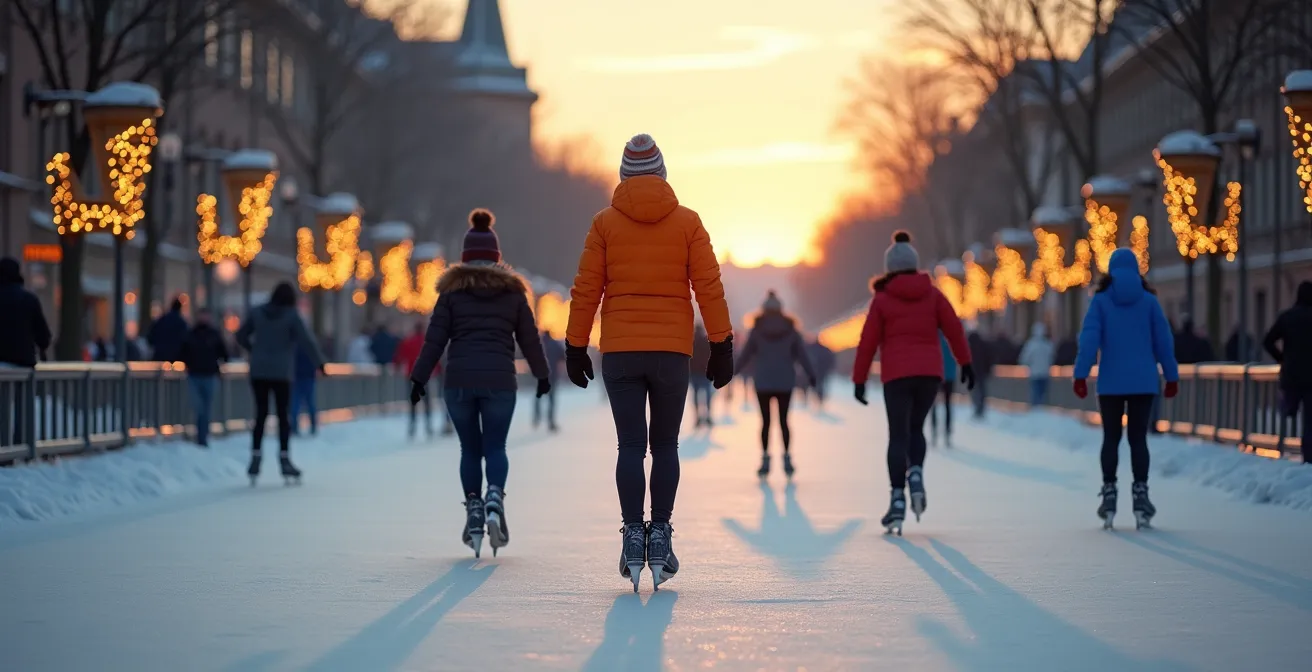
Forget seeing the sights from a bus; in Ottawa, the best way to experience the city is by gliding through its heart on the Rideau Canal Skateway, a UNESCO World Heritage Site. This isn’t just an activity; it’s a beloved winter ritual. The Skateway stretches 7.8 kilometers, transforming the historic canal into the world’s largest naturally frozen skating rink. To do it right, you need a strategy. The ice quality is paramount, and the National Capital Commission (NCC) works tirelessly to maintain it, waiting for a sustained minimum ice thickness of 30 cm before opening the season. This commitment ensures a safe and spectacular experience for everyone.
The key to a perfect day on the ice is timing. Locals know the best skating is in the morning, right after the “Froster” zamboni has groomed the surface, leaving it as smooth as glass. You can rent skates at multiple locations, including near the National Arts Centre (Km 0) and at Dow’s Lake, but bringing a backpack to carry your boots is a pro move. It gives you the freedom to hop on and off the ice at any of the 30+ access points, exploring neighborhoods like the Glebe along the way. And no skate is complete without indulging in another Canadian ritual: eating a BeaverTail. These hot, fried dough pastries, dusted with cinnamon sugar or other decadent toppings, are the official fuel of the Skateway, with huts conveniently located at key points.
Your Action Plan: Skating the Rideau Canal Like a Local
- Check Conditions: Before you go, check the official NCC website. Ice conditions are updated twice daily, at 8 am and 4 pm, so you know exactly which sections are open and safe.
- Plan Your Entry: Identify your access point. With over 30 options, including 5 universal access ramps, you can start your skate from almost anywhere in the downtown core.
- Gear Up: Bring a backpack for your boots. This allows you to walk to the canal, change into skates, and not worry about leaving your footwear behind or renting a locker.
- Time Your Skate: Aim for a morning skate, especially after a fresh snowfall. The ice will be freshly cleared and at its smoothest, offering the best gliding conditions.
- Fuel the Fun: Make a “BeaverTail stop” part of your plan. Locate the huts at Km 0, Fifth Avenue, or Dow’s Lake on the map for a well-deserved, quintessentially Canadian treat.
Is the “Underground City” Just a Mall or a Survival Tool?
In Montreal, the answer is a resounding “both.” The RESO, French for *réseau* (network), is far more than a collection of shops; it’s a brilliant piece of winter infrastructure. This 32-kilometer network of tunnels is a lifeline that allows life to flourish even when temperatures plummet. It’s a prime example of a city not just enduring winter, but actively designing a way to thrive within it. While tourists might see it as a convenient way to get from a hotel to a shopping center, for locals, it’s an essential urban artery. It’s a place where you can go to work, see a movie, grab dinner, and even visit an art installation, all without ever putting on a winter coat.
On any given day, nearly 500,000 people use Montreal’s underground city, a testament to its integration into daily life. This isn’t an isolated, sterile environment; it’s a bustling, vibrant extension of the city above. The RESO connects metro stations, universities, concert halls, and residential buildings, creating a true “city within a city.” It’s a system designed for resilience and comfort, allowing Montrealers to maintain a high quality of life throughout the year.

As you navigate the bright, warm corridors, you’ll see a cross-section of urban life: students heading to class, professionals walking to meetings, and families enjoying a day out. This illustrates the core philosophy of embracing urban winter—it’s not about hiding, but about having smart, comfortable alternatives that make the season enjoyable. The RESO is the ultimate expression of this mindset.
Case Study: Montreal’s RESO vs. Toronto’s PATH
While both are impressive underground networks, their philosophies differ. Toronto’s PATH is the world’s largest underground shopping complex, spanning 30 kilometers and primarily serving the Financial District’s office workers with over 1,200 businesses. It is a marvel of commercial connectivity. Montreal’s RESO, however, offers a more diverse, “lifestyle-oriented” experience. It integrates not just shopping and offices, but also cultural venues, residential buildings, and public art, making it feel less like a massive mall and more like a genuine subterranean neighborhood—a true tool for living, not just for commerce.
Why You Need Waterproof Boots for Slushy Toronto Streets
While Montreal and Quebec City are known for their dry, crisp cold and picturesque snow, Toronto’s winter presents a different, soggier challenge: the slush. Due to its proximity to Lake Ontario, the city often hovers around the freezing mark, leading to a constant cycle of snowing, melting, and re-freezing. This creates ankle-deep puddles of icy, salty slush at nearly every street corner, a formidable foe for unprepared footwear. This is why the single most important piece of gear for a Toronto winter isn’t the warmest parka, but a truly waterproof pair of boots. A warm boot that gets wet is useless; a waterproof boot keeps you dry, mobile, and happy.
Choosing the right material is crucial. While insulated leather is great for the dry cold of Montreal, it can quickly become saturated and salt-stained in Toronto. For navigating the city’s slushy intersections, materials like GORE-TEX are your best friend, offering a breathable yet impenetrable barrier against moisture. Rubber boots are also effective, though they can be less comfortable for long walks. When shopping, always consider buying your boots one size larger than you normally would. This simple trick allows you to wear thick, moisture-wicking wool socks, which provide the actual insulation and are a game-changer for all-day warmth.
Investing in good boots is an investment in your entire trip. It means you can walk confidently, explore neighborhoods without fear of frozen toes, and say “yes” to spontaneous adventures. To protect your investment and the floors of your hotel or Airbnb, a boot tray is a wise accessory. It contains the melting slush and salt, preventing damage and mess. Proper gear isn’t about fashion; it’s about freedom.
Ice Carvings and Snow Slides: Exploring Ottawa’s Winterlude with Kids
If you need proof that Canadians celebrate winter rather than just endure it, look no further than Winterlude. For three weekends every February, Ottawa and Gatineau transform into a massive winter festival that is pure, unadulterated fun. This is “engineered play” on a grand scale, drawing hundreds of thousands of visitors to revel in the magic of the season. It’s an especially incredible experience for families, offering a host of activities that turn the coldest time of year into the most exciting.
The heart of the festival is typically split across several sites. The Crystal Garden in Confederation Park becomes an outdoor art gallery, showcasing breathtakingly intricate ice sculptures created by artists from around the world. At night, illuminated by colorful lights, the sculptures take on a magical quality. Meanwhile, Jacques-Cartier Park in Gatineau usually becomes the Snowflake Kingdom, a giant winter playground. Here, kids (and kids at heart) can zip down massive snow slides, navigate snow mazes, and meet the festival’s fuzzy mascots, the Ice Hogs. These activities are designed to get you moving, laughing, and generating your own warmth.
Winterlude embodies the resilient, cheerful spirit of a Canadian winter. It’s a collective celebration that reframes the cold as an opportunity for creativity, community, and play. For a visitor, especially one with children, it’s the perfect antidote to any winter blues. Instead of huddling indoors, you’re part of a city-wide party, making memories surrounded by jaw-dropping art and the joyful sounds of families at play. It’s a powerful reminder that winter is what you make of it.
The Hygge Guide: Best Cafés with Fireplaces in Old Quebec
After a day spent exploring snow-dusted cobblestone streets, there is no feeling more satisfying than stepping into a warm, cozy sanctuary. In Quebec, this feeling is a way of life, a form of “cocooning” that’s the local answer to the Danish concept of *hygge*. It’s about creating an atmosphere of warmth, comfort, and conviviality, and nowhere is this more evident than in the charming cafés of Old Quebec. Finding a spot with a crackling fireplace isn’t just a lucky break; it’s a core part of the winter experience, a ritualized enjoyment that balances outdoor adventure with indoor bliss.
The best places are often tucked away in centuries-old stone buildings, their historic character adding to the authentic atmosphere. To truly embrace the *cocooning* experience, follow the local rhythm:
- Walk first, warm up later: Start with a brisk walking tour of landmarks like the Petit Champlain district and Place Royale. Feeling the chill on your cheeks makes the eventual warmth of a fireplace even more rewarding.
- Taste the comfort: This is the time to indulge in winter comfort foods. Order a traditional, steaming poutine or a rich French onion soup. For drinks, try both a decadent *chocolat chaud* (hot chocolate) and a spiced *vin chaud* (mulled wine) to complete the tasting experience.
- Time your visit: Many cafés light their fireplaces in the afternoon. Aim for a late-afternoon break, between 3 pm and 5 pm, when the fire is fully stoked and the ambiance is at its peak.
This deliberate pursuit of coziness is central to the local winter mindset. It’s not about escaping the cold but about creating a perfect, comforting contrast to it. It transforms a simple coffee break into a memorable highlight of your trip, a moment of peaceful respite that rejuvenates you for your next winter adventure.
The “Brown Bag” Strategy: Where to Eat Lunch at Tremblant Without Spending $100
A day at a world-class ski resort like Mont-Tremblant is exhilarating, but the cost of on-mountain dining can quickly cool your enthusiasm. A simple lunch for a family can easily approach triple digits. This is where a classic Canadian winter move, the “Brown Bag” Strategy, comes into play. Far from being a sign of cutting corners, packing your own lunch is a smart, resilient tactic that gives you more control over your budget, your time, and your nutrition. It’s about maximizing your day on the slopes, not in a pricey, crowded cafeteria.
Many resorts, including Tremblant, understand and accommodate this. They provide designated indoor lunch spaces or “chalets” where you can eat your packed meal in warmth and comfort. The strategy is simple: pack a thermos with hot soup or chili, make some hearty sandwiches, and throw in some high-energy snacks. This not only saves a significant amount of money but also saves you time waiting in long food lines, giving you more precious minutes on the hill. For those who don’t want to prepare in advance, another savvy option is to stop at a grocery store in the village before heading up the mountain to grab fresh supplies.
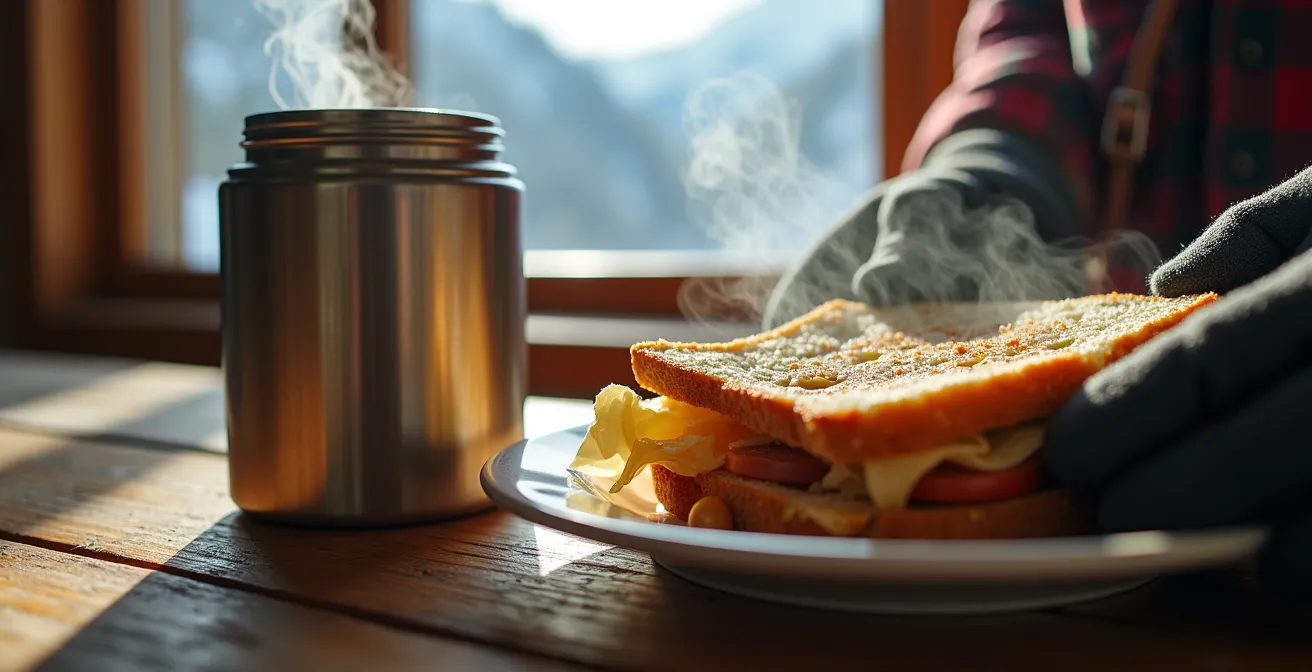
The table below breaks down the typical options, highlighting why the Brown Bag strategy offers unbeatable value. It’s a perfect example of the resourceful, practical mindset that defines a Canadian winter enthusiast.
| Option | Cost Range | Pros | Cons |
|---|---|---|---|
| Brown Bag/Packed Lunch | $0-10 | Most economical, customizable | Requires preparation, storage |
| Village Grocery Store | $10-20 | Fresh options, local products | Need to leave mountain |
| Cafeteria Side Items | $15-25 | Hot food, convenient | Limited selection |
| Full Mountain Restaurant | $30-50+ | Full service, variety | Most expensive option |
The Real Reason Montreal Houses Have Spiral Staircases Outside
One of the most charming and curious architectural features of Montreal is the prevalence of exterior spiral staircases, especially in neighborhoods like the Plateau Mont-Royal. They twist elegantly up the fronts of duplexes and triplexes, creating a distinctive urban streetscape. While they are beautiful, their origin is purely practical—a clever solution born from 19th-century urban planning and a desire to maximize livable space. Understanding their history reveals another layer of how the city has been shaped by, and for, its climate and community.
In the late 1800s, Montreal passed a bylaw aimed at improving public health by ensuring more green space for residents. The law mandated that new residential buildings have a small yard in front. To comply without sacrificing precious indoor square footage on narrow city lots, architects devised an ingenious workaround: they moved the bulky interior staircases to the outside. This freed up significant interior space, allowing for the creation of the long, narrow apartments known as “plexes” that are still common today. The spiral shape was chosen for its compact footprint, saving even more space.
From Function to Icon: The Evolution of a Staircase
As highlighted in analyses of Canadian urban design, these staircases have evolved far beyond their original purpose. In the summer, they become social spaces—impromptu balconies where neighbors chat and watch the world go by. In the winter, they present a navigational challenge, requiring careful treading, but they also remain a powerful symbol of Montreal’s unique approach to urban density. They are a constant, visible reminder of a city’s history, a physical manifestation of a community that values both private living space and public street life, woven together by a uniquely beautiful—and practical—design.
So, when you see these staircases, you’re not just looking at a pretty architectural quirk. You’re seeing a piece of living history and a testament to Montreal’s innovative, resilient character. They are a perfect metaphor for the city itself: a bit challenging in the winter, but ultimately full of charm and ingenuity.
Key takeaways
- Winter cities are engineered for enjoyment: Look for the purpose-built infrastructure like underground networks and skateways designed to make winter life better.
- The right gear is freedom: Don’t just dress warm, dress smart. Waterproof boots for slush and layers for activity will let you do more, comfortably.
- Embrace the rituals: Winter enjoyment is cultural. Participating in traditions like festival-going, seeking cozy cafés, and eating BeaverTails is key to the experience.
Snowshoeing for Non-Skiers: How to Enjoy Winter Trails
Skiing and snowboarding often dominate the winter sports conversation, but they require expensive gear, lift tickets, and a steep learning curve. For the non-skier looking to immerse themselves in Canada’s serene winter landscapes, there is a far more accessible and equally magical alternative: snowshoeing. It’s essentially hiking on snow, requiring little more skill than walking. This makes it the perfect activity for anyone to connect with nature, get some great exercise, and experience the quiet beauty of a snow-covered forest, often right within the city limits.
Urban centers like Montreal and Ottawa are fantastic for this. You don’t need a car or a long drive to a mountain. In Montreal, you can take the metro to the foot of Mont-Royal, rent snowshoes on-site, and be on a peaceful, wooded trail within minutes of leaving the downtown core. The key is to stay off the groomed cross-country ski tracks, which are reserved for skiers, and instead follow the dedicated snowshoeing paths. Many parks also offer guided nighttime tours, where you explore the trails by the light of a headlamp, a truly unique and enchanting experience that offers a completely different perspective on the winter woods.
Snowshoeing is the embodiment of the “thriving in winter” mindset. It’s low-cost, easy to learn, and provides an incredible sense of accomplishment and peace. It proves that you don’t have to be an extreme athlete to have a profound winter adventure. All you need is a willingness to step out onto the snow and walk. It’s a simple act that opens up a whole new world of winter enjoyment, far from the crowds and the high costs of the ski hill.
Now that you’re equipped with the strategies and mindset to transform a cold trip into a vibrant adventure, the next logical step is to pick an experience and dive in. Start planning your visit to a festival, map out a café tour, or simply rent a pair of skates and see where the ice takes you.