
Contrary to the postcard image, Canada’s heritage sites are not a finished history but active landscapes where colonial narratives and Indigenous sovereignty are still in negotiation.
- Colonialism is an ongoing structure, not a closed historical chapter, with impacts visible in treaty relationships and land use today.
- Understanding these sites requires moving beyond the French-British conflict to center the Indigenous perspectives that were erased or marginalized.
Recommendation: Approach each site as a critical observer by asking whose land you are on, whose story is not being told, and how you can support authentic Indigenous-led tourism.
For many travellers, exploring Canada’s colonial heritage sites feels like stepping back in time. We see the grandeur of fortified walls, walk the battlefields that supposedly forged a nation, and admire the architecture of a bygone era. These places are presented as foundational chapters in the story of Canada, often focusing on the epic rivalry between the British and the French. But this familiar narrative, tidy and heroic, represents only one side of a much more complex and ongoing story.
What if these sites are not just relics of a finished past, but active landscapes of power where history is still being debated? The critical perspective this guide proposes is that the colonial history of Canada is not over; its structures and consequences persist. Viewing these places solely through a European lens ignores the deep, continuous history of the First Nations, Inuit, and Métis peoples on whose land these forts and settlements were built, often in direct violation of treaties and relationships. It overlooks the economic and cultural disruptions that were set in motion and continue to this day.
This article moves beyond the monuments to examine the evidence. We will not simply list dates and battles. Instead, we will analyze these key sites as points of contact, conflict, and negotiation. By recentering the Indigenous context and questioning the accepted narratives, we can begin to understand them not as static tourist attractions, but as crucial places for dialogue in the era of reconciliation. It’s an invitation to become a more conscious and responsible visitor, one who seeks not just to see history, but to understand its living legacy.
To navigate this complex terrain, this guide examines several key sites and themes, offering a more nuanced understanding of Canada’s past and present. Each section unpacks a different facet of this negotiated history, from pivotal battles to the modern-day interpretation of controversial symbols.
Summary: Navigating the Layers of Canadian History
- Why the Battle of the Plains of Abraham Changed North America in 20 Minutes
- Grand-Pré National Historic Site: Uncovering the Story of the Deportation
- Hudson’s Bay Company Forts: How Fur Trade Built the Country
- Louisbourg vs. Halifax Citadel: Two Different Approaches to Colonial Defense
- How to Interpret Colonial Statues in the Era of Reconciliation
- The Historical Myth About “Totem Poles” That 60% of Tourists Believe
- The Sourtoe Cocktail: Why Travelers Pay $10 to Touch a Human Toe
- How to Support Indigenous Tourism in Canada Respectfully?
Why the Battle of the Plains of Abraham Changed North America in 20 Minutes
The 1759 Battle of the Plains of Abraham is often framed as the defining moment in the creation of Canada, a swift and dramatic clash between British General Wolfe and French General Montcalm that decided the fate of New France. While the battle itself was remarkably brief, its consequences rippled across the continent, shaping not just Canada but the future United States. However, the story typically begins with European ships arriving, erasing the millennia of Indigenous presence. At the time of Champlain’s arrival, the land around what is now Quebec City was a vital territory for multiple Indigenous nations. As the CBC’s “Canada: The Story of Us” notes, this area was controlled by the Innu and the Wendat, whose alliances, trade routes, and societies were the dominant reality.
The battle was not merely a French versus British affair; it was an imperial conflict with global participants. As a critical analysis in War on the Rocks highlights, the event can be seen as the “first battle of the American Revolution.” It involved thousands of American-born colonists serving in the British Army and Royal Navy. Their participation in securing a British victory inadvertently destabilized the balance of power in North America. With the French threat removed, the American colonies no longer depended as heavily on British military protection, setting the stage for their own push for independence less than two decades later.
Therefore, viewing the Plains of Abraham solely as a Canadian birth story is a simplification. It was a pivotal event in a much larger imperial game, one that radically altered Indigenous sovereignty and unintentionally catalyzed another colonial rebellion. The 20-minute battle didn’t just cede a city; it reconfigured the power dynamics of an entire continent, with lasting consequences for all its inhabitants.
Grand-Pré National Historic Site: Uncovering the Story of the Deportation
The serene landscape of Grand-Pré, a UNESCO World Heritage Site in Nova Scotia, evokes a sense of pastoral peace with its lush marshlands and iconic memorial church. It stands as a monument to the Acadian people and their tragic deportation, Le Grand Dérangement, by the British between 1755 and 1764. Yet, this narrative of Acadian settlement and loss often overshadows a much deeper history. The site is located in Mi’kma’ki, the ancestral and unceded territory of the Mi’kmaq people. Official documentation from Parks Canada for its World Heritage status confirms the land was inhabited for thousands of years by the Mi’kmaq before any European settlement.
The Acadians, arriving in the 17th century, developed a unique relationship with the Mi’kmaq. They were not just neighbours but allies, intermarrying and sharing knowledge. The Acadians’ famous dykeland farming (aboiteau) transformed the landscape, but they coexisted within a territory fundamentally shaped by Mi’kmaq society. The British decision to deport the Acadians was driven by their refusal to swear an unconditional oath of allegiance to the British Crown, largely because it would have forced them to fight against their Mi’kmaq allies.
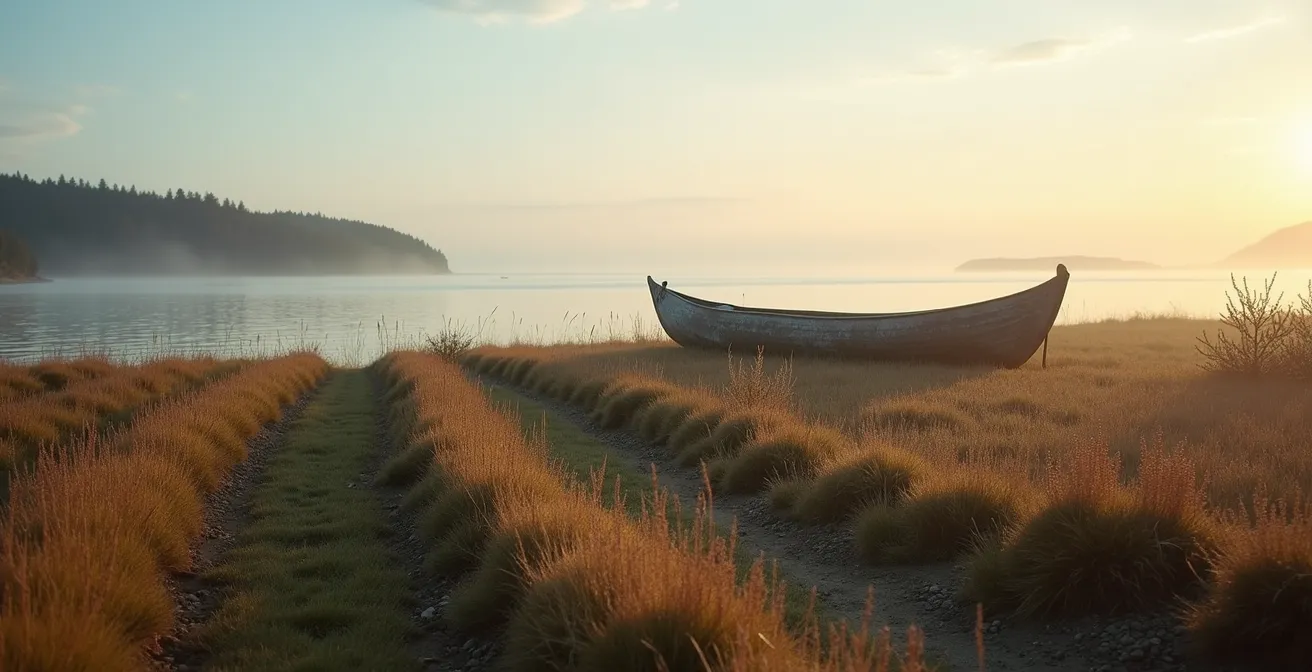
As this image suggests, the story of Grand-Pré is one of overlapping worlds: the engineered Acadian farmlands and the traditional Mi’kmaq waterways. The deportation was not just an act of ethnic cleansing against the Acadians; it was also a strategic move by the British to shatter the Acadian-Mi’kmaq alliance and assert total control over the region. Understanding Grand-Pré requires holding both these truths: it is a site of profound Acadian memory and a landscape that reveals the complex, interwoven histories of European settlement and Indigenous sovereignty.
Hudson’s Bay Company Forts: How Fur Trade Built the Country
The network of Hudson’s Bay Company (HBC) forts stretching across Canada represents more than just a commercial enterprise; it was a primary engine of colonial expansion. Using long-established Indigenous trade routes, the HBC’s quest for beaver pelts drove European exploration deep into the continent. According to Crown-Indigenous Relations and Northern Affairs Canada, this trade fundamentally altered Indigenous economies. The focus on a single commodity created new forms of dependency, disrupted traditional subsistence patterns, and ultimately shaped the power dynamics of future treaty negotiations, where Indigenous nations found their bargaining positions weakened.
While the fur trade is often romanticized as an adventure of rugged voyageurs, from an Indigenous perspective, it was a process of slow-moving but profound change that eroded sovereignty. It introduced not only new goods but also new diseases, alcohol, and a transactional relationship with the land that stood in contrast to many Indigenous worldviews. This slow erosion of control is powerfully articulated in the Indigenous Peoples Atlas of Canada:
The whalers, the fur traders who followed the whalers, the missionaries and then the government all wanted something from us in return for what they were prepared to give. Slowly, we started to lose control over the destiny of our culture and our lives.
– Indigenous Peoples Atlas of Canada, Article on Colonialism
The HBC forts, therefore, were not neutral outposts of commerce. They were vanguards of ecological and economic colonialism. They functioned as nodes in a vast network that extracted wealth from Indigenous lands, rerouted traditional economies to serve European markets, and established a permanent colonial presence that governments would later formalize. To visit these sites is to witness the foundations of a system that intertwined economic exploitation with territorial dispossession.
Louisbourg vs. Halifax Citadel: Two Different Approaches to Colonial Defense
The Fortress of Louisbourg and the Halifax Citadel are two of Canada’s most impressive National Historic Sites, often presented as military titans of a bygone era. They represent the peak of the French and British imperial contest in the 18th century. However, their histories and modern interpretations reveal two very different ways of understanding colonialism. Louisbourg, the grand French fortress on Cape Breton Island, was built in Mi’kma’ki territory to protect France’s fishing and trade interests. Today, it is a meticulously reconstructed historical theme park, where costumed interpreters bring a specific year, 1744, to life. This approach, while immersive, tends to frame colonialism as a finished, sealed-off chapter of history.
In contrast, the Halifax Citadel was built by the British specifically as a counter-fortress to Louisbourg. Its establishment in 1749 directly violated a 1726 treaty with the Mi’kmaq, an act of aggression that led its founder, Edward Cornwallis, to issue bounties for Mi’kmaq scalps. Unlike Louisbourg, which was destroyed and later rebuilt for tourism, the Halifax Citadel has a continuous military legacy, with the site protecting the city for years. This ongoing presence makes it harder to see colonialism as a thing of the past. The Citadel sits above a modern city where debates about its founder’s legacy are very much alive, connecting its colonial origins to ongoing power structures.
This table highlights the fundamental differences in how these two sites are presented to the public, influencing our understanding of history.
| Aspect | Fortress of Louisbourg | Halifax Citadel |
|---|---|---|
| Original Purpose | French fortress in Mi’kma’ki territory | British counter-fortress violating 1726 Mi’kmaq treaty |
| Modern Interpretation | Reconstructed historical theme park | Site with continuous military legacy |
| Public Understanding Impact | Colonialism as finished historical chapter | Colonialism as ongoing power structure |
Ultimately, while Louisbourg offers a sanitized glimpse into a colonial past, the Halifax Citadel stands as a more complicated reminder that the foundations of the city, and the country, were built on conflict and broken promises whose legacies continue to be debated.
How to Interpret Colonial Statues in the Era of Reconciliation
For decades, statues of colonial figures like explorers, generals, and politicians stood unquestioned in public parks across Canada. They were seen as monuments to city founders and nation-builders. However, in the era of Reconciliation, these statues are being re-examined through a critical lens, forcing a public reckoning with historical memory. Many of these figures were directly responsible for policies of violence, dispossession, and cultural assimilation against Indigenous peoples. The central question is no longer just “Who are we celebrating?” but also “Whose pain and history does this celebration erase?”
A landmark moment in this national conversation occurred in 2018 in Halifax, Nova Scotia. After decades of advocacy by the Mi’kmaq community, the city council voted 12-4 to remove the statue of its founder, Edward Cornwallis. As reported by APTN News, Cornwallis had issued bounties on Mi’kmaq scalps in 1749, and his monument was a painful and constant reminder of that violence for the Mi’kmaq people. The removal of the statue was not an erasure of history; it was an act of making history by acknowledging a more complete and honest version of the past. It demonstrated a shift from glorifying a colonizer to prioritizing the dignity of the Indigenous people on whose land the city stands.
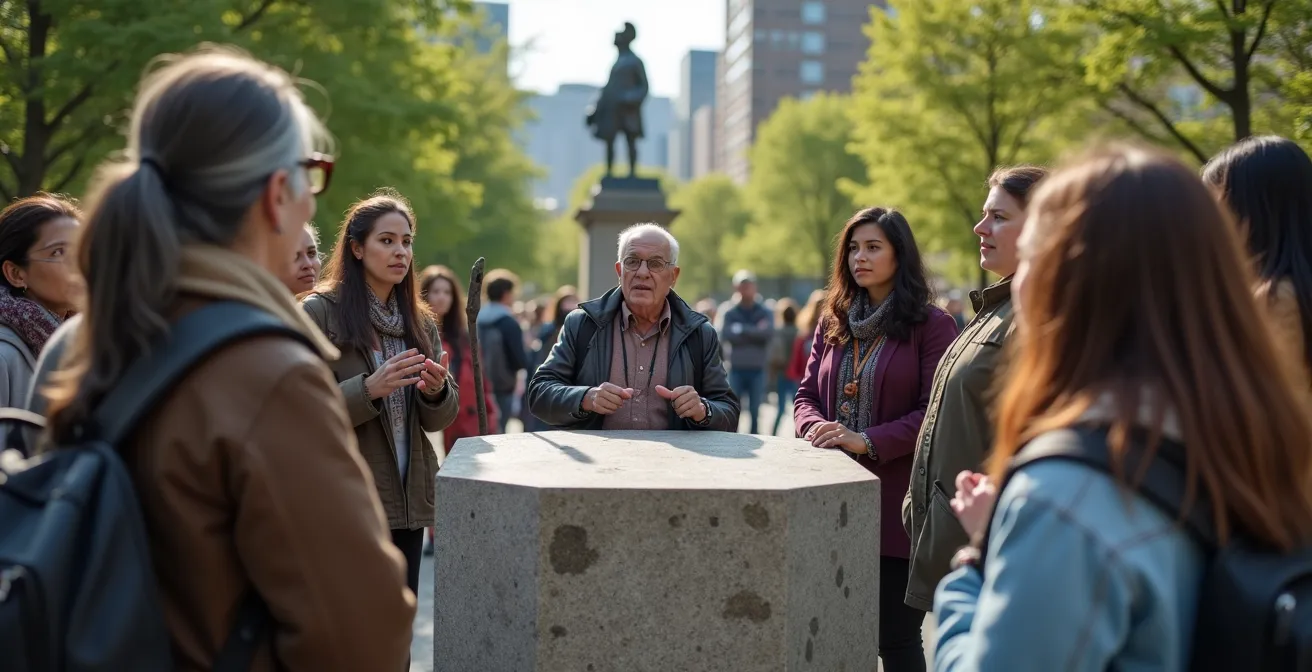
The empty pedestal becomes a new kind of monument—one that invites dialogue rather than demanding reverence. It represents a space for decolonization, which involves dismantling colonial structures and ways of thinking, as a necessary step toward true reconciliation. For travellers and citizens alike, encountering these sites of contested history offers an opportunity for active engagement rather than passive viewing.
Action Plan: Three Questions to Ask in Front of a Colonial Monument
- Whose land am I on? Research the traditional Indigenous territory and current treaty status.
- Whose story is NOT being told by this monument? Consider the Indigenous perspectives erased or marginalized.
- What local Indigenous place names has this colonial name replaced? Investigate the original names and their meanings.
The Historical Myth About “Totem Poles” That 60% of Tourists Believe
Among the most iconic and misunderstood symbols of Indigenous cultures in Canada are the monumental carvings often generically referred to as “totem poles.” A pervasive myth, particularly among tourists, is that these are universal “Indian” artifacts found across the continent. In reality, these poles are a specific cultural practice of a handful of First Nations along the Pacific Northwest coast, such as the Haida, Tsimshian, and Kwakwaka’wakw. Each pole is a complex narrative document, recording a family’s lineage, history, rights, or a significant event. They are not religious idols or generic decorations, but sophisticated legal and historical records.
This misunderstanding is rooted in a history of cultural suppression. The Canadian government, through the Indian Act, actively sought to eradicate such cultural practices. A key piece of this legislation was The Potlatch Ban, which for 66 years (1885-1951) made it illegal to participate in the vital gift-giving ceremonies where these poles were often raised and their stories shared. This ban was a direct assault on the social, political, and economic structures of these nations, causing a devastating interruption in the transmission of cultural knowledge.
A powerful counter-example to the generic myth is the UNESCO World Heritage Site of SGang Gwaay (Anthony Island) in Haida Gwaii. This sacred Haida village features the remains of large cedar longhouses and intricately carved mortuary and memorial poles. These are not just “art”; they are tangible connections to Haida ancestors and their worldview. They demonstrate with profound clarity that these poles are a unique heritage of the Haida Nation, not a pan-Indigenous symbol. To call every carved pole a “totem pole” and to disassociate it from its specific nation of origin is to perpetuate the very colonial erasure that policies like the Potlatch Ban sought to achieve.
Key Takeaways
- Colonial heritage sites are not neutral; they are deeply political spaces where historical narratives are actively constructed and contested.
- The economic foundations of Canada, particularly the fur trade, were built on the appropriation of Indigenous lands, routes, and economies, creating dependencies that persist today.
- As a traveller, you have a role to play. Moving beyond passive tourism to active, critical engagement is a vital part of supporting reconciliation.
The Sourtoe Cocktail: Why Travelers Pay $10 to Touch a Human Toe
In Dawson City, Yukon, a bizarre ritual attracts thousands of tourists each year: the Sourtoe Cocktail. The “drink” consists of a shot of whiskey (typically Yukon Jack) garnished with a genuine, amputated, and mummified human toe. To join the “Sourtoe Cocktail Club,” one must let the toe touch their lips. This form of dark tourism has become a quirky bucket-list item, a testament to the human fascination with the macabre and the desire for an outlandish travel story. The tradition began in 1973 and has since become a major marketing tool for the town, inseparable from its Gold Rush identity.
The cocktail’s appeal lies in its transgressive nature—it’s a safe, controlled way to brush up against death and decay. The ceremony is theatrical, complete with a “Captain” who administers the drink and recites a verse. It plays into the mythology of the North as a harsh, eccentric frontier where bizarre tales are born. The focus is entirely on the shock value and the novelty of the experience, which is precisely where a critical lens becomes necessary.

While the Sourtoe Cocktail is presented as harmless fun, it raises important questions about what stories we choose to consume and promote. Dawson City is located on the traditional territory of the Tr’ondëk Hwëch’in First Nation, a people with a deep, complex history that was violently disrupted by the Klondike Gold Rush. The intense focus on a gimmick like a severed toe risks trivializing the location’s true historical significance. As one critical analysis of tourism in the region asks, “What ancient stories and profound ceremonies are being overlooked in the quest for a quirky cocktail?” This is the central challenge of such attractions: they can easily overshadow the authentic, living cultures of the place itself.
How to Support Indigenous Tourism in Canada Respectfully?
Moving from a critical observer to an active ally involves making conscious choices about where your tourism dollars go. Supporting authentic Indigenous-owned and -led tourism is one of the most direct and effective ways to contribute to self-determination and cultural revitalization. These experiences offer visitors a chance to learn about the land and its history from the perspectives of the people who have stewarded it for millennia. It shifts the dynamic from one of consumption to one of reciprocity and respectful exchange.
The economic impact is significant. According to the Indigenous Tourism Association of Canada (ITAC), these businesses are powerful community employers, with 57% of employees being Indigenous and a third of the businesses owned by women. To ensure you are supporting genuine experiences, look for ITAC’s “Original Original” mark of excellence. This accreditation program vets businesses to guarantee they are truly Indigenous-owned and provide a quality, authentic experience. This program not only helps travellers make informed choices but also provides crucial support for the businesses themselves, as seen in the $325,000 in federal funding recently awarded to 13 businesses in Newfoundland and Labrador.
A key part of respectful support is understanding the concept of reciprocity. You are a guest paying to listen and learn, not a consumer demanding a performance. It’s also important to practice basic land acknowledgement, which means taking a moment to learn and name the traditional Indigenous territory you are visiting. This simple act acknowledges the enduring relationship between Indigenous peoples and their lands. By choosing accredited businesses, listening with an open mind, and acknowledging the land’s history, you can help ensure that tourism becomes a force for empowerment, not exploitation.
Your journey through Canada’s historical landscapes can be more than a sightseeing tour. By engaging critically, asking the right questions, and consciously choosing to support authentic Indigenous voices, you transform from a tourist into a participant in the vital, ongoing project of understanding Canada’s full story.
Frequently Asked Questions on Exploring Colonial Heritage
How can I identify authentic Indigenous tourism experiences?
Look for the ‘Original Original’ trademark from ITAC and check ownership on provincial Indigenous tourism association websites.
What is the concept of reciprocity in Indigenous tourism?
Support is not just financial but an exchange of respect. You are a guest paying to listen and learn, not a consumer demanding a performance.
Are there specific protocols when visiting Indigenous territories?
Yes, protocols vary widely. Ask permission before photographing people or ceremonies, consider offering tobacco in Anishinaabe and Cree cultures, and follow visitor guidelines in self-governed territories.