Arriving at Point Pelee in May without a plan leads to frustrating crowds and missed opportunities; the key to a magical experience is strategy, not luck.
- Success depends on smart logistics, like abandoning your car and using park transit to navigate the intense visitor traffic.
- True mastery involves birding ethics, understanding that tired migrants need rest more than they need to respond to your calls.
- The most spectacular birding days are predictable “fallout” events created by specific weather fronts, which you can learn to anticipate.
Recommendation: Treat your visit like a strategic expedition. Master the park’s system, respect its rules, and you’ll transform a potentially overwhelming trip into the birding experience of a lifetime.
The air at dawn in Point Pelee in mid-May is electric. It vibrates with the songs of dozens of warbler species, a symphony of buzzy trills and sweet whistles filtering through the fresh leaves of the Carolinian canopy. For any nature enthusiast, this is the holy grail: the peak of spring migration at one of the world’s most celebrated birding hotspots. Many arrive with a simple checklist, hoping to tick off 30 warbler species by sheer luck. They jostle for space on the boardwalk, crane their necks, and often leave feeling overwhelmed by the crowds and underwhelmed by their sightings.
But what if the most rewarding experiences at Pelee have little to do with luck? What if the birders who leave with the best stories and sightings aren’t the luckiest, but the most strategic, respectful, and prepared? The secret to truly timing the spring migration isn’t just about showing up during the second and third weeks of May. It’s about understanding the park as a system, the birds as exhausted athletes, and the weather as your most valuable guide. It’s about ditching the tourist mindset and adopting the approach of an informed naturalist.
This guide is your insider briefing. It moves beyond the obvious to give you the strategic framework for a successful and ethical visit. We will cover the essential logistics of navigating the park during its busiest season, the nuances of identifying key species, the critical debate around attracting birds, and the advanced strategies for using weather to your advantage. By the end, you’ll be equipped to master the Pelee system and turn your trip into a profound connection with one of nature’s greatest spectacles.
To help you navigate this comprehensive guide, we’ve broken down the essential strategies into clear sections. This structure will take you from fundamental logistics to advanced tactics for an unforgettable birding adventure at Point Pelee.
Summary: An Insider’s Strategic Guide to Point Pelee’s Spring Migration
- Why You Should Ditch Your Car at the Visitor Centre in May
- Warbler vs. Vireo: How to ID the “Confusing Fall Warblers”
- The “Pishing” Debate: Should You Call Birds Out of Hiding?
- Binoculars for Birding: Is a $300 CAD Pair Good Enough?
- How a Storm Front Can Create the Best Birding Day of Your Life
- Why the Gray Jay is the “Camp Robber” of the Boreal Forest
- The Salt Air Mistake That Corrodes Camera Lenses in One Trip
- Mastering the Parks Canada System: Fees, Rules, and Access
Why You Should Ditch Your Car at the Visitor Centre in May
The single biggest mistake a first-time visitor makes during the Festival of Birds is underestimating the crowds. With as many as 10,000 birders per weekend descending on this narrow peninsula, parking is not just limited; it’s virtually non-existent past the Visitor Centre after sunrise. Attempting to drive towards the Tip in your own vehicle is a recipe for frustration. The park’s infrastructure is wisely designed to handle this influx, but it requires you to change your mindset: your car is for getting *to* the park, not for getting *around* it.
Embracing the park’s transportation system is the first step in a strategic visit. The free shuttle, which departs from the Visitor Centre every 20 minutes starting at 6 a.m. during peak season, is your lifeline to the Tip. It’s efficient, it eliminates the stress of finding a parking spot, and it allows you to focus on the sky and trees instead of the brake lights in front of you. More importantly, it concentrates human traffic, leaving other areas of the park quieter.
For those seeking more flexibility and a chance to stop at a moment’s notice, other options provide a superior experience to driving:
- Rent a bicycle: Available at the Marsh Boardwalk area, a bike gives you exclusive access to certain trails and the Tip Road itself during shuttle hours. This is a fantastic way to cover ground while still being able to stop instantly for a flock of warblers.
- Walk the Tip Road: The 4km road from the Visitor Centre to the Tip is a destination in itself. Walking under the magnificent Carolinian canopy allows for countless spontaneous birding stops and a much more intimate experience with the habitat.
- Arrive before dawn: For the truly dedicated, a small amount of parking is available at the Tip before the shuttle starts. Local etiquette dictates that if you use this option, you should plan to leave by 8 a.m. to make way for the waves of day visitors arriving by shuttle.
By ditching your car, you aren’t sacrificing convenience; you are gaining access and reducing stress, which are the most valuable commodities during a crowded migration event.
Warbler vs. Vireo: How to ID the “Confusing Fall Warblers”
During the spring migration, Point Pelee is famed for its warblers. These small, colourful, and hyperactive birds flit through the canopy, creating a dazzling but often confusing spectacle. While the brilliant breeding plumage of a Blackburnian or a Prothonotary Warbler is unmistakable, many species can look frustratingly similar. A common point of confusion for many birders is distinguishing the more robust warblers from the vireos that share the same habitat.
The key to identification lies in focusing on structure and behaviour before colour. Warblers are generally more slender, with fine, needle-like bills perfect for picking tiny insects off leaves. They are perpetual motion machines, constantly flicking their wings and tails. Vireos, by contrast, are more sluggish. They are slightly thicker-bodied with a noticeably stouter, slightly hooked bill. They move more deliberately through the branches, methodically searching for caterpillars. If you see a small bird with a prominent “spectacled” look and a thicker bill, your first thought should be vireo.
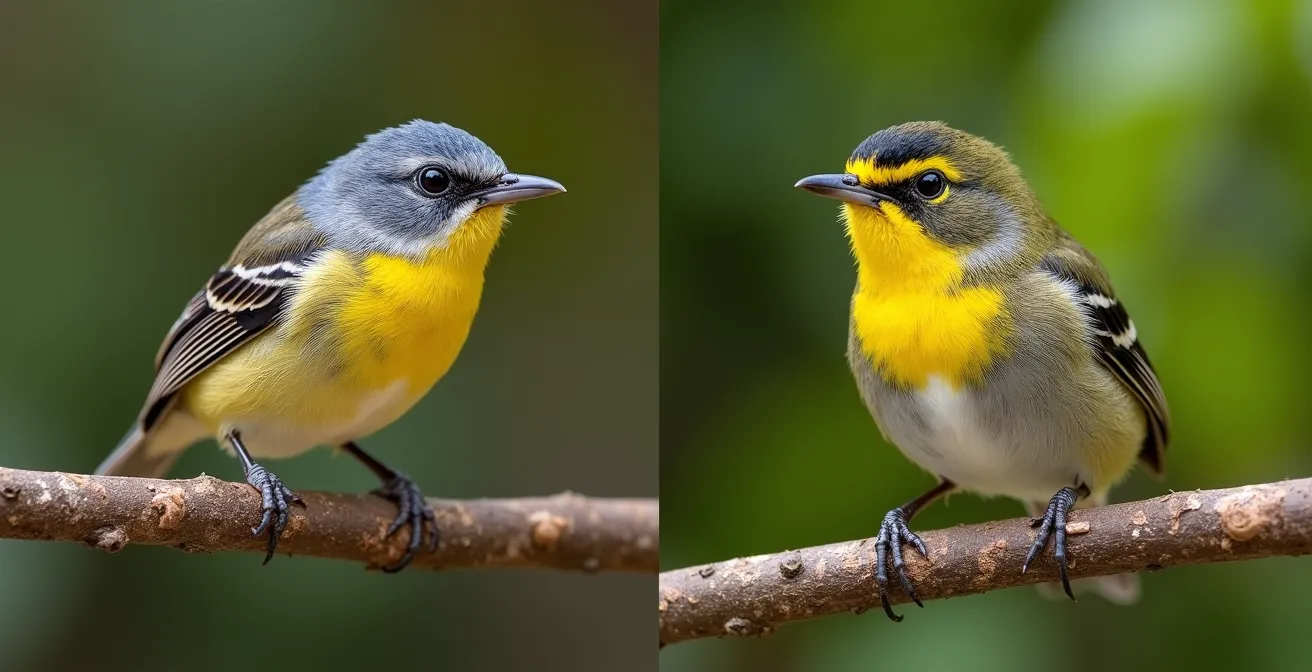
As the illustration above highlights, the bill is a crucial field mark. Note the vireo’s thicker, more powerful bill on the left compared to the warbler’s delicate, pointed bill on the right. According to guides from the Ontario Field Ornithologists, the best viewing time is between 7:00 and 9:00 a.m., when the morning sun warms the leaves, making insects—and the birds that hunt them—more active and vocal. On a good day in mid-May, it’s not uncommon for Point Pelee birders to observe over 30 species of warblers, so honing these subtle identification skills is essential for appreciating the full diversity of the spectacle.
The “Pishing” Debate: Should You Call Birds Out of Hiding?
As you walk the trails, you will inevitably hear it: a soft, insistent “pish-pish-pish” sound made by a fellow birder. This technique, known as “pishing,” is used to imitate alarm calls, which can sometimes draw curious or agitated birds out from dense cover. This raises one of the most important ethical questions in birding: just because you *can* call a bird out, *should* you? At Point Pelee during spring migration, the answer is nuanced but leans heavily towards restraint.
To understand why, you must first understand the incredible journey these birds are on. As Parks Canada experts explain, this is the heart of the matter:
Most of the songbirds moving through Point Pelee in spring are nocturnal migrants. When they find themselves over Lake Erie near sunrise, they look for the nearest point of land to rest and refuel after flying up to two hundred kilometres in a night.
– Parks Canada, Point Pelee National Park – Songbird Migration
These birds are not on a leisurely vacation; they are exhausted athletes in desperate need of food and rest. Every moment they spend responding to a perceived threat (your pishing) is a moment they are not refueling for the next leg of their journey. While pishing is not explicitly banned, Parks Canada strongly emphasizes minimizing all forms of wildlife disturbance. Using recorded bird songs, or “playback,” is even more disruptive and highly discouraged by conservation bodies like Birds Canada. On crowded boardwalks, during guided walks, or when a rare bird is trying to feed, pishing is considered poor etiquette by the experienced birding community.
The ethical choice is to prioritize the bird’s welfare over your desire for a better view. Patience is the ultimate birding skill. By waiting quietly, you allow the birds to go about their essential business, and often, they will eventually reveal themselves naturally. A view of a bird foraging peacefully is infinitely more rewarding than a stressed bird agitated into view.
Binoculars for Birding: Is a $300 CAD Pair Good Enough?
The right pair of binoculars can make or break your Point Pelee experience. Trying to spot a tiny Cape May Warbler high in the canopy with inadequate optics is an exercise in frustration. But does that mean you need to spend thousands of dollars? Not necessarily. For most birders, a budget of around $300 CAD can secure a perfectly adequate pair, but understanding the trade-offs is key.
The most popular configuration for forest birding is 8×42. The “8x” refers to the magnification (things appear 8 times closer), and the “42” is the diameter of the objective lenses in millimeters. This combination offers a wide field of view, which is crucial for finding and tracking fast-moving warblers in dense foliage. While a $300 pair will perform well in bright, open conditions, its main limitation will be in low light. Under the thick Carolinian canopy, especially at dawn or on overcast days, more expensive binoculars with better glass and coatings will gather more light, producing a brighter, sharper image.
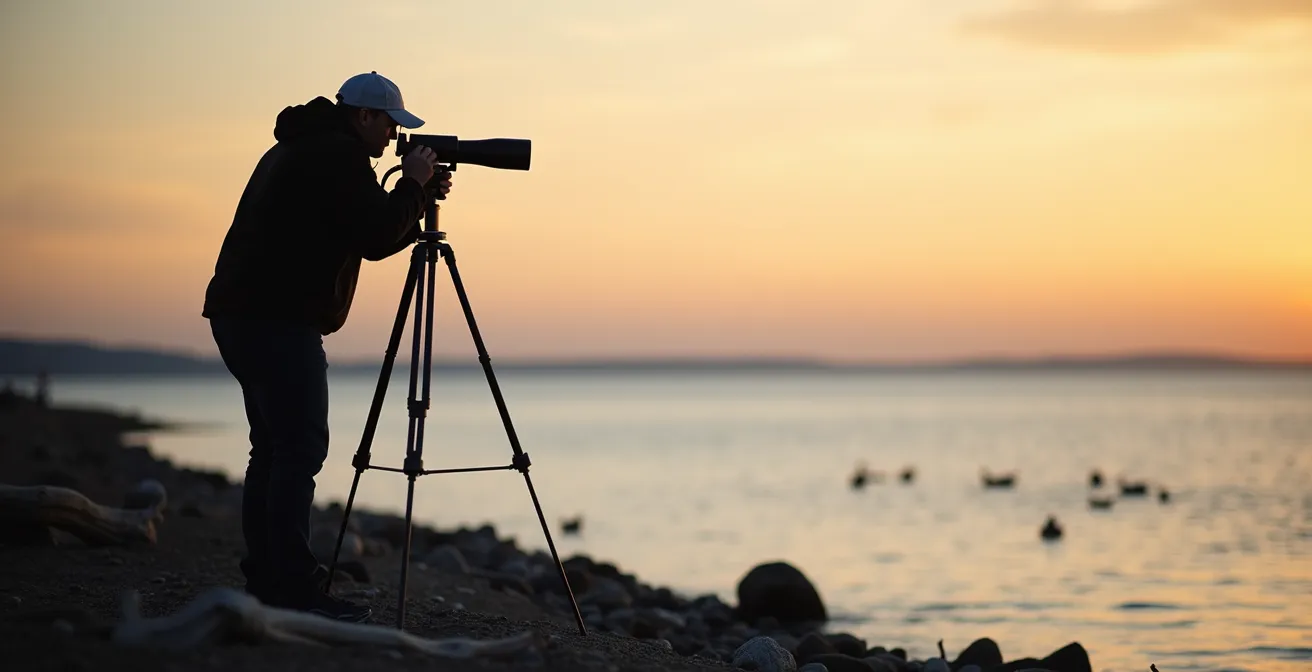
For birders focused on shorebirds and waterfowl at the Tip, a spotting scope is almost essential. Its high magnification (20-60x) is necessary for identifying distant birds on the water or sandbars. If you’re unsure about investing, renting is an excellent option to understand your needs.
The following table, based on local rental options, breaks down the choices for a visiting birder. This can help you decide whether to bring your own, rent, or buy a new pair for your trip.
| Option | Cost (CAD) | Pros | Cons |
|---|---|---|---|
| Rent at Pelee Wings | $15-25/day | No travel hassle, try before buying | Limited availability during peak season |
| Budget 8×42 (<$300) | $200-300 | Adequate for most birding, wide field of view | Lower light transmission in forest canopy |
| Mid-range 8×42 | $400-800 | Better optics for Carolinian forest conditions | Higher initial investment |
| Spotting scope rental | $30-40/day | Essential for shorebirds at the Tip | Heavy to carry all day |
Ultimately, a $300 pair of 8×42 binoculars is absolutely “good enough” for a fantastic experience. The most important factor is having them up to your eyes and enjoying the view.
How a Storm Front Can Create the Best Birding Day of Your Life
The most magical, almost unbelievable, birding days at Point Pelee are not random. They are the direct result of a specific weather phenomenon known as a “fallout.” This occurs when birds migrating north on warm south winds encounter a cold front moving down from the north, often accompanied by rain or storms. Unable or unwilling to fly into the headwind and bad weather, the birds are forced to land en masse at the first available piece of land—the Point Pelee peninsula.
The result is a landscape suddenly dripping with birds. Trees can seem to be decorated with warblers, and the ground can be alive with thrushes and sparrows. These are the legendary days that birders talk about for years. Understanding how to predict these events transforms you from a passive tourist into a strategic hunter of experiences. It’s not about being lucky; it’s about reading the weather map. The key is to watch for the convergence of southerly and northerly winds over Lake Erie.
According to the Ontario Field Ornithologists, the fallout itself is just the beginning. The days that follow have a predictable pattern. The first morning after a fallout brings spectacular numbers. On day two, you might still see 50-70% of those birds. By day three, numbers drop to 25-40%, and then to 10-20% on subsequent days before the next wave arrives. This knowledge allows you to manage your expectations and plan your time effectively.
Action Plan: Predicting and Maximizing Fallout Events
- Monitor Radar: Check Environment Canada’s weather radar, specifically looking for south or southeast winds meeting an incoming northwest cold front over Lake Erie.
- Assess Dawn Conditions: The best time to gauge overnight arrivals is at first light. An early start is critical to witness the peak of a fallout.
- Explore Secondary Locations: After the initial fallout at the Tip, birds disperse. Focus on areas like the DeLaurier Homestead or nearby Wheatley Provincial Park on day two or three.
- Watch for Wind Shifts: A switch to strong north winds often signals that the birds will resume their migration, leading to incredible “morning flights” off the Tip.
- Arrive Early: During the May peak season, be at the Tip by 5 a.m. The park accommodates this with earlier opening hours specifically for the Festival of Birds.
By learning to read these weather patterns, you can dramatically increase your chances of being in the right place at the right time for a truly unforgettable day.
Why the Gray Jay is the “Camp Robber” of the Boreal Forest
While the title mentions the Gray Jay, a quintessential “camp robber” of Canada’s vast boreal forests, you will not find this species at Point Pelee. Its inclusion here serves a critical purpose: to highlight just how ecologically unique and different Point Pelee is from the rest of the country. Canada is overwhelmingly a nation of boreal and arctic ecosystems. But here, at its southernmost tip, lies a tiny, precious remnant of a completely different world: the Carolinian Forest.
As the Cornell Lab of Ornithology notes, this unique habitat makes “Point Pelee and southwestern Ontario rather unique to the rest of the country”. The park protects just over 1,564 hectares of this Carolinian ecosystem, an area characterized by species found almost nowhere else in Canada, like the Tulip-tree, Sassafras, and Kentucky Coffee-tree. This warm, deciduous forest is more typical of the Carolinas or Tennessee in the United States.
This ecological rarity is the very reason Point Pelee is such a vital migration hotspot. For northbound birds, it’s the first patch of rich, insect-filled deciduous forest they encounter after crossing Lake Erie. For southbound birds in the fall, it’s their last chance to refuel before the perilous lake crossing. The park’s fragility and its outsized importance to millions of migrating birds are why the rules and ethics discussed throughout this guide are so stringent. Unlike the vast, resilient boreal forest where the Gray Jay thrives, the Carolinian zone is a small, precious jewel that requires our utmost care and respect.
So, while you won’t be shooing a Gray Jay away from your lunch, you will be walking through a forest that represents less than 1% of Canada’s land area but supports a disproportionately high amount of its biodiversity. This context is essential to appreciating the privilege of birding here.
The Salt Air Mistake That Corrodes Camera Lenses in One Trip
Photographers often hear dire warnings about “salt air” corroding expensive camera equipment on coastal trips. While the title mentions this, it highlights a common misconception when visiting the Great Lakes. Point Pelee is on Lake Erie, a massive body of fresh water. You don’t have to worry about corrosive salt spray here. However, this does not mean your gear is safe. The threats at Pelee are different, more subtle, and can be just as damaging if you’re not prepared.
As professional bird photographers who frequent the park have documented, the primary challenges are high humidity, fine sand, and thick pollen. In May, the air can be heavy with moisture from the lake, which can promote fungus growth inside lenses if gear is stored improperly. At the Tip, the wind whips up incredibly fine sand that can work its way into lens barrels and camera mechanisms, causing a gritty, grinding feel that requires professional cleaning. Finally, the Carolinian forest in full bloom produces a huge amount of fine, sticky tree pollen that can gum up focusing rings and coat the front element of your lens, degrading image quality.
Protecting your equipment requires a specific, freshwater-focused approach rather than a saltwater one. Simple preventive measures can save you from costly repairs.
- Use a UV filter: This is a cheap, sacrificial piece of glass that protects your expensive front lens element from sand and pollen.
- Carry microfiber cloths: Bring several cloths specifically for cleaning off sticky pollen.
- Avoid storing gear in a hot car: The high temperatures in a vehicle parked in the sun can damage sensitive lens coatings and internal electronics.
- Consider weather-sealed gear: Ontario’s spring weather is notoriously variable. A camera body and lens with weather sealing provides peace of mind against sudden rain showers.
- Clean gear after each visit to the Tip: Don’t let that fine sand sit on your equipment. A quick wipe-down and puff of air from a rocket blower can prevent it from working its way inside.
By preparing for the right threats—humidity, sand, and pollen—you can ensure your camera gear survives the migration season in perfect working order.
Key Takeaways
- Your visit’s success hinges on strategy: ditch your car for park transit, understand binocular trade-offs, and learn to predict weather-driven “fallouts.”
- Birding at Pelee is an ethical practice; prioritize the welfare of exhausted migratory birds by limiting disturbances like “pishing” and playback.
- The park’s unique Carolinian ecosystem is what makes it a vital and fragile migration hub, requiring visitors to be exceptionally mindful of their impact.
Mastering the Parks Canada System: Fees, Rules, and Access
A smooth trip to Point Pelee requires a final piece of the strategic puzzle: understanding the rules, fees, and access options of the Parks Canada system. Navigating this efficiently frees you to focus on the birds. The most fundamental rule during the May migration is the park’s early opening. To accommodate the dawn birding rush, during peak migration (May 1-20), the park opens at 5 a.m., a full hour earlier than usual. Being there at opening is key to experiencing the best morning activity.
Your entry fee is another point of decision. While a daily pass is simple, frequent visitors or those planning to visit other national parks within the year will find the Parks Canada Discovery Pass offers much better value. The Festival of Birds in May also offers special packages that can be ideal for multi-day trips focused on guided walks and presentations.
Here’s a breakdown of the typical pass options to help you choose the most cost-effective solution for your visit:
| Pass Type | Cost 2024 | Coverage | Break-even for Pelee Birders |
|---|---|---|---|
| Daily Entry | $9.00 CAD | One day at Point Pelee | Best for single day visits |
| Discovery Pass | $72.25 CAD | All Parks Canada sites for 12 months | 8 days at Pelee, or combine with other parks |
| Festival Package | Varies | May 1-20 special programs included | Ideal for 3-5 day Festival of Birds trips |
Beyond fees, mastering the system means contributing to it. The park and its partners, like the Friends of Point Pelee, encourage visitors to submit their sightings to eBird. This act of citizen science provides invaluable data for researchers tracking migration patterns and bird populations. By sharing what you see, your visit transcends tourism and becomes a meaningful contribution to the conservation of the very spectacle you came to witness. You are not just a spectator; you are part of the monitoring system.
By integrating these strategies—from logistics and ethics to weather prediction and system mastery—you are no longer leaving your experience to chance. You are actively shaping it, ensuring that your time at Point Pelee is not just a trip, but a deeply rewarding and respectful pilgrimage.
Frequently Asked Questions about Birding Ethics at Point Pelee
What is Parks Canada’s position on using calls to attract birds?
While not explicitly banned, Parks Canada emphasizes minimizing wildlife disturbance, especially during critical migration periods when birds need to conserve energy for crossing Lake Erie. The official stance prioritizes the health and safety of the wildlife over the viewing convenience of visitors.
What’s the difference between pishing and playback?
Pishing uses human-made sounds (like ‘pish-pish-pish’) to arouse curiosity in birds. Playback, on the other hand, uses recorded bird calls, often of a territorial or mating song. Playback is generally considered much more disruptive as it can cause significant stress, elicit a territorial response, and distract birds from essential activities like feeding and resting. For this reason, playback is strongly discouraged by Birds Canada and the wider birding community.
When is pishing most problematic at Point Pelee?
The negative impact of pishing is amplified in certain situations. It is considered particularly poor etiquette during official guided walks with park staff, on crowded boardwalks during the Festival of Birds where it can disturb many other visitors, and anytime a bird shows clear signs of stress or is actively foraging to refuel.