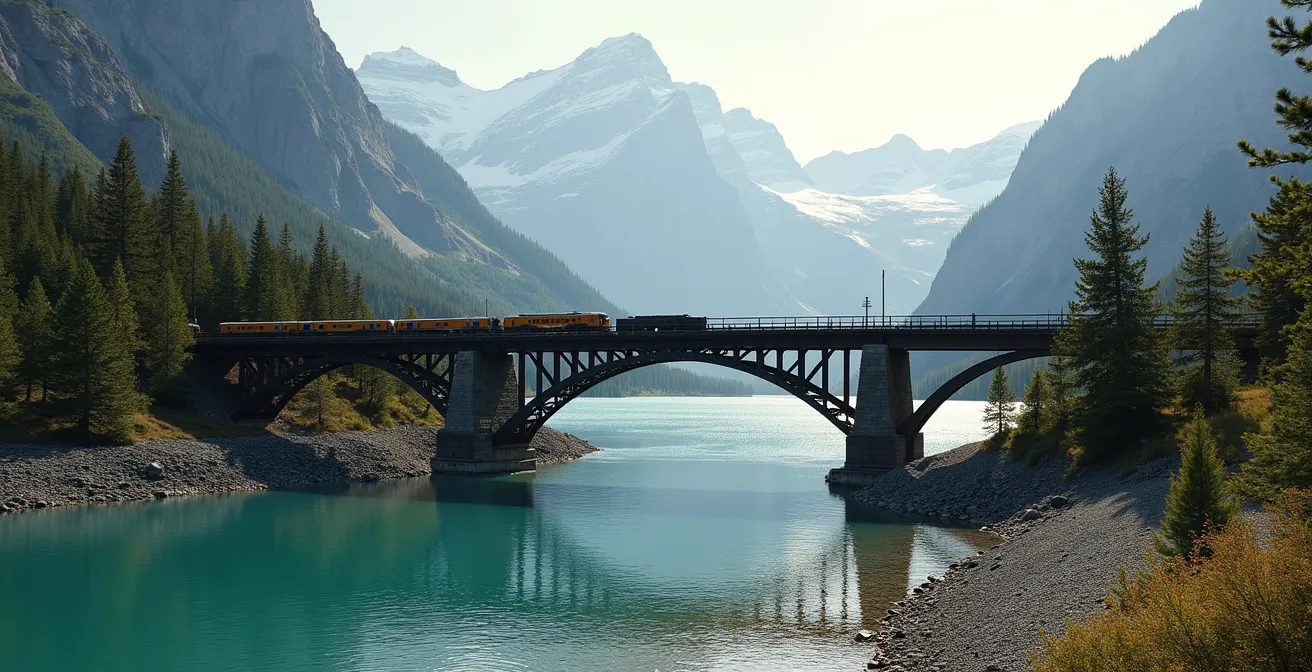
Planning a trip to Canada’s UNESCO sites is less about seeing them all and more about curating a profound, personalized experience.
- Strategic logistical choices—like a remote fly-in versus an urban road trip—fundamentally dictate the nature, cost, and depth of your journey.
- Ethical engagement, including understanding the complex historical context and supporting local conservation, is as vital as the visit itself.
Recommendation: Use a framework of “Experiential ROI” to select sites that align with your specific travel style, budget, and timeline for a more rewarding adventure.
The UNESCO World Heritage list acts as a global beacon for travelers seeking destinations of “outstanding universal value.” For the culture-focused voyager, it’s a seal of quality, promising profound encounters with history, nature, and human ingenuity. Canada, with its vast landscapes and layered history, boasts a remarkable collection of these treasures. In fact, official reports show that the 22 UNESCO World Heritage sites across Canada welcome over 15 million visitors annually, a testament to their powerful allure. Yet, the sheer scale of the country presents a significant challenge. It’s impossible to simply “see them all” in one trip.
Many guides offer simple lists or provincial groupings, encouraging a box-ticking approach. But this often misses the point. A truly meaningful heritage journey isn’t about quantity; it’s about quality and connection. What if the key wasn’t just *what* you see, but *how* you strategically plan to experience it? This is the art of heritage curation: designing an itinerary that aligns with your interests, acknowledges logistical realities, and fosters a deeper understanding of each site’s unique narrative.
This guide moves beyond the checklist. It provides a strategic framework for making informed decisions, whether you’re weighing the logistical trade-offs of two distinct sites, planning a multi-site road trip, or considering the ethical implications of your visit. We will explore how to analyze the experiential return on investment of your time and budget, navigate the practical challenges of accessing these incredible places, and engage with their stories in a way that is both respectful and enriching.
To help you craft your own curated journey, this article breaks down the key questions and strategic considerations you’ll face. The following sections offer a detailed exploration of specific planning dilemmas and opportunities, providing the tools you need to build a truly unforgettable Canadian heritage tour.
Summary: A Curated Route for Heritage Lovers
- L’Anse aux Meadows or Rideau Canal: Which Site Fits a 1-Week Itinerary?
- Why Mistaken Point is Worth the Detour for Fossil Enthusiasts
- The “Do Not Touch” Rule: Why It Matters at UNESCO Heritage Sites
- Where to Stay When Visiting Dinosaur Provincial Park?
- How to Link 3 UNESCO Sites in a Single Quebec Road Trip
- Grand-Pré National Historic Site: Uncovering the Story of the Deportation
- Old-Growth Tourism: How Your Visit Can Support Conservation Efforts
- Exploring Colonial Heritage Sites: A Critical Look at History
L’Anse aux Meadows or Rideau Canal: Which Site Fits a 1-Week Itinerary?
Choosing between two iconic yet vastly different UNESCO sites for a one-week trip is a classic exercise in heritage curation. This decision is not about which site is “better,” but about defining your desired experiential return on investment. L’Anse aux Meadows in Newfoundland offers a profound, singular immersion into Viking history at the edge of the continent. The journey itself—requiring flights and a dedicated rental car—is part of the experience, demanding a higher investment in both time and budget. It’s a deep-dive model, best for travelers who wish to absorb one powerful narrative in a remote, dramatic landscape, especially during the late spring iceberg season.
In contrast, the Rideau Canal offers an urban “hub and spoke” model. Easily accessible from Ottawa or Kingston, it allows for a diverse itinerary blending heritage with city attractions. Whether it’s skating the world’s largest rink in winter or boating its historic locks in summer, the Canal is integrated into the fabric of daily life and tourism. This model provides more variety and flexibility, with extensive accommodation and dining options. It caters to the traveler who enjoys mixing cultural touchstones with museums, festivals, and urban exploration. The choice ultimately depends on your travel philosophy: the focused, remote pilgrimage versus the dynamic, multi-faceted urban discovery.
To make an informed decision, a direct comparison of the logistics, costs, and experiences is essential. An analysis from Parks Canada highlights these critical differences, providing a clear framework for your planning.
| Criteria | L’Anse aux Meadows (Viking Site) | Rideau Canal (Historic Waterway) |
|---|---|---|
| Travel Model | Fly-in & Deep Dive – Remote immersion requiring flights to Deer Lake (YDF), dedicated rental car | Urban Hub & Spoke – Easy access from Ottawa/Kingston, combinable with city attractions |
| Total Cost (Summer) | CAD $3,500-4,500 per person (flights, car rental, accommodations) | CAD $1,500-2,500 per person (VIA Rail, museum passes, urban hotels) |
| Experience Variety | Single powerful site + Viking Trail scenic drive + Gros Morne National Park | Multiple daily activities: skating, boating, Parliament Hill, 7+ museums |
| Best Season | Late May-Early July (Iceberg Alley season) | January-February (Winterlude skating) or June-September (boating) |
| Accommodation Options | Limited: Small B&Bs, few hotels in St. Anthony | Extensive: Full range from hostels to luxury hotels |
Why Mistaken Point is Worth the Detour for Fossil Enthusiasts
For the traveler whose passion lies in deep time and the origins of life, some detours are not just worthwhile—they are the entire point of the journey. Mistaken Point, Newfoundland’s newest UNESCO site, is a prime example. Located on a remote 17-kilometre strip of coastal cliffs along the Avalon Peninsula, it requires a deliberate effort to reach. But the reward is an unparalleled window into the Ediacaran Period, roughly 580 million years ago. This is not just another fossil site; UNESCO recognizes it for illustrating “a watershed in the history of life on earth: the appearance of large, biologically complex organisms.”
The wave-polished rock surfaces at Mistaken Point hold over 10,000 fossil impressions of some of the planet’s first large, multicellular life forms. These are not dinosaur bones but the mysterious, frond-like shapes of creatures that lived in the deep, dark ocean—some nearly two metres in length. To walk these shores is to walk on the seafloor of an ancient world. Access is strictly controlled to protect this fragile record, making a mandatory guided tour an essential part of the experience. This ensures not only the site’s preservation but also a rich, contextualized understanding of what you are seeing. The name itself, derived from sailors mistaking the point for nearby Cape Race in the fog, adds a layer of human history to this geological wonder.
Your Action Plan: Preparing for a Mistaken Point Visit
- Pre-book the mandatory guided tour via the Newfoundland provincial parks website, as spots fill weeks in advance, especially in summer.
- Plan for the 160km drive along the scenic Irish Loop Route from St. John’s, allowing at least 3 hours to accommodate coastal stops.
- Pack full waterproof gear, including jacket and pants, regardless of the forecast; the site experiences over 200 days of fog annually.
- Ensure your vehicle has a full tank of gas before leaving Trepassey, the last service station before the remote Interpretive Centre.
- Schedule your arrival 30 minutes prior to your tour time for the mandatory orientation film at the visitor center.
The “Do Not Touch” Rule: Why It Matters at UNESCO Heritage Sites
The simple directive—”Do Not Touch”—is one of the most common and crucial rules at heritage sites worldwide. While it may seem like a minor restriction, it is a fundamental principle of conservation rooted in scientific reality. This is particularly true for sites featuring ancient petroglyphs or pictographs, like Writing-on-Stone/Áísínai’pi in Alberta. The oils, salts, and microbes on human hands can cause irreversible damage to delicate surfaces like sandstone, accelerating erosion and obscuring art that has survived for millennia.
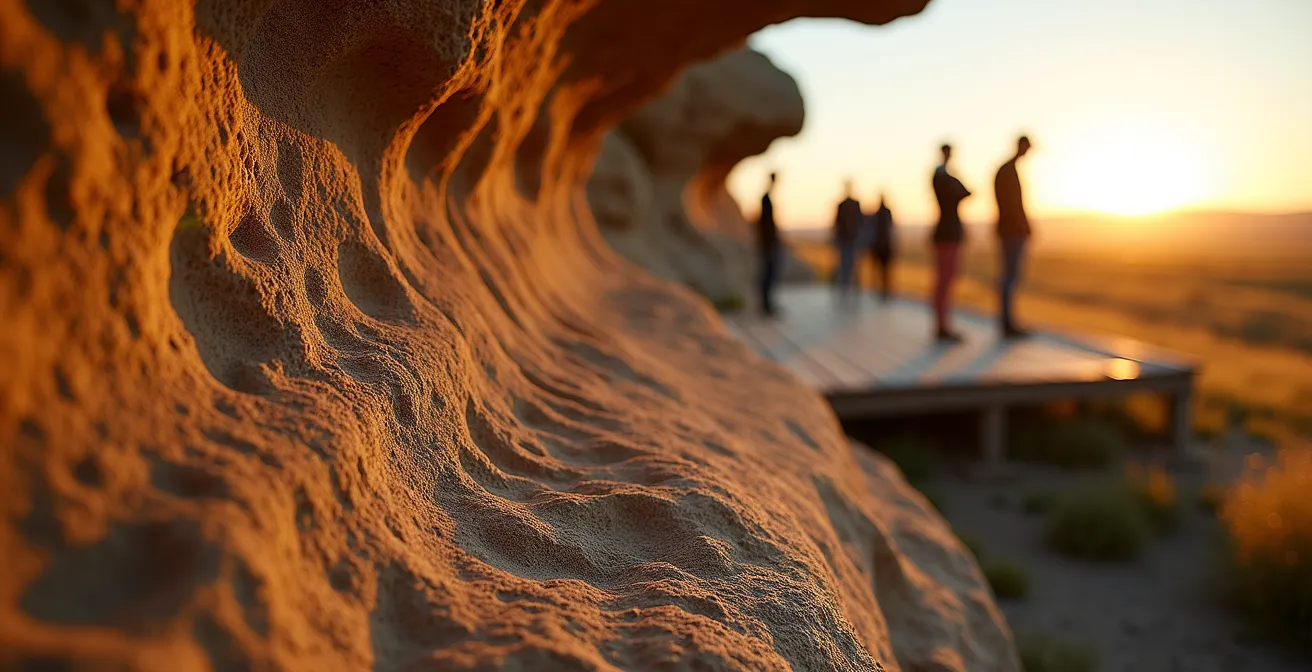
As the image above illustrates, the goal is not to create distance but to ensure longevity. However, respectful tourism goes beyond simple avoidance. It’s about shifting from a passive “don’t” to an active “do.” This is the principle of conscious access: finding ways to engage with a site’s story that don’t compromise its physical integrity. The successful co-management of Writing-on-Stone/Áísínai’pi by Alberta Parks and the Blackfoot Confederacy is a model for this approach. They balance preservation with education by requiring guided-only access to the most sacred petroglyphs while allowing self-guided exploration in less sensitive areas. This strategy honors the site’s spiritual significance and its archaeological value.
For the modern heritage traveler, there are numerous ways to engage deeply without touching:
- Use Parks Canada’s augmented reality apps to virtually interact with artifacts.
- Support local Indigenous artists by purchasing authentic work from authorized vendors.
- Participate in interpretive programs led by Indigenous knowledge keepers for authentic storytelling.
- Practice responsible photography with a zoom lens from designated viewpoints.
- Contribute to site preservation funds or share your experience on social media using official hashtags to promote respectful visitation.
Where to Stay When Visiting Dinosaur Provincial Park?
Choosing your accommodation for a visit to Dinosaur Provincial Park is a key strategic decision that will define your entire experience in the Alberta Badlands. This isn’t merely about finding a bed; it’s about selecting a base camp that aligns with your travel style, be it fully immersive, budget-conscious, or comfort-oriented. The park is famed as the world’s richest dinosaur fossil site, having unearthed nearly 500 species of ancient life, and its remote location means that planning is paramount. Your lodging choice dictates your proximity to the park’s core, your access to amenities, and the overall narrative of your trip.
For the ultimate immersive experience, staying within the park itself is unparalleled. The Comfort Camping furnished tents place you directly in the heart of the badlands, with interpretive programs at your doorstep. However, this popular option requires significant foresight; recent visitor data shows that these spots must be booked 3-4 months in advance during the peak June-August season. For those with their own gear, the park’s standard campground offers a more budget-friendly, yet still immersive, option. If comfort and convenience are priorities, the nearby town of Brooks offers full services, including hotels and restaurants, just a 30-minute drive away. Finally, for travelers looking to combine their visit with the renowned Royal Tyrrell Museum, staying in Drumheller provides a base for a more extended exploration of the entire Badlands region, though it requires a two-hour drive to reach Dinosaur Provincial Park.
This decision hinges on a trade-off between immersion, comfort, and convenience. As a comparative analysis from travel authority AFAR Magazine shows, each option serves a different type of traveler.
| Location | Distance from Park | Accommodation Type | Amenities | Best For |
|---|---|---|---|---|
| Inside Park (Comfort Camping) | 0 km | Furnished canvas tents | Basic facilities, interpretive programs | Immersive experience seekers |
| Park Campground | 0 km | RV sites, tent camping | Washrooms, fire pits, picnic tables | Budget travelers, RV owners |
| Brooks | 48 km (30 min drive) | Hotels, motels | Full services, restaurants, gas | Comfort seekers, families |
| Drumheller | 150 km (2 hours) | Full range hotels, B&Bs | Royal Tyrrell Museum, multiple dining | Extended Badlands exploration |
| Local Farm Stays | 20-40 km | Rural B&Bs | Home-cooked meals, prairie views | Cultural experience enthusiasts |
How to Link 3 UNESCO Sites in a Single Quebec Road Trip
Curating a road trip to connect multiple UNESCO sites is the ultimate expression of a heritage-focused journey. In Quebec, the St. Lawrence River provides a natural, narrative thread to link three distinct but historically connected sites: the historic districts of Old Montreal and Old Quebec, and the fossil-rich Miguasha National Park. This itinerary is not just a route; it’s a chronological story of the province, from its urban colonial foundations to its deep geological past. The key to success lies in strategic planning to overcome the “logistical friction” inherent in such a journey.
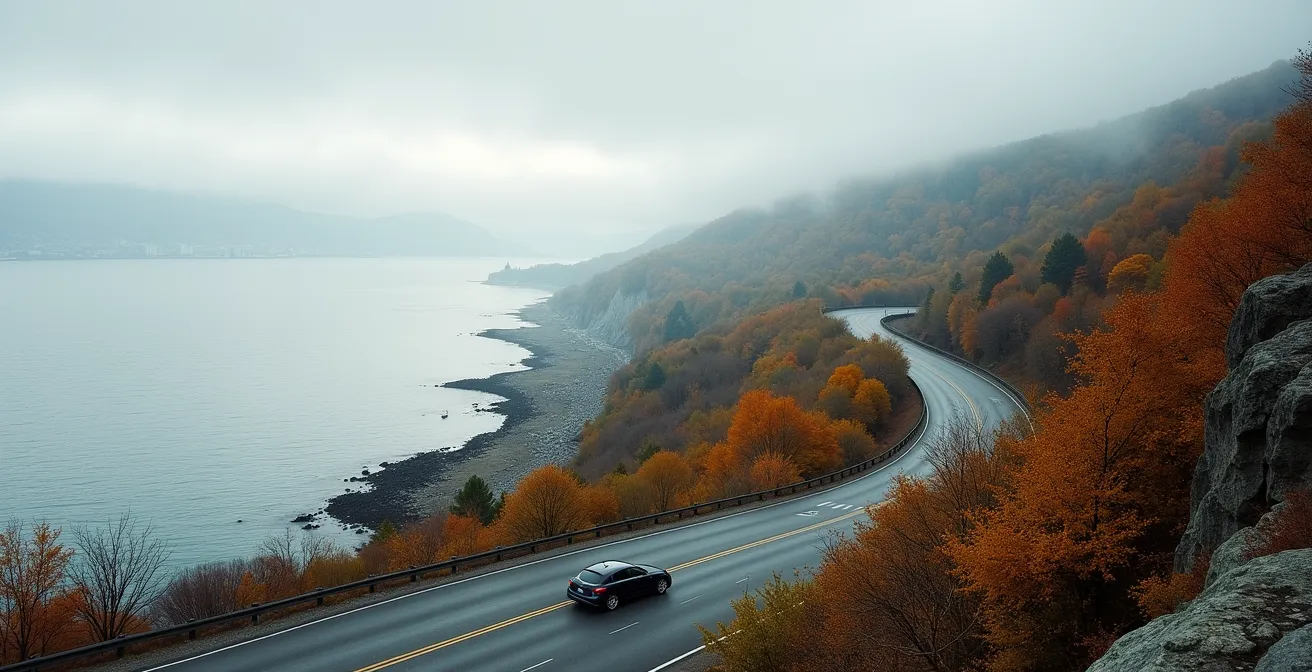
The route naturally unfolds along the river, creating a stunning visual and historical narrative. A well-paced 7-day itinerary could look like this:
- Days 1-2: Begin in Montreal, exploring the Old Montreal UNESCO district and its landmarks before driving the scenic Route 138 to Quebec City.
- Day 3: Dedicate a full day to the fortifications and historic streets of Old Quebec, the heart of New France.
- Days 4-5: Continue east toward the Gaspé Peninsula, a journey that involves a critical ferry crossing to reach Miguasha National Park for a fossil beach walk.
- Days 6-7: The return journey via the south shore’s Route 132 offers new perspectives and a stop at related historic sites like Forges du Saint-Maurice before returning to Montreal.
While the drive is scenic, the primary logistical challenge is the ferry crossing, which can become a significant bottleneck. Proper planning is essential to maintain the flow of your curated experience.
Case Study: The Ferry Crossing Strategy
The Baie-Sainte-Catherine to Tadoussac ferry is a known chokepoint in summer, with wait times that can exceed three hours. As travel experts at Wanderlust Magazine highlight, successful navigation of Quebec’s heritage sites depends on mitigating these delays. Experienced travelers report that booking the first crossing of the day (around 6:30 AM) or a late evening trip (after 8 PM) can reduce wait times to under 30 minutes, turning a potential frustration into a smooth transition, often with the added bonus of a whale watching opportunity in the Saguenay-St. Lawrence Marine Park.
Grand-Pré National Historic Site: Uncovering the Story of the Deportation
Grand-Pré is more than just a picturesque landscape of dykelands and marshes; it is a site of profound memory and a testament to cultural survival. This UNESCO site in Nova Scotia commemorates the story of the Acadian people and the Great Upheaval (Le Grand Dérangement) of 1755, when thousands were deported from their homes by the British. For the heritage curator, visiting Grand-Pré is an exercise in understanding “narrative integrity.” The site’s serene beauty, with its Victorian gardens and memorial church, stands in poignant contrast to the traumatic history it represents.
The story of Grand-Pré is not confined to the past. It is a living heritage, powerfully demonstrated by events like the Congrès Mondial Acadien. During the 2024 gathering, over 50,000 Acadian descendants from around the world—including large communities from Louisiana and Maine—convened at Grand-Pré. This transformed a place of historical tragedy into a vibrant celebration of cultural resilience and continuity. It underscores that the site’s primary value is not just its preserved landscape, but its role as a touchstone for a global diaspora. A visit here is an opportunity to witness how a community has reclaimed its narrative and continues to build its future upon the foundations of its past.
For visitors, especially those with Acadian roots, the site offers powerful tools for personal connection and genealogical research. Engaging with these resources moves a visit from passive observation to active participation in the site’s living story:
- Start at the Visitor Centre’s genealogy kiosk, which holds digitized deportation records.
- Connect with volunteer genealogists from the Société Nationale de l’Acadie on weekends.
- Access the Centre d’études acadiennes database, containing over 750,000 family records.
- Schedule a consultation with a Parks Canada heritage interpreter for personalized history.
- Visit the Deportation Cross monument, a place of memorial and connection.
Key Takeaways
- Curating a Canadian heritage tour is an exercise in strategic trade-offs, balancing remote, immersive sites against accessible, multi-faceted urban ones.
- Ethical tourism at UNESCO sites involves more than just “leaving no trace”; it requires active, conscious choices that support conservation and respect local and Indigenous narratives.
- Logistical planning is paramount; factors like accommodation booking windows, seasonal access, and transportation bottlenecks can define the success of your itinerary.
Old-Growth Tourism: How Your Visit Can Support Conservation Efforts
Visiting an old-growth forest within a UNESCO site, such as in the Clayoquot Sound Biosphere Reserve in British Columbia, is a humbling experience. It is also an act with direct economic and ecological consequences. “Old-growth tourism” is not a passive activity; the choices you make as a visitor can either contribute to the preservation of these ancient ecosystems or inadvertently harm them. Conscious access is the guiding principle, where your visit becomes a direct investment in conservation.
The economic impact of this model is significant. Sustainable tourism related to Canada’s UNESCO sites is a major economic driver, and in British Columbia, old-growth forest tourism plays a vital role. It is estimated to contribute $450 million to the economy while supporting thousands of jobs, many of which are in rural and Indigenous communities. When you choose to book with certified First Nations operators or stay in accommodations that contribute to environmental funds, your tourism dollars flow directly into the hands of those who are the primary stewards of the land. This transforms your trip from a simple vacation into a partnership for preservation, aligning your travel with the very values that earned the site its designation.
To ensure your visit is a positive force, a clear ethical checklist is an invaluable tool. It empowers you, the traveler, to make informed decisions that support the long-term health of the forest and the sovereignty of the local First Nations.
- Book tours exclusively with operators certified by the Tla-o-qui-aht or Ahousaht First Nations.
- Verify the operator’s partnership with the Tribal Parks initiative before confirming.
- Stay strictly on designated boardwalks within the Pacific Rim National Park Reserve to prevent soil compaction and root damage.
- Contribute to trail maintenance funds like the one managed by the Ancient Forest Alliance.
- Choose accommodations in Tofino or Ucluelet with a “1% for the Planet” certification.
- Ask your guides about their traditional ecological knowledge and the conservation protocols they follow.
Exploring Colonial Heritage Sites: A Critical Look at History
Many of Canada’s most celebrated heritage sites are rooted in its colonial past. For the thoughtful traveler, visiting these places requires more than appreciation; it demands critical engagement. The concept of narrative integrity is crucial here. It means acknowledging that the story presented is often incomplete and seeking out the perspectives that have historically been excluded, particularly those of the Indigenous peoples on whose land these sites exist. A critical look at history does not diminish a site’s importance, but rather enriches our understanding of its complex legacy.
A powerful model for this narrative reclamation can be found at SG̱ang Gwaay Llnagaay (Nan Sdins) in Haida Gwaii. While the site is recognized by UNESCO for its stunning collection of Haida mortuary and memorial poles, its true significance lies in its modern co-management. The Haida Gwaii Watchmen Program, run by the Haida Nation, ensures that every visitor receives interpretation directly from Haida knowledge keepers. This fundamentally reframes the experience, shifting the narrative from one of a “vanished village” discovered by colonizers to one of Indigenous continuity, resilience, and spiritual connection. It is a living site, the resting place of ancestors, and its story is told by its rightful owners.
This approach has been reinforced at a national level. As a key figure in Canadian heritage interpretation has noted, the landscape is changing from celebration to examination.
The Truth and Reconciliation Commission’s Calls to Action fundamentally changed how we interpret colonial heritage sites, moving from celebration to critical examination of our complex history.
– Dr. Marie-Claude Landry, Canadian Human Rights Commission
To engage with these sites responsibly, the curated traveler can adopt a framework of critical inquiry. Asking pointed questions before, during, and after your visit is a powerful tool for uncovering a more complete story:
- On what Indigenous nation’s traditional territory was this site built?
- How are descendants of the original inhabitants involved in the site’s management today?
- What perspectives or stories were excluded from the site’s original interpretation?
- How has the site’s narrative changed in response to Truth and Reconciliation recommendations?
- What economic benefits from tourism flow directly to local Indigenous communities?
By asking these questions and choosing sites and operators that prioritize authentic narratives, you not only enrich your own travel experience but also contribute to a more honest and equitable future for Canadian heritage tourism. Your journey becomes part of the solution.