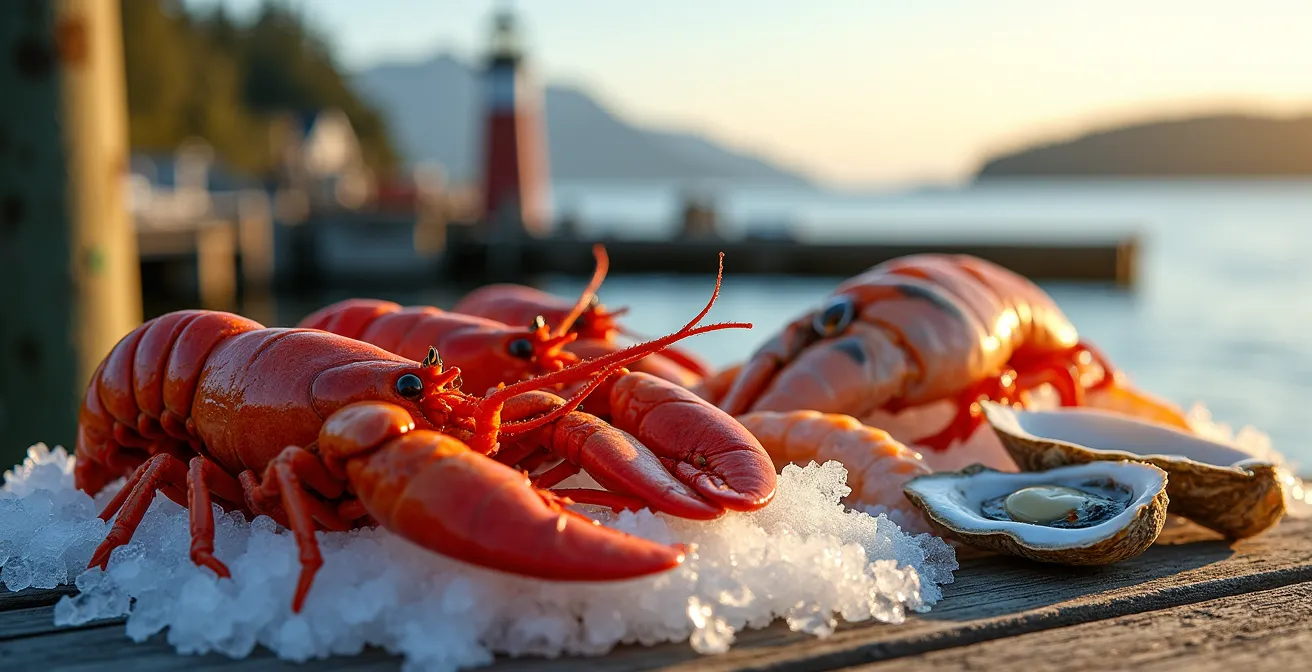
Navigating a Canadian fish market can feel overwhelming, with fleeting seasons and confusing sustainability labels. The key isn’t just knowing *what* to eat, but *why* it’s at its peak at a specific moment. This guide moves beyond simple lists, delving into the biology, geography, and human stories behind Canada’s best seafood. By understanding the ‘ephemeral peak’ of a BC spot prawn or the ‘merroir’ of a PEI oyster, you transform from a simple consumer into a true connoisseur, able to choose the most delicious and ethical options with confidence.
You’re standing at a glistening seafood counter in Canada. A mountain of ruby-red lobster, silvery salmon fillets, and trays of intricately patterned prawns beckon. The signs proclaim “Fresh,” “Local,” “Seasonal,” but what do they truly mean? For many seafood lovers, the desire for the freshest, most ethical catch is strong, but the path is murky. You’ve been told to look for logos, to ask questions, but the answers often feel incomplete. Is a soft-shell lobster a bargain or a compromise? Does that little symbol on the menu genuinely make a difference? The typical advice often misses the most delicious part of the story.
The secret to truly extraordinary seafood doesn’t lie in a simple calendar. It’s found in understanding the rhythm of the ocean itself. It’s about appreciating the fleeting, perfect moment in a creature’s life cycle when its flavour and texture are unparalleled—an ephemeral peak dictated by biology and environment. This is where a marine biologist’s knowledge meets a chef’s palate. The real magic is in the details: the cold, nutrient-rich currents that give a scallop its sweetness, the few short weeks a spot prawn has before it’s shipped across the world, or the distinct briny kiss of an oyster shaped by its unique ‘merroir’.
This guide is designed to be your compass. We will navigate the nuances of Canada’s coastal bounty, not by just listing seasons, but by explaining the story behind them. We will decode the labels, compare the coasts, and introduce you to the people who bring this incredible food from the water to your plate. Prepare to go beyond the surface and learn to eat with the tides, transforming your next seafood meal from merely fresh to truly unforgettable.
This article will guide you through the specific, fleeting moments of peak seafood quality across Canada, from the Pacific to the Atlantic. Discover the stories behind each catch and learn how to make choices that are both delicious and responsible.
Summary: An Insider’s Guide to Canada’s Seasonal Seafood
- Why You Only Have 6 Weeks to Eat Fresh BC Spot Prawns
- Hard Shell vs. Soft Shell: Which Lobster Offers More Meat for Your Money?
- What Does the Ocean Wise Symbol Actually Mean on a Menu?
- East Coast vs. West Coast Oysters: Can You Taste the Merroir?
- How to Pack Frozen Salmon for a Flight Home
- Why You Must Check Tide Tables Before Photographing Hopewell Rocks
- Salmon n’ Bannock vs. Tourist Traps: Where to Eat Authentic in Vancouver
- The Agritourism Trail: Meeting the Farmers Who Feed Canada
Why You Only Have 6 Weeks to Eat Fresh BC Spot Prawns
For a brief, glorious window each spring, usually starting in May, the coast of British Columbia is buzzing with a singular obsession: the spot prawn. These large, sweet, and succulent crustaceans are celebrated for their firm texture and delicate flavour, a true taste of the Pacific. But their appearance on local menus and in fish markets is heartbreakingly short-lived. This scarcity isn’t a marketing gimmick; it’s a reality dictated by a powerful combination of biology and global economics. The spot prawn fishery is carefully managed to last only about six to eight weeks to ensure a sustainable harvest, aligning with their life cycle.
What makes this season even more frantic for Canadian seafood lovers is the immense international demand. These prawns are highly prized in Asia, particularly Japan, for their sashimi-grade quality. As a result, the economics of the industry heavily favour exporting. In fact, an astonishing 90% of BC spot prawns are exported to Asia, leaving only a tiny fraction for the domestic market. This is why scoring a pound of fresh, live spot prawns directly from a fisherman’s boat at Steveston’s Fisherman’s Wharf or Vancouver’s Granville Island feels like winning the lottery. You are intercepting a world-class delicacy at its absolute peak, moments after it left the water.
This extremely limited local availability defines the experience. It creates a culinary event, marked by festivals and special menus across Vancouver. For those six weeks, chefs and home cooks alike are in a race against the clock to feature these gems. Eating a fresh spot prawn in BC is to taste an ephemeral peak—a fleeting moment of perfect, local flavour that the rest of the world pays a premium to experience frozen. It’s a delicious lesson in supply, demand, and the privilege of being in the right place at the right time.
Hard Shell vs. Soft Shell: Which Lobster Offers More Meat for Your Money?
On the Atlantic coast, another seasonal drama unfolds, this one starring the iconic Canadian lobster. As you approach a lobster pound in the Maritimes, you’ll often see two price points: one for “hard shell” and a lower one for “soft shell” or “shedders.” A novice might see the lower price and think they’ve found a bargain. A seasoned connoisseur, however, knows the choice is more complex, involving a trade-off between yield, texture, and flavour. This difference is entirely biological. Lobsters must shed their old, smaller shells to grow, a process called molting. A “soft-shell” lobster is one that has recently molted.
A hard-shell lobster is in its prime, having fully grown into its tough, heavy exoskeleton. Its body is packed with firm, dense meat, offering the best yield. In contrast, a soft-shell lobster’s new carapace is still soft and has more room to grow. This means there is more water and less meat inside. While the meat is often described as exceptionally tender and sweet, you are ultimately paying for more shell and water weight. The value proposition is clear: for sheer quantity of meat, the pricier hard-shell lobster offers more for your money. The best time for these is typically in the colder months, from late fall to early spring.
This illustration highlights the visual difference in the claw, where the density and colour reflect the stage of the lobster’s life cycle. The deep, mottled red of the hard shell signifies a mature, full animal, while the lighter, more uniform colour of the soft shell hints at its recent transformation.
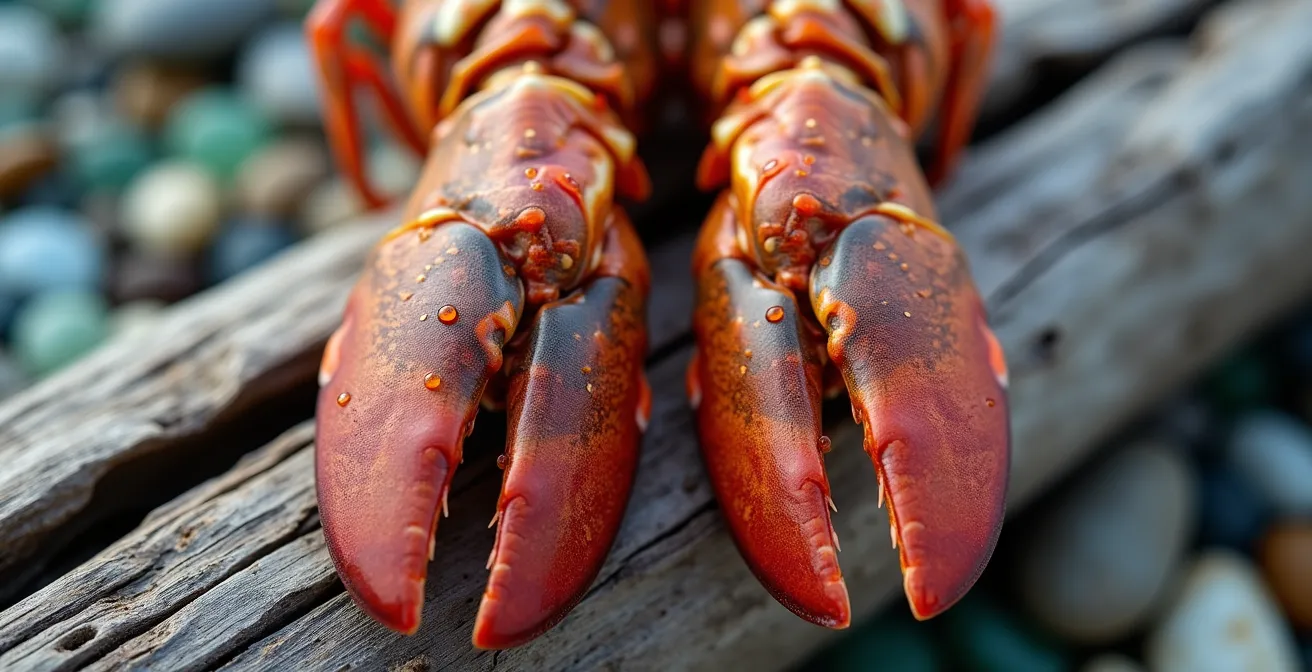
To make the choice even clearer, let’s break down the specifics. The decision between a hard and soft shell depends entirely on your culinary goal and budget, as shown in this comparative analysis.
| Characteristic | Hard Shell Lobster | Soft Shell Lobster |
|---|---|---|
| Season | October-December | July-September |
| Meat Yield | 30-35% of total weight | 20-25% of total weight |
| Meat Texture | Firm, dense | Tender, sweet |
| Price per pound | Higher ($15-20 CAD) | Lower ($10-15 CAD) |
| Best Use | Fine dining, grilling | Traditional boils, rolls |
| Shipping Durability | Excellent – survives 48+ hours | Poor – requires immediate cooking |
What Does the Ocean Wise Symbol Actually Mean on a Menu?
When you see the little fish logo next to a menu item, you likely feel a sense of relief. You’re making a good choice. But what does the Ocean Wise symbol actually signify? It’s more than just a sticker; it’s a recommendation program born out of the Vancouver Aquarium, designed to help consumers and businesses navigate the complex world of seafood sustainability. It is not a formal certification like the Marine Stewardship Council (MSC). Instead, it’s a conservation program that assesses fisheries on their abundance, habitat impact, and management practices to determine if they are a “recommended” choice.
The program’s strength lies in its Canadian-centric, science-based approach. Ocean Wise works directly with its partners—from large-scale suppliers to small, independent restaurants—to audit their seafood sourcing and provide easy-to-understand recommendations. This partnership model has been incredibly successful. Today, there are over 3,000 Ocean Wise partner locations across Canada, making it one of the most recognizable and accessible sustainability guides for Canadian diners. It empowers you to support fisheries that are actively working to minimize their environmental footprint.
However, being an informed consumer means understanding the nuances. Ocean Wise covers both wild-caught and farmed seafood, giving it a broader scope than wild-only programs like MSC. Its purpose is to steer the market towards better practices. If you don’t see the symbol, it doesn’t automatically mean the seafood is unsustainable. It’s an opportunity to engage and ask the key questions: “What species is this? Where was it caught? What method was used?” The Ocean Wise program is a powerful tool, but the ultimate goal is to foster a culture of curiosity and accountability, where consumers are empowered to make informed choices, logo or not.
East Coast vs. West Coast Oysters: Can You Taste the Merroir?
For oyster lovers, Canada is a paradise of bivalve diversity. The debate between East Coast and West Coast oysters is a passionate one, and the differences are not just geographical—they are profoundly sensory. The French have the word ‘terroir’ to describe how a wine’s taste is shaped by its land, climate, and soil. For seafood, we have ‘merroir’: the idea that an oyster’s flavour profile is a direct reflection of the specific body of water in which it grew. In Canada, this concept is vividly expressed in the contrast between the two coasts.
West Coast oysters, like the Kusshi or Fanny Bay from British Columbia, tend to be smaller, with deep cups. They are grown in the cold, nutrient-rich Pacific and often have a creamy texture and a flavour profile marked by notes of melon, cucumber, and a sweet, subtle finish. They are a delicate and nuanced expression of their environment. East Coast oysters, hailing from the frigid, turbulent Atlantic, are a different beast entirely. They are often larger, tear-drop shaped, and deliver a powerful punch of flavour. They are characterized by a firm, almost crunchy texture and a high-salinity, intensely briny finish that tastes like a wave crashing in your mouth.
This distinctiveness is a gift of Canada’s diverse marine ecosystems. Nothing illustrates this better than the country’s most famous oyster, a prime example of ‘merroir’ in action.
Case Study: Malpeque Bay Oysters – Prince Edward Island’s Signature Merroir
Malpeque Bay oysters from PEI are renowned for their unique ‘merroir’ – a sweet start with a sharp, briny finish that reflects the cold waters of the Gulf of St Lawrence. These oysters, harvested from waters that have been cultivating shellfish for over 100 years, are often cited as the perfect ‘beginner oyster’ due to their clean, oceanic taste with plenty of flavor but without overwhelming brininess.
So, can you taste the ‘merroir’? Absolutely. The next time you’re at an oyster bar, order a selection from both coasts. Close your eyes and let the oyster tell you its story. Is it the gentle, vegetal sweetness of the Pacific or the bracing, salty slap of the Atlantic? It’s a delicious journey through Canada’s sensory geography.
How to Pack Frozen Salmon for a Flight Home
A trip to Canada’s West Coast isn’t complete without indulging in its world-famous salmon. Whether it’s the rich, oily King (Chinook) or the ruby-red Sockeye, bringing a taste of the Pacific home is the ultimate souvenir. But the logistics of flying with frozen seafood can be daunting. The key to success is proper preparation and understanding airline regulations. Simply throwing a frozen fillet in your suitcase is a recipe for a soggy, spoiled disaster.
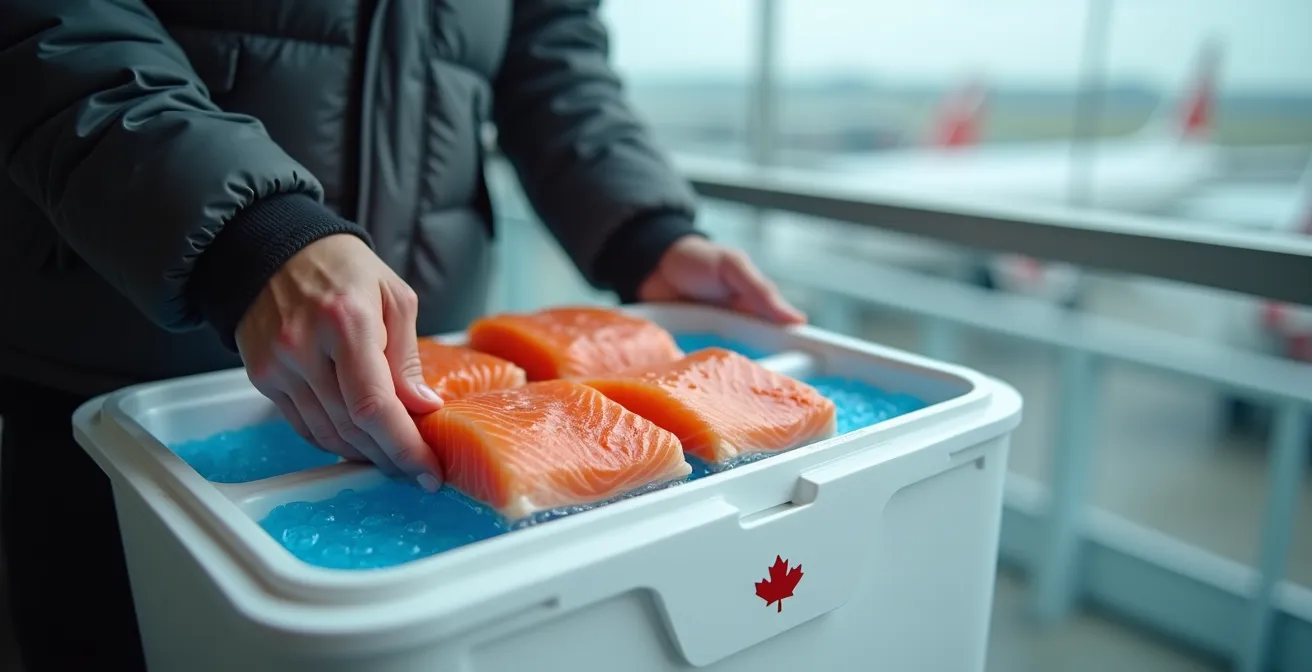
Your journey begins at the source. Reputable vendors, like those at Vancouver’s Granville Island Market or dedicated seafood retailers at YVR airport, are your best allies. They specialize in packing for travel. The gold standard is flash-frozen-at-sea (FAS) salmon, which is frozen on the fishing vessel moments after being caught, locking in peak freshness. Request that your fish is vacuum-sealed and, for extra security, double-bagged to prevent any leaks during pressure changes in the cargo hold. Loose ice is a strict no-go for air travel; you must use gel ice packs in an airline-approved hard-sided cooler for the best insulation and durability.
This image captures the careful process of packing these prized fillets, ensuring they arrive home as perfect as when you bought them.
Before heading to the airport, be sure to check the specific policies of your airline. Canadian carriers like Air Canada and WestJet have clear guidelines for transporting perishable goods. Planning ahead ensures your delicious investment makes it home safely, allowing you to share the authentic taste of Canada with friends and family.
Your Action Plan: Flying with Canadian Salmon
- Source Smartly: Purchase flash-frozen-at-sea (FAS) salmon from YVR airport retailers or Granville Island Market vendors who specialize in travel packing.
- Package Securely: Insist on vacuum-sealed packaging and ask for it to be double-bagged to prevent leaks under pressure.
- Cool Correctly: Use an approved hard-sided cooler with frozen gel packs. Avoid regular ice, as it’s typically prohibited.
- Declare at Check-In: For airlines like Air Canada and WestJet, you must declare the seafood at check-in. Be aware of weight limits, which are often around 23kg per cooler.
- Consider Smoked for Long Hauls: For flights over 12 hours, hot-smoked salmon is a more stable and safer option than raw frozen fillets.
Why You Must Check Tide Tables Before Photographing Hopewell Rocks
The Hopewell Rocks, with their iconic “flowerpot” formations, are a crown jewel of New Brunswick and the Bay of Fundy. Photographers and tourists flock here to capture their dramatic beauty. However, the most critical tool for a successful visit isn’t a camera lens—it’s a tide table. The Bay of Fundy is home to the highest tides on Earth, with a difference of up to 16 meters (52 feet) between high and low tide. At low tide, you can walk on the ocean floor and gaze up at the massive sea stacks. Just six hours later, the same spot will be under several stories of water, transforming the landscape into a series of small, tree-topped islands.
This incredible tidal exchange is more than just a spectacle; it is the engine of a unique marine ecosystem. This immense movement of water stirs up nutrients from the ocean floor, creating an incredibly rich feeding ground. This is the secret behind some of Atlantic Canada’s most prized seafood. Experts often highlight how the Bay of Fundy’s 16-meter tides create ideal conditions for Digby scallops, making them plump and exceptionally sweet. The power of the tides directly translates to the flavour on your plate.
As the culinary experts at Great British Chefs note in their guide to Canadian seafood, this unique environment is what creates world-class flavour. They state, “The crisp, clear waters in Digby harbour mean the scallops thrive, growing larger and more flavourful than those found elsewhere”. It’s a direct endorsement of this ‘sensory geography’.
Harvest Narrative: Dulse Harvesting in the Bay of Fundy
Dulse, a purple-red seaweed hand-harvested at low tide along New Brunswick and Nova Scotia coasts, represents a sustainable seafood tradition entirely dependent on the Bay of Fundy’s extreme tides. Harvesters work during the lowest tides to access beds normally submerged under 10+ meters of water. This mineral-rich sea vegetable is sold dried at local markets and provides a unique umami flavor profile distinct to Atlantic Canada.
So, while you are planning your Hopewell Rocks photoshoot, remember that the very same force of nature you are there to witness is also responsible for a remarkable culinary bounty. Checking the tide table is not just for photographers; it’s for any traveler who wants to understand the powerful connection between geology and gastronomy in Atlantic Canada.
Salmon n’ Bannock vs. Tourist Traps: Where to Eat Authentic in Vancouver
Vancouver’s culinary scene is vibrant, but for visitors seeking an authentic taste of Indigenous cuisine, the path can be confusing. Many souvenir shops and restaurants use generic “Native” imagery, but offer little in the way of genuine cultural connection or culinary tradition. Discerning a truly authentic experience from a “tourist trap” is crucial, not just for a better meal, but to ethically support the Indigenous communities who are the original stewards of these lands and waters.
An authentic Indigenous restaurant, like the renowned Salmon n’ Bannock in Vancouver, is more than just a place to eat. It’s a celebration of culture, owned and operated by Indigenous peoples. The menus are built on traditional ingredients and preparation methods, and there is a clear and proud connection to the specific Nations and fishers who supply them. This stands in stark contrast to inauthentic venues, which often lack specificity, feature no Indigenous staff in leadership, and use art as decoration without attributing or compensating the artists. Choosing an authentic establishment is a vote for food sovereignty.
This principle of support is powerfully articulated by advocates for Indigenous-owned businesses. When you make a conscious choice, your tourism dollars have a direct and positive impact. As a proponent from Watershed Watch Salmon Society explains:
When tourists choose restaurants like Salmon n’ Bannock in Vancouver or seek out Authentic Indigenous Seafoods at local markets, they directly support Indigenous-owned businesses and fishers. These establishments prioritize sourcing from Indigenous suppliers and communities, ensuring that tourism dollars flow back to the people who have sustainably managed these waters for thousands of years.
To help you make these conscious choices, it’s helpful to know what to look for. The following points can serve as your guide to identifying and avoiding establishments that misappropriate Indigenous culture for commercial gain.
Checklist: Identifying Inauthentic Indigenous Restaurants
- Missing Partnerships: The restaurant or menu makes no mention of specific Indigenous Nation partnerships or suppliers.
- Generic Branding: The establishment uses vague “Native” or “Indian” branding without any cultural specificity.
- Lack of Representation: No Indigenous people are visibly part of the ownership or management team.
- Vague Sourcing: The menu lacks information about traditional preparation methods or where ingredients are sourced.
- Unattributed Art: Indigenous art is used purely for decoration, with no information about or compensation for the artists.
Key Takeaways
- The best seafood is time-sensitive; respect the biological clocks of species like spot prawns and lobsters for peak flavour.
- Flavour is geographical. The concept of ‘merroir’ explains why oysters from different Canadian coasts taste so distinct.
- Your choices matter. Supporting programs like Ocean Wise and authentic Indigenous restaurants directly contributes to sustainability and community well-being.
The Agritourism Trail: Meeting the Farmers Who Feed Canada
Our journey through Canada’s seasonal seafood has shown that flavour is tied to moments and places. The final, and perhaps most rewarding, layer of this experience is connecting with the people behind the food. The agritourism trail in Canada is expanding to the coastline, inviting travelers to go beyond the restaurant and meet the fishers, harvesters, and aquaculturists who dedicate their lives to these waters. This is the essence of the ‘harvest narrative’—understanding that every fillet and every oyster has a human story.
This connection transforms a meal into a meaningful exchange. It puts a face to the food and fosters a deeper appreciation for the labour and knowledge involved. The Canadian seafood industry is a significant economic engine, and by participating in aqua-tourism, you are directly contributing to the livelihoods of coastal communities. The sector is vast, with over 90,000 workers supported by the Canadian seafood industry, which contributes $9 billion to the economy annually. When you buy directly from a fisher or take a tour of an oyster farm, you are ensuring that your money supports these local economies in the most direct way possible.
Nowhere is this model of community-integrated tourism more inspiring than on a remote island off the coast of Newfoundland, which has become a global benchmark for sustainable practice.
Case Study: Fogo Island Inn – A Sustainable Seafood Tourism Model
The Fogo Island Inn in Newfoundland represents a pioneering model of aqua-tourism where guests stay in a luxury social enterprise that directly supports local fishing communities. Visitors can join fishers on their boats, learn traditional cod fishing techniques, and dine on seafood caught within sight of their rooms. This model ensures tourism revenue directly sustains the island’s 2,700 residents and preserves centuries-old fishing traditions.
The Fogo Island Inn proves that tourism can be a powerful force for good, preserving culture and creating sustainable economic opportunities. By seeking out these experiences, you are no longer just a tourist; you become a participant in the local food system, a supporter of tradition, and a keeper of stories.
Armed with this knowledge, your next journey to Canada’s coasts can be a true culinary adventure. The next logical step is to use this guide to plan a trip, visit a local market with new eyes, or simply start a conversation with your fishmonger, not just as a customer, but as an informed and passionate connoisseur.
Frequently Asked Questions About Canadian Seafood Sustainability
What’s the difference between Ocean Wise and MSC certification?
Ocean Wise is a recommendation program that covers both wild and farmed seafood, while MSC only certifies wild fisheries. Ocean Wise uses broader criteria including local Canadian fisheries.
Is Ocean Wise a formal certification or just a recommendation?
Ocean Wise is a recommendation program, not a formal third-party certification. It was founded by the Vancouver Aquarium and relies on scientific assessments rather than audits.
What questions should I ask if I don’t see the Ocean Wise symbol?
Ask: What species is this? Where exactly was it caught or farmed? What fishing method was used? These questions help you make informed choices beyond relying on logos.