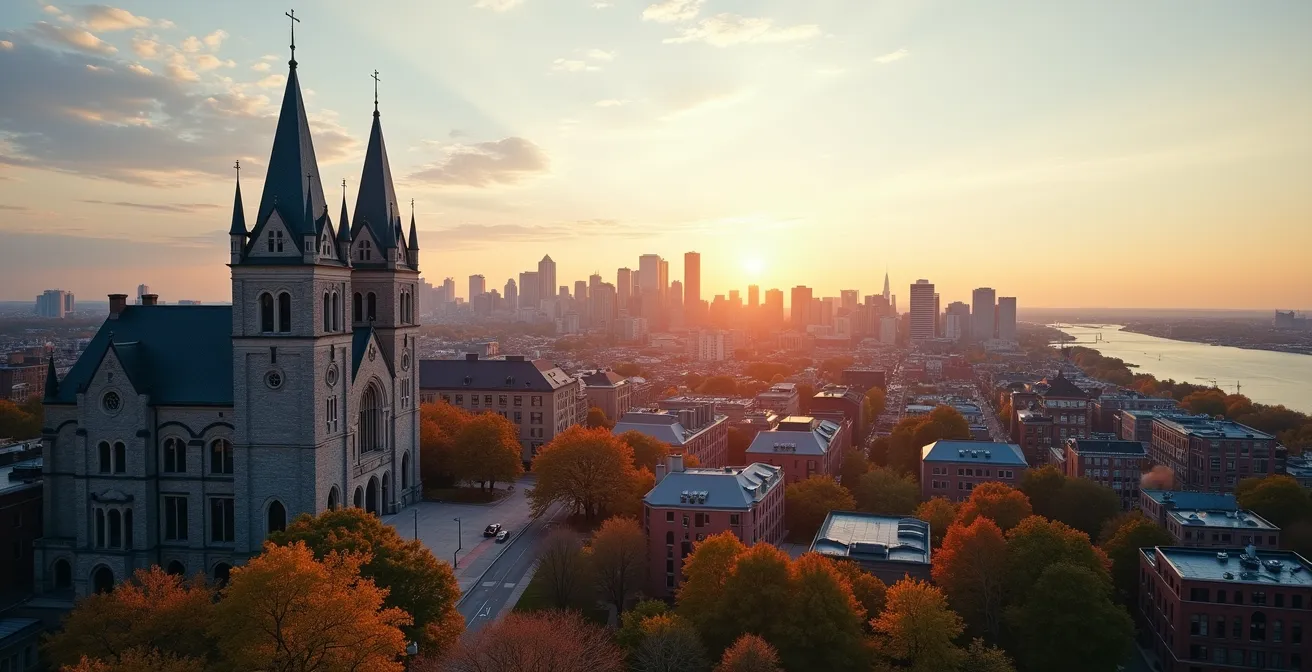
Canada’s “European” architecture is not a simple copy of the Old World, but a tale of selective adaptation in the East and deliberate counterpoint in the West.
- Montreal and Quebec City’s charm stems from specific French and British styles, reinterpreted to solve unique Canadian economic and topographical challenges.
- Vancouver’s glass-tower aesthetic, or “Vancouverism,” represents a conscious philosophical break, prioritizing views and density over historical preservation.
Recommendation: Observe a city’s design not just for its beauty, but for the economic and cultural stories its buildings tell—from Montreal’s exterior stairs to Vancouver’s podium towers.
For the architecture enthusiast, the quest for “Old World” charm in North America often leads to a well-trodden path: the cobblestone streets of Old Montreal and the fortified walls of Quebec City. The comparison is immediate and seductive—a slice of Paris or a provincial French town, conveniently located on this side of the Atlantic. This initial impression, while pleasant, often misses the more compelling narrative. The story of European architecture in Canada is not one of simple imitation, but of translation, adaptation, and, in some cases, outright rejection.
The common platitude that “Old Montreal feels just like Paris” overlooks the specific historical and economic forces that shaped its unique stone facades and cast-iron details. It was as much a British colonial trading hub as it was a French settlement. Similarly, to label Quebec City as merely “European” is to ignore the military ingenuity required to adapt French fortification principles to the sheer cliffs of Cap Diamant. The real story is found in the “why”—why the mansard roofs, why the outdoor staircases, why the star-shaped fortress?
This guide adopts a critic’s lens to move beyond surface-level comparisons. We will explore the specific architectural vernacular of Montreal and Quebec, revealing how their most iconic features are a product of a unique urban philosophy—one of selective adaptation. To fully appreciate this, we will also turn our gaze westward to Vancouver, a city whose design represents a powerful aesthetic counterpoint, a conscious decision to look towards the Pacific Rim and the future, rather than back to European history.
This cross-country architectural tour will deconstruct the styles, laws, and philosophies that define Canada’s most captivating urban landscapes. By understanding the distinct narratives embedded in the brick, stone, and glass of these cities, you will learn to see them not as copies, but as original works with a complex and fascinating heritage.
Summary: Tracing European Blueprints in Canadian Cityscapes
- Second Empire vs. Victorian: Spotting the Difference in Montreal’s Plateau
- Why Montreal is Called the “City of a Hundred Steeples”
- Petit Champlain or Saint-Paul Street: Which Feels More Like Paris?
- The Real Reason Montreal Houses Have Spiral Staircases Outside
- How Heritage Laws Protect Old Facades in Modern Condo Projects
- Gastown Brick vs. Yaletown Glass: A Tale of Two Neighborhoods
- Why the Citadelle is Shaped Like a Star: A Defense Explanation
- Vancouverism: How Urban Design Created the City of Glass
Second Empire vs. Victorian: Spotting the Difference in Montreal’s Plateau
Walking through Montreal’s Plateau or Golden Square Mile, one is confronted with a rich tapestry of 19th-century residential and civic architecture. Discerning the threads of this tapestry requires a trained eye, particularly in distinguishing the two dominant styles of the era: the grand, Parisian-influenced Second Empire and the ornate, eclectic Victorian. While often overlapping, their core philosophies are distinct. The Second Empire style, which saw its peak in Canada in the 1870s according to the Canadian Encyclopedia, is most readily identified by its signature mansard roof. This steep, four-sided gambrel-style roof, often clad in metal and punctuated by decorative dormer windows, was a direct import from Haussmann’s Paris, conveying a sense of monumental, institutional gravity.
Montreal’s City Hall stands as a premier Canadian example of this style. A close examination reveals the key tells: steep, metal-clad mansard roofs, a symmetrical façade dominated by a projecting central pavilion, and prominent stringcourses dividing each storey. As a government analysis notes, “Montreal City Hall is noteworthy partly because it is the first city administrative building in Canada intended as a city hall, with over half the original space devoted to ceremonial functions,” a purpose perfectly suited to the Second Empire’s imposing aesthetic.
In contrast, Victorian architecture in Montreal is less about a single defining feature and more about a spirit of decorative excess. Look for asymmetrical facades, elaborate wooden trim (known as “gingerbread”), colorful brickwork, and prominent bay windows. While a Victorian home might borrow elements, its overall effect is one of picturesque charm and individual expression, a departure from the formal, unified front of a Second Empire building. The key difference lies in intent: Second Empire projects an image of stately, centralized authority, while Victorian celebrates domesticity and ornate detail.
Why Montreal is Called the “City of a Hundred Steeples”
The nickname “City of a Hundred Steeples,” famously attributed to Mark Twain after a visit, is more than a quaint historical moniker; it’s a direct reflection of Montreal’s foundational urban philosophy. For centuries, the city’s identity and power structure were inextricably linked to the Catholic Church and, to a lesser extent, various Protestant denominations. This influence is not merely historical text—it is inscribed directly onto the skyline. The “steeples” are the physical manifestation of a society where religious institutions were the primary patrons of monumental architecture, competing to assert their presence and prestige.
The result is a remarkable concentration of ecclesiastical buildings, showcasing a wide array of European architectural revivals. One can trace a direct lineage from the Gothic Revival spires of Saint-Patrick’s Basilica, with its pointed arches and soaring vaults reminiscent of medieval France, to the opulent Neo-Baroque dome of the Mary, Queen of the World Cathedral, a scaled-down replica of St. Peter’s in Rome. The city features at least four Roman Catholic basilicas, each a significant architectural statement. This sheer density and variety created a unique urban fabric where, from almost any viewpoint, the horizon was punctuated by sacred symbols.
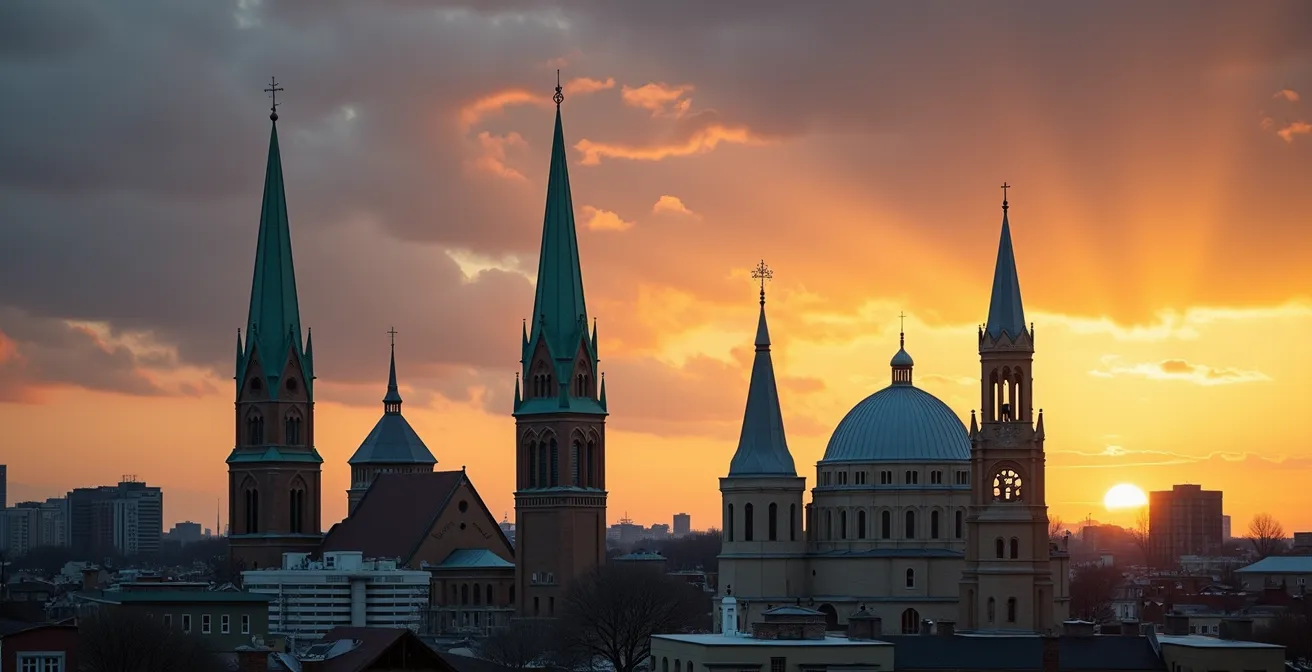
As this image illustrates, the architectural conversation between these steeples defines the city’s character. They are not isolated monuments but part of a collective skyline, a testament to an era when faith, wealth, and civic identity were expressed through ambitious, European-inspired design. The nickname persists today not just because the churches remain, but because their collective presence continues to tell the story of Montreal’s spiritual and cultural origins, a deeply ingrained part of its selective adaptation of Old World forms.
Petit Champlain or Saint-Paul Street: Which Feels More Like Paris?
The debate over which Canadian street feels most “European” often pits Quebec City’s Quartier Petit Champlain against Montreal’s Rue Saint-Paul. While both offer a compelling escape from North American urbanism, an architectural critic’s analysis reveals they evoke very different aspects of the Old World, specifically Paris. The feeling isn’t monolithic; it’s nuanced. Petit Champlain, with its narrow, winding lanes and tightly packed stone houses, channels the spirit of a pre-Haussmann, almost medieval Paris—think the provincial charm and human scale of Le Marais before its grand avenues.
Rue Saint-Paul in Old Montreal, conversely, reflects a later period and a different purpose. It’s wider, straighter, and its stone buildings are grander, reflecting its history as a bustling 18th and 19th-century commercial artery in a major British colonial port. The atmosphere is less of a quaint village and more akin to the sophisticated, commercial energy of a district like Saint-Germain-des-Prés, with its galleries, bistros, and grand apartment blocks. As one guide notes, ” Old Montreal’s stone buildings are largely from the 18th and 19th centuries, reflecting its history as a larger British colonial trading hub.”
This comparative analysis highlights the key differences in their architectural DNA and modern function, clarifying which “Paris” each street evokes.
| Feature | Petit Champlain (Quebec City) | Saint-Paul Street (Montreal) |
|---|---|---|
| Historical Period | New France origins (17th century) | 18th-19th century trading hub |
| European Comparison | Medieval Le Marais, Paris | Saint-Germain-des-Prés commercial feel |
| Street Character | Narrow, provincial French village | Wider, working port city atmosphere |
| Modern Function | Tourist-focused, museum-like preservation | Active galleries, bistros, mixed use |
Ultimately, the choice depends on the experience sought. For a preserved, almost museum-like immersion into the atmosphere of New France, Petit Champlain is unparalleled. For a living, breathing street where history coexists with a vibrant modern commercial and cultural scene, Saint-Paul Street offers a more dynamic, though perhaps less “pure,” European experience. Neither is a perfect replica, but both are powerful examples of distinct urban philosophies.
The Real Reason Montreal Houses Have Spiral Staircases Outside
The whimsical, ornate exterior staircases of Montreal are perhaps the city’s most iconic and misunderstood architectural feature. The common assumption ties them to heavy snowfall, but the true origin is a fascinating story of economics, public health, and urban regulation. This unique form of economic vernacular arose during the city’s explosive growth in the 19th century. As waves of industrial workers arrived, between 1840 and 1880, Montreal’s population doubled every 10 years, creating immense pressure for high-density housing on narrow lots.
In response, city officials, driven by a Victorian-era desire to bring light and air into the dense urban core, implemented new bylaws. A key case study of this period reveals the logic: “The city began to enforce regulations restricting the width of multiplexes. They also required that they be set back from the street, with enough room for a green outdoor space to exist in front of each building.” This created a dilemma for builders: how to maximize valuable, rentable square footage within these new constraints? The ingenious, cost-saving solution was to move the bulky staircase—a major space-consumer—to the exterior.
This decision had several benefits. It freed up the interior for larger apartments, maximizing rental income. The elegant spiral or winding form of the staircase was a further space-saving measure, allowing access to upper floors without eating into the mandated front green space. This architectural quirk was not just a stylistic choice; it was a brilliant economic response to a specific set of legal and spatial problems, a testament to the practical creativity that defines much of Montreal’s residential design.
How Heritage Laws Protect Old Facades in Modern Condo Projects
As Montreal evolves, the tension between development and preservation becomes a defining feature of its urban landscape. The sight of a historic stone facade grafted onto a sleek, modern glass condo building is increasingly common. This practice, known as “facadism,” is a direct result of Canada’s, and specifically Montreal’s, robust heritage protection laws. These regulations are the modern expression of an urban philosophy that values the city’s historical narrative, seeking to integrate it into the present rather than erasing it. The goal is to maintain the character and human scale of historic streetscapes while allowing for necessary densification.
Organizations like Heritage Montreal play a crucial role in shaping this policy. They advocate for stringent criteria governing how—and if—heritage buildings can be altered. A recent resolution urges the city to develop a Heritage Charter “founded on the maintenance of heritage buildings’ integrity, including, as a last resort, criteria governing the admissibility, evaluation and acceptability of proposals to preserve only portions or fragments.” This highlights a preference for full preservation, with facadism being a compromise solution.
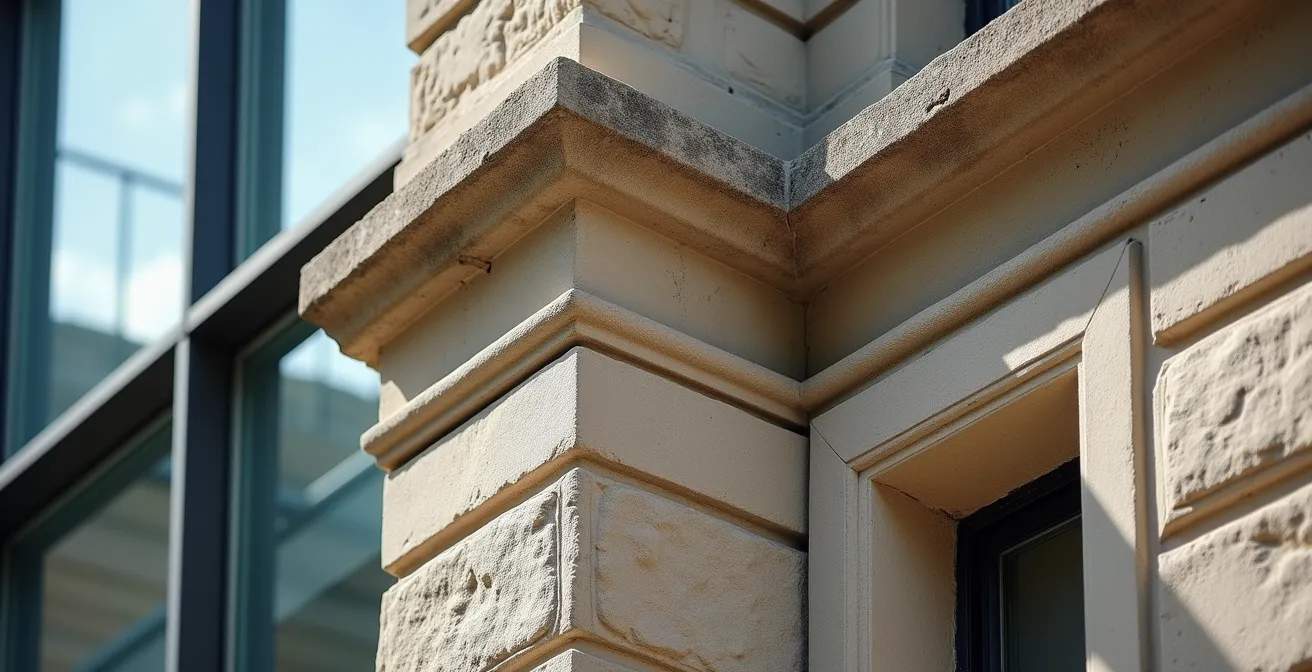
This image of a preserved 19th-century facade meeting a contemporary structure is a physical manifestation of this legal and cultural negotiation. It represents a city grappling with its identity, attempting to reconcile its European-influenced past with its future as a growing metropolis. For property owners, navigating these laws requires careful planning and adherence to a strict process, from verifying heritage status to obtaining specific permits before any work begins.
Action Plan: Navigating Heritage Property Requirements in Montreal
- Verify status: Check if your property is listed under the Cultural Heritage Act by consulting the official Répertoire du patrimoine culturel du Québec.
- Obtain permits: Before any construction, restoration, or renovation, secure all necessary permits from your local borough’s permits office.
- Ensure compliance: If your property has a specific status under the Act, confirm that your plans fully comply with all associated provisions and restrictions.
- Contact the borough: Reach out to your borough for detailed information on the specific bylaws and aesthetic guidelines that apply to your property’s location.
- Seek subsidies: Investigate and apply for available municipal or provincial subsidies and financial aid programs designed to support heritage preservation.
Gastown Brick vs. Yaletown Glass: A Tale of Two Neighborhoods
A short walk in downtown Vancouver offers a dramatic lesson in contrasting urban philosophies. The journey from Gastown to Yaletown is a journey through time and ideology, showcasing the city’s complex relationship with its own history. Gastown, Vancouver’s original downtown, is a preserved enclave of Victorian commercial architecture. Its streets are lined with substantial brick-and-timber warehouses, their robust forms and rhythmic arches speaking to the city’s origins as a rugged, late-19th-century port. The preservation of this district is no accident; it is the result of a conscious decision to maintain a tangible link to the past, a pocket of historical texture in a city defined by the new.
Yaletown, just a few blocks away, presents the aesthetic counterpoint. Also a former warehouse district, its redevelopment followed a completely different playbook. Here, the dominant aesthetic is “Vancouverism”—sleek glass towers rising from podiums that often incorporate the brick facades of the original warehouses. The heritage is not preserved as a whole, but used as a textural base for a vertical, forward-looking vision. This approach, which contrasts sharply with Montreal’s more holistic preservation ethos, is driven by a different set of priorities: maximizing density and capturing stunning views of the surrounding mountains and water.
This table encapsulates the fundamental differences in how Vancouver and Montreal approach their architectural heritage, revealing divergent urban values.
| Aspect | Vancouver (Gastown/Yaletown) | Montreal |
|---|---|---|
| Heritage Approach | Density bank system – height exceptions for preservation | Conseil du patrimoine advises on preservation |
| Dominant Style | Victorian brick warehouses (Gastown) / Glass towers (Yaletown) | Low-rise stone and brick, French colonial |
| Urban Philosophy | Pacific Rim forward-looking aesthetic | European ‘human scale’ preservation |
| Preservation Groups | Municipal heritage register system | Save Montreal (1974), Heritage Montreal (1976) |
Gastown’s brick represents a commitment to historical narrative, while Yaletown’s glass embodies an ambition for a dense, modern, view-oriented city. Together, they tell the story of Vancouver’s evolution from a gritty port to a polished Pacific Rim metropolis.
Why the Citadelle is Shaped Like a Star: A Defense Explanation
Perched atop the formidable Cap Diamant, the Citadelle of Quebec is the city’s most dominant architectural feature. Its distinctive star shape is not a stylistic flourish but a masterclass in European military engineering, specifically the bastion fort system, or trace italienne. This design was the definitive response to the rise of cannon warfare in the 15th and 16th centuries. The low, thick, sloping walls of traditional castles were vulnerable to artillery, and their right-angled towers created “dead zones” or blind spots where attackers could shelter from defensive fire.
The star fort solved this problem with brutal efficiency. Its design is based on a series of projecting, angular bastions. From the top of one bastion, defenders could lay down a devastating crossfire, covering the walls of the adjacent bastions and eliminating any potential blind spots. Every inch of the fortress’s perimeter was exposed to defensive fire. The key features of this defensive system include:
- Bastions: The projecting, arrow-headed points that allow for flanking fire.
- Curtain Walls: The straight walls connecting the bastions.
- Ravelins: Detached, triangular fortifications placed in front of the curtain walls to protect gates and split an attacking force.
- Glacis: A long, gentle slope of open earth leading up to the walls, forcing attackers into a clear line of fire with no cover.
What makes the Citadelle of Quebec particularly fascinating is its selective adaptation of this European blueprint. While a textbook trace italienne fort is often a perfectly symmetrical star, Quebec’s was built upon the irregular, dramatic topography of Cap Diamant. The result is a unique, asymmetrical star pattern—a European military concept expertly tailored to a specific and challenging North American landscape. It is the ultimate fusion of Old World theory and New World reality.
Key takeaways
- Montreal’s “European” styles, like Second Empire, are not pure copies but pragmatic adaptations driven by local economics, regulations, and available materials.
- Quebec City’s defensive architecture, like the Citadelle, represents a direct and sophisticated import of cutting-edge European military technology, tailored to a unique North American landscape.
- “Vancouverism” stands as a deliberate aesthetic counterpoint, prioritizing density, modernity, and views of nature over the historical preservation ethos seen in Eastern Canada.
Vancouverism: How Urban Design Created the City of Glass
While Montreal and Quebec City looked to Europe for their architectural DNA, Vancouver forged a different path. The result is a unique urban planning philosophy known as “Vancouverism.” This is not a style in the traditional sense, but a set of principles for creating high-density urban living that doesn’t sacrifice livability. It stands as a powerful aesthetic counterpoint to the preservation-focused, human-scale streetscapes of its eastern Canadian counterparts. At its core, Vancouverism is about embracing verticality while maintaining a connection to the spectacular natural setting of the city.
The most recognizable model of Vancouverism is the “podium tower.” This consists of a tall, slender residential tower with a small floor plate, set back atop a wider, low-to-mid-rise podium. This podium is typically three to six stories high and houses street-oriented commercial space, townhouses, and amenities. This design accomplishes several key goals simultaneously: it concentrates a large population in a small footprint (density), the slender towers preserve view corridors for neighbors, and the street-level podium maintains an active, human-scaled public realm. The overwhelming preference for glass in these towers is also deliberate, designed to dissolve the boundary between inside and out, maximizing light and reflecting the surrounding sky, water, and mountains.
This table contrasts the core values of Vancouver’s design philosophy with Montreal’s, illustrating two fundamentally different approaches to building a city.
| Design Philosophy | Vancouver | Montreal |
|---|---|---|
| Primary Focus | Maximizing views of nature (mountains, water) | Preserving historic streetscapes |
| Building Height | Tall, slender towers on mixed-use podiums | Low to mid-rise-maintaining ‘human scale’ |
| Material Preference | Glass and contemporary materials | Stone, brick, traditional materials |
| Urban Planning Goal | Density with preserved view corridors | Cultural heritage preservation |
| Architectural Heritage | Pacific Northwest modernism | French colonial and Victorian roots |
Vancouverism is a conscious choice to prioritize a forward-looking, nature-integrated identity over historical homage. It created the “City of Glass” not by accident, but through a disciplined and innovative approach to urban design that has become a model for dense cities worldwide.
To truly appreciate the cities you visit, look beyond the surface aesthetics. The next time you walk down a street, ask not only “Is this beautiful?” but “Why was it built this way?” By learning to read the language of architecture, you can uncover the rich economic, cultural, and philosophical stories that every building has to tell.
Frequently Asked Questions about Montreal’s Architectural Idiosyncrasies
Why are external stairs practical in Montreal’s cold climate?
It eliminated the need for heated common stairwells inside buildings, saving landlords money on heating costs while maximizing rentable interior space.
Can these historic staircases still be built today?
The staircases don’t meet current Canadian construction codes, but Montreal has instituted bylaws allowing owners to maintain them in their original form.
What influenced the Catholic Church’s preference for external stairs?
The Church preferred the transparent view of entering through public space, rather than hidden common areas inside buildings where unsupervised mingling could occur.