In summary:
- Your standard rain gear is insufficient; you need a layered system designed for pervasive humidity, not just rain.
- Access is a strategic choice between fast but weather-dependent floatplanes and slower, scenic BC Ferries.
- Spirit Bear sightings are tied to the fall salmon run; book your trip 18-24 months in advance for peak season.
- There is zero cell service. A two-way satellite communicator and a detailed trip plan are non-negotiable for safety.
- Respect for the ecosystem, from staying on trails to choosing Indigenous guides, is central to a meaningful visit.
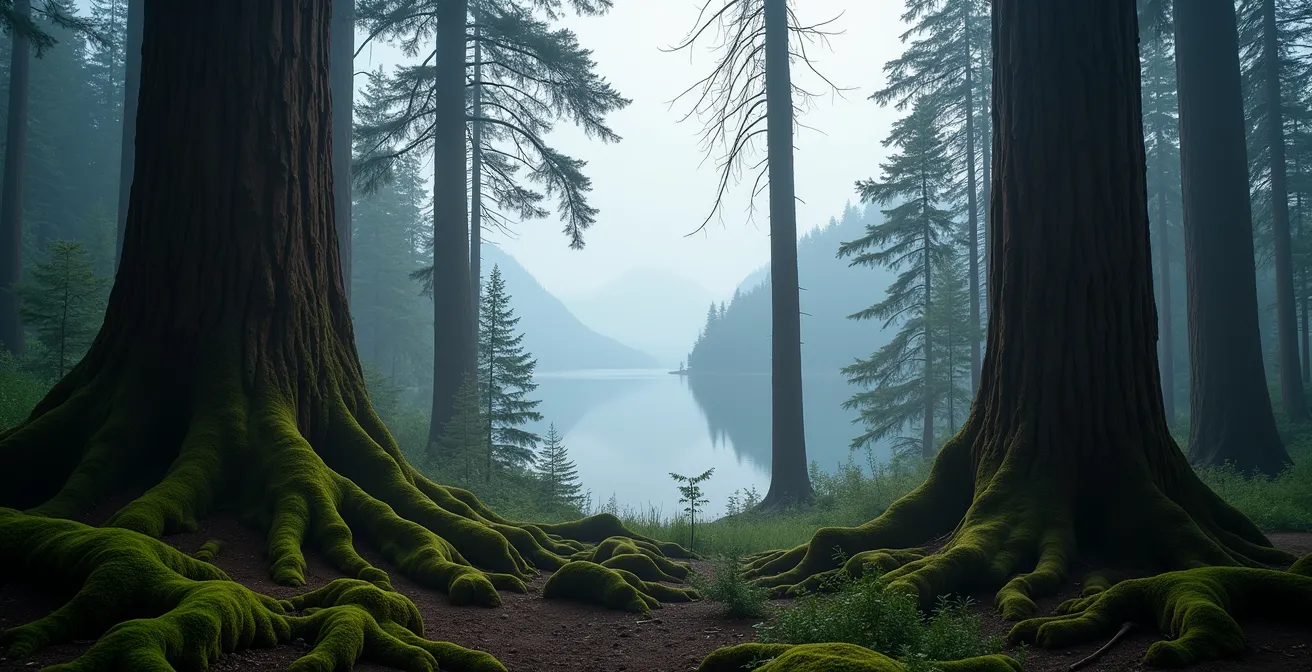
Thinking about the Great Bear Rainforest conjures images of mist-shrouded fjords, ancient cedars, and the elusive white Spirit Bear. It’s a place that calls to the adventurous soul. But the raw, untamed beauty of this part of British Columbia comes with a set of logistical challenges that most travellers underestimate. Many arrive thinking a good Gore-Tex jacket and a sense of adventure are enough. They prepare for rain, but not for the systemic dampness that seeps into everything. They hope to see a bear, but don’t understand the wildlife calendar that governs its appearance.
This isn’t a trip you can plan on a whim. The logistics are a puzzle of seasonal timing, transport limitations, and essential safety protocols. Out here, nature sets the rules. The mistake I see most often is people trying to force their schedule onto the environment, rather than adapting to its powerful rhythms. A trip to the Great Bear is a significant investment, and success isn’t measured by a checklist of sights, but by your ability to integrate into this wild system respectfully and safely.
But what if the key to a successful trip wasn’t about packing more gear, but about understanding the ‘why’ behind each choice? It’s not just about bringing a satellite phone; it’s about having a communication strategy that acknowledges the complete connectivity black hole. It’s not just about staying on a trail; it’s about understanding how a single footstep can damage a moss bed that has been growing for centuries. This guide is built from years of experience on this coast. We’ll move beyond the basics to give you the strategic insight needed to plan a truly profound and safe adventure.
This article breaks down the critical logistics you need to master. From selecting the right gear and transport to understanding the unwritten rules of the rainforest, you’ll find the practical, on-the-ground advice needed for your journey.
Summary: Great Bear Rainforest Logistics: A Guide to Thriving in Canada’s Wild Coast
- Why Your Standard Raincoat Will Fail You in the BC Rainforest
- Floatplane or Ferry: Choosing Your Access to Remote Coastal Lodges
- When to Book Your Trip to Maximize Spirit Bear Sightings
- The Communication Error That Strands Hikers in Remote BC Areas
- How to Hike Rainforest Trails Without Damaging Ancient Moss Beds
- Why Dead Trees Are More Important Than Live Ones in the Rainforest
- Why Your Rec Kayak Will Sink in Tofino’s Ocean Swell
- Whale Watching in Canada: How to Pick the Right Season and Spot
Why Your Standard Raincoat Will Fail You in the BC Rainforest
The first thing you learn on the BC coast is the difference between rain and damp. Your city raincoat is designed for a downpour, to keep water out for an hour or two. Out here, we deal with systemic dampness. The air itself is saturated. With some areas receiving approximately 300cm of annual precipitation, moisture doesn’t just fall from the sky; it rises from the ground, clings to the foliage, and finds its way into every seam and zipper.
A standard waterproof jacket, even a high-end one, will fail here for one primary reason: a lack of breathability. As you hike, your body generates heat and sweat. In a high-humidity environment, this moisture has nowhere to escape. Your jacket becomes a personal sauna. You end up just as wet from condensation on the inside as you would be from the rain on the outside. This is more than uncomfortable; it’s a fast track to hypothermia, even in mild temperatures.
The solution is not a single piece of gear, but a system. You need a fully seam-sealed waterproof shell, but one with mechanical venting like pit zips or large chest vents. These allow you to dump heat and moisture vapour without exposing yourself to the elements. This shell is paired with lightweight, waterproof overtrousers, ideally with side zips so you can put them on over your boots. All of this, and your other critical gear, must be stored in roll-top dry bags. Trusting the “waterproof” pockets on your pack is a rookie mistake that will leave you with a wet change of clothes and a dead phone.
Floatplane or Ferry: Choosing Your Access to Remote Coastal Lodges
Getting to the heart of the Great Bear Rainforest is your first logistical challenge. There are no roads. Your primary options are the floatplane or the ferry, and they represent two fundamentally different philosophies of travel. Choosing correctly depends on your priorities: time, budget, baggage, and the kind of experience you want. These are the logistical choke points of the coast, and they demand careful planning.
Floatplanes, operated by carriers like Pacific Coastal Airlines, offer surgical precision. You can fly from Vancouver directly to hubs like Bella Bella or Bella Coola, or even land right at the dock of a remote lodge in an hour or two. It’s fast and breathtakingly scenic. However, this speed comes with trade-offs. Baggage allowances are tight, typically 25-40 lbs per person, which requires meticulous packing. More importantly, floatplanes are extremely sensitive to weather. Coastal fog can ground flights for hours or even days, demanding flexibility in your itinerary.
BC Ferries, particularly the summer-only Discovery Coast Passage, represents the slow-travel approach. The journey can take 10 to 20 hours, but it’s an experience in itself—a mini-cruise through the Inside Passage where you can watch for whales and sea lions from the deck. Ferries are less susceptible to fog but can be affected by rough seas. They offer standard baggage allowances and are often a more budget-friendly option. Your choice dictates the entire pace of your trip.
This table, based on information from travel experts at National Geographic, breaks down the key differences:
| Factor | Floatplane | BC Ferry |
|---|---|---|
| Access Points | Direct to remote lodges | Main hubs: Bella Bella, Klemtu |
| Travel Time | 1-2 hours from Vancouver | 10-20 hours via Discovery Coast |
| Baggage Limit | Typically 25-40 lbs | Standard airline allowance |
| Weather Sensitivity | High (fog cancellations) | Moderate (rough seas) |
| Experience Type | Quick, surgical access | Slow-travel coastal viewing |
When to Book Your Trip to Maximize Spirit Bear Sightings
Seeing a Kermode bear, or Spirit Bear, is the primary goal for many visitors. But it’s crucial to approach this with realism and strategic planning. This isn’t a zoo. These are incredibly rare animals. While the Great Bear Rainforest is their only home, estimates suggest only 50 to 100 spirit bears remain. Maximizing your chances means aligning your visit with the wildlife calendar, specifically the annual salmon run.
The absolute prime time for viewing is from late August to mid-October. During this window, salmon return to the coastal rivers to spawn, providing a critical food source for the bears. The bears congregate along specific creeks and estuaries, making them more predictable and visible. This is when you’ll get those iconic photos of bears fishing. Consequently, this is also the period of highest demand. For the top lodges with exclusive territory access, you must book 18 to 24 months in advance. It’s not an exaggeration; the best spots are reserved years ahead.
You can visit during the shoulder season of May and June. The landscape is lush, there are fewer people, and you’ll see plenty of grizzly bears foraging on sedge grasses in the estuaries. However, your probability of seeing a Spirit Bear is significantly lower as they are more dispersed throughout the forest. If the Spirit Bear is your non-negotiable priority, you must aim for the fall and plan far, far ahead. Understand that lodge-based tours offer guaranteed access to specific river systems, whereas opportunistic boat tours may not be able to get you to the right place at the right time.
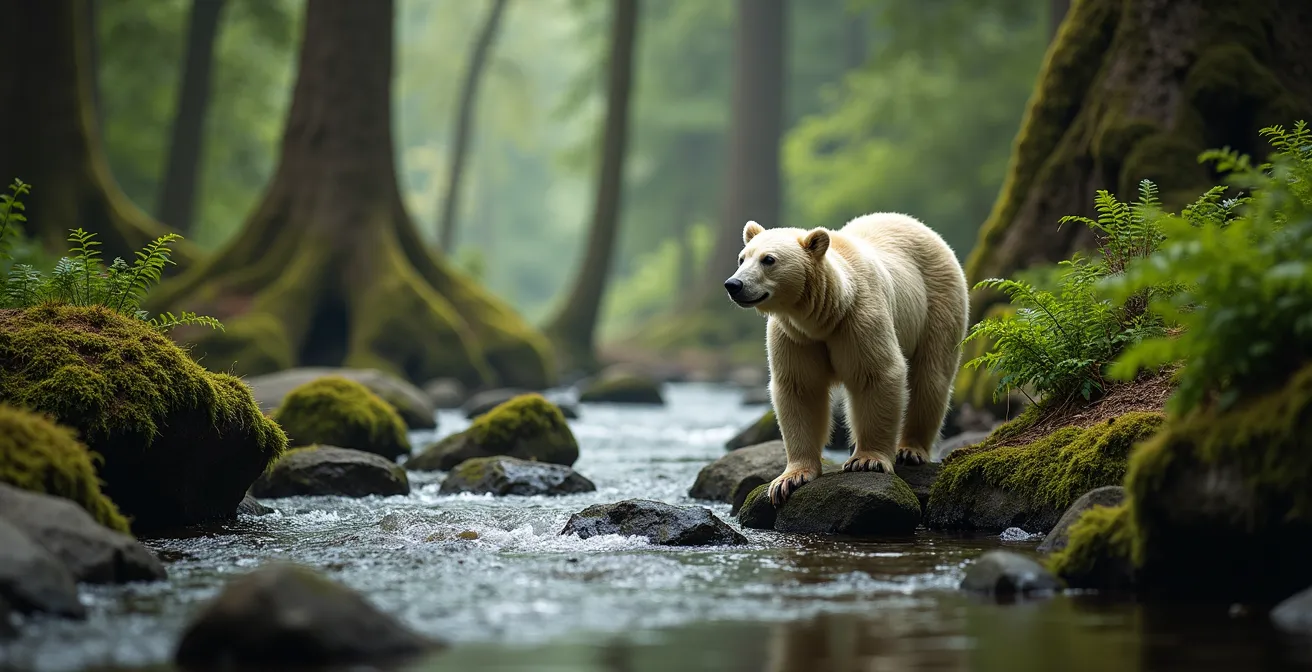
The sight of a Spirit Bear in its natural element is a profound experience, a reward for meticulous planning and patience. This rare animal is a powerful symbol of the wild, and seeing one is a privilege, not a guarantee.
The Communication Error That Strands Hikers in Remote BC Areas
The single most dangerous assumption people make when coming to the Great Bear Rainforest is about communication. Let’s be unequivocal: this is a complete connectivity black hole. There are no cell towers. Your phone is a camera and a GPS device, nothing more. As one travel safety expert bluntly put it, “The Great Bear Rainforest is a complete cellular black hole.” Ignoring this reality can, and does, lead to preventable emergencies.
The critical error is not just the lack of a satellite device, but the lack of a communication *strategy*. Simply carrying a one-way Personal Locator Beacon (PLB) or an SOS device is not enough. While essential for a worst-case scenario, it provides no way to de-escalate a situation. What if you’re simply running a few hours late and a worried family member triggers a massive search and rescue operation? What if you need to report a minor, non-life-threatening injury and get advice?
This is why a two-way satellite communicator (like a Garmin inReach or ZOLEO) is the standard for anyone venturing beyond a guided tour. It allows you to send and receive text messages, get weather updates, and declare an SOS if needed. But the device is only one part of the plan. You must create a detailed trip plan and leave it with a reliable contact. This person is your lifeline to the outside world, and they need to know your exact route, your gear, and your check-in schedule. If you miss a check-in, they know who to call: the RCMP or the Joint Rescue Coordination Centre (JRCC) in Victoria.
Your Non-Negotiable Communication Plan
- Create a detailed trip plan with exact route, gear list, and a strict check-in schedule (e.g., “every evening at 7 PM PST”).
- Leave this plan with a reliable contact who has the emergency numbers for the local RCMP detachment and JRCC Victoria.
- Choose a two-way satellite communicator (like a Garmin inReach or ZOLEO) over a one-way SOS device for flexible communication.
- Activate your subscription and test the device in an open area at home *before* you leave a major centre like Vancouver.
- Pre-load offline maps onto your phone and sync your emergency contacts to your satellite device before you lose service.
How to Hike Rainforest Trails Without Damaging Ancient Moss Beds
Walking through this rainforest is like stepping back in time. It is the traditional, unceded territory of more than seventeen First Nations, some of whom have inhabited these lands for over 14,000 years. Through landmark agreements, these Nations now play a central role in the stewardship and conservation of their ancestral lands, with programs like the Coastal Guardian Watchmen monitoring ecosystem health. This isn’t just a park; it’s a living cultural landscape. Your presence here is as a guest, and that requires a deep commitment to ecological integrity.
The ground beneath your feet is a complex, fragile community. The thick, green carpets of moss can be hundreds of years old. A single errant footstep can crush them, creating a scar that takes decades, or even centuries, to heal. This is why trail etiquette here is so strict. You must stay on designated trails or boardwalks at all times. If a trail is muddy, you walk through the mud. Widening the trail to avoid a puddle causes irreparable damage to the sensitive root systems and moss beds alongside it.
If you are on a route that requires some off-trail travel with a guide, you learn to walk only on durable surfaces: exposed rock, large roots, and downed logs. You use trekking poles with rubber tips, never the carbide spikes that puncture the forest floor. Every piece of infrastructure, from a simple boardwalk to a tent pad, is there for a critical reason: to concentrate human impact and protect the vast, delicate ecosystem around it.
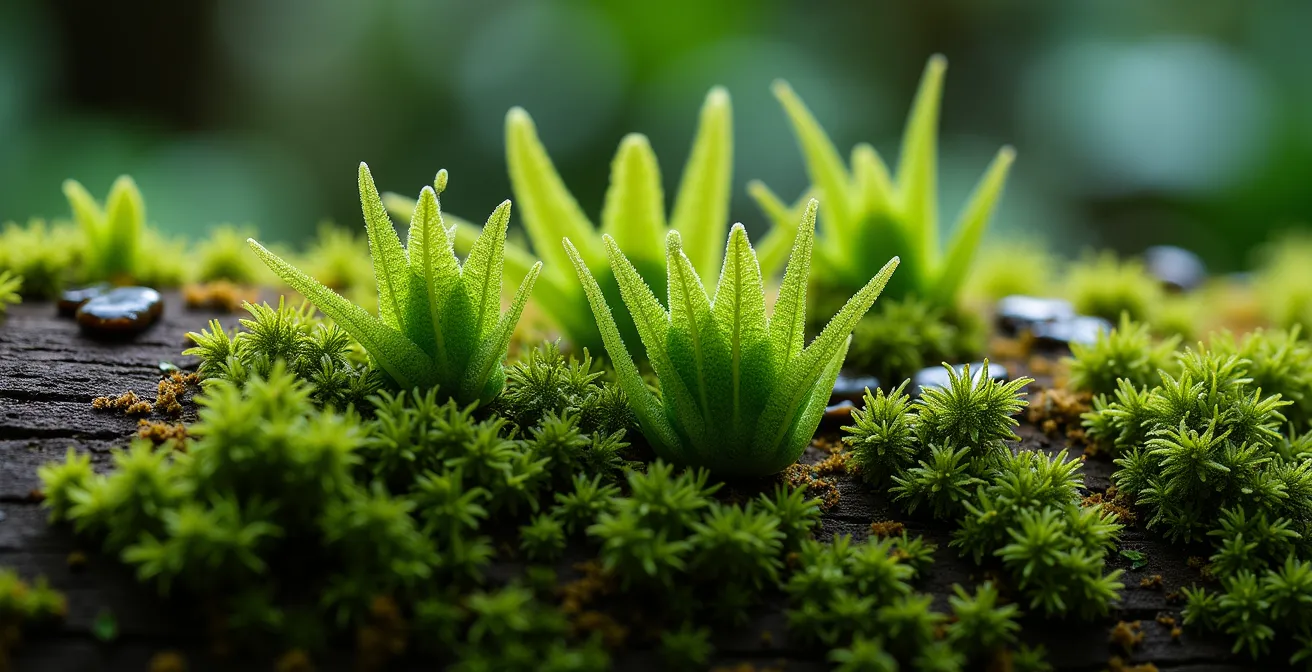
This isn’t about following rules for their own sake. It’s about a fundamental respect for a place where life operates on a different timescale. Showing this respect is the most important way to honour the First Nations who have stewarded this land for millennia.
Why Dead Trees Are More Important Than Live Ones in the Rainforest
In most forests, a dead, fallen tree is seen as decay. In the coastal temperate rainforest, it’s the opposite: a dead tree is a cradle of new life. These fallen giants are called “nurse logs,” and they are one of the most vital components of the entire ecosystem. They are the reason this landscape is so incredibly lush and productive. In fact, Parks Canada identifies the coastal temperate rainforest as one of the highest biomass-producing communities on Earth.
The forest floor is dark, competitive, and often waterlogged. For a tiny seed to germinate, it needs a fighting chance. A nurse log provides the perfect platform. Elevated above the damp ground, it offers sunlight and a direct substrate to root into. As the log slowly decomposes over hundreds of years, it becomes a reservoir of moisture and nutrients, feeding the seedlings that grow upon it. You can often see a perfectly straight line of mature trees in the forest, and if you look at their base, you’ll find the last remnants of the massive nurse log they all started their lives on.
These logs are also critical wildlife habitat. They provide shelter for small mammals, a hunting ground for martens, and a home for countless species of insects, fungi, and salamanders. The sheer mass of organic matter—some alive, some dead, some being recycled—is staggering. Nothing is wasted. This constant, slow-motion cycle of death, decay, and rebirth is the engine that powers the rainforest. Recognizing the life in a dead tree is a profound shift in perspective, and it’s key to understanding the deep interconnectedness of this ecosystem.
Why Your Rec Kayak Will Sink in Tofino’s Ocean Swell
The protected inlets and channels of the Great Bear Rainforest look like a sea kayaker’s paradise. And they are—if you have the right equipment and experience. But the waters here are powerful, cold, and unforgiving. A common mistake is assuming that the kayak you use on a calm lake or in a sheltered harbour like Tofino is suitable for an expedition on the central coast. That assumption can be fatal. As one marine safety analysis noted, “The GBR’s remoteness amplifies risk by 10x compared to Tofino due to extreme tides and lack of immediate rescue.”
Your typical recreational kayak, the kind with a large open cockpit, has a critical design flaw for these conditions: it has no sealed bulkheads. Bulkheads are interior walls that create watertight compartments in the bow and stern. If you capsize in a proper sea kayak, these compartments keep the boat afloat, allowing you to perform a self-rescue. If you capsize a recreational kayak in open water, it will fill with water and sink like a stone.
Furthermore, the dynamic conditions of the coast—strong tidal currents, high winds, and unpredictable ocean swell—require a specific type of boat. A proper sea kayak must have a spray skirt to keep waves out of the cockpit and a rudder or skeg for steering and control in crosswinds. Attempting to paddle here without this specific equipment and expedition-level experience is reckless. This is why unguided kayaking is only for true experts. For everyone else, the only safe way to experience these waters is with a qualified local guide, especially Indigenous guides whose families have navigated these channels for generations. They possess a knowledge of the tides, currents, and weather that can’t be learned from a map.
Key takeaways
- Success in the Great Bear Rainforest is about adapting to the environment, not overpowering it.
- Plan for systemic dampness, not just rain, with a vented, multi-layered gear system and dry bags.
- The region is a connectivity black hole; a two-way satellite communication strategy is a non-negotiable lifeline.
- Respect for the fragile ecosystem and the First Nations who steward it is the foundation of a meaningful visit.
Whale Watching in Canada: How to Pick the Right Season and Spot
The Great Bear Sea is as rich with life as the forest. It’s a critical habitat and migratory route for several species of whales, and watching them is an unforgettable part of any trip. Just like with land animals, successful whale watching is about aligning your visit with the wildlife calendar. Different species are present at different times, engaging in specific behaviours.
Humpback whales are the stars of the summer. They arrive in May to feed in these nutrient-rich waters and stay through September. In the late summer and early fall, you might be lucky enough to witness the incredible phenomenon of bubble-net feeding, where groups of humpbacks work together to corral fish. From March to April, the focus is on Grey whales as they pass through on their epic northbound migration from Baja California to the Arctic. Orcas, both resident fish-eaters and transient mammal-hunters, can be seen year-round, though sightings are always a matter of chance. Knowing this calendar helps you set realistic expectations for your trip.
As a guest in this marine environment, you also have a responsibility. The recovering populations of these magnificent animals are protected. Canada has strict marine mammal viewing regulations, managed by the Department of Fisheries and Oceans (DFO). For most whale species, including humpbacks, boats must maintain a minimum distance of 100 metres. For orcas in certain protected areas of BC, that distance increases to 200 metres. Reputable tour operators know and respect these rules. Choosing a certified operator ensures you are contributing to a sustainable tourism model that protects the very animals you’ve come to see.
This calendar, based on information from Indigenous Tourism BC, provides a general guide:
| Season | Whale Species | Activity |
|---|---|---|
| March-April | Grey Whales | Northbound spring migration |
| May-September | Humpback Whales | Summer residency |
| Late Summer/Fall | Humpbacks | Bubble-net feeding phenomenon |
| Year-round | Orcas | Resident and transient pods |
| Occasional | Fin & Minke | Less common sightings |
Your journey to the Great Bear Rainforest begins long before you step on a floatplane. It starts with this kind of planning—with respecting the power of the place and preparing accordingly. By understanding the systems at play, you can move from being a simple tourist to being a mindful and appreciative guest in one of the last truly wild places on Earth.