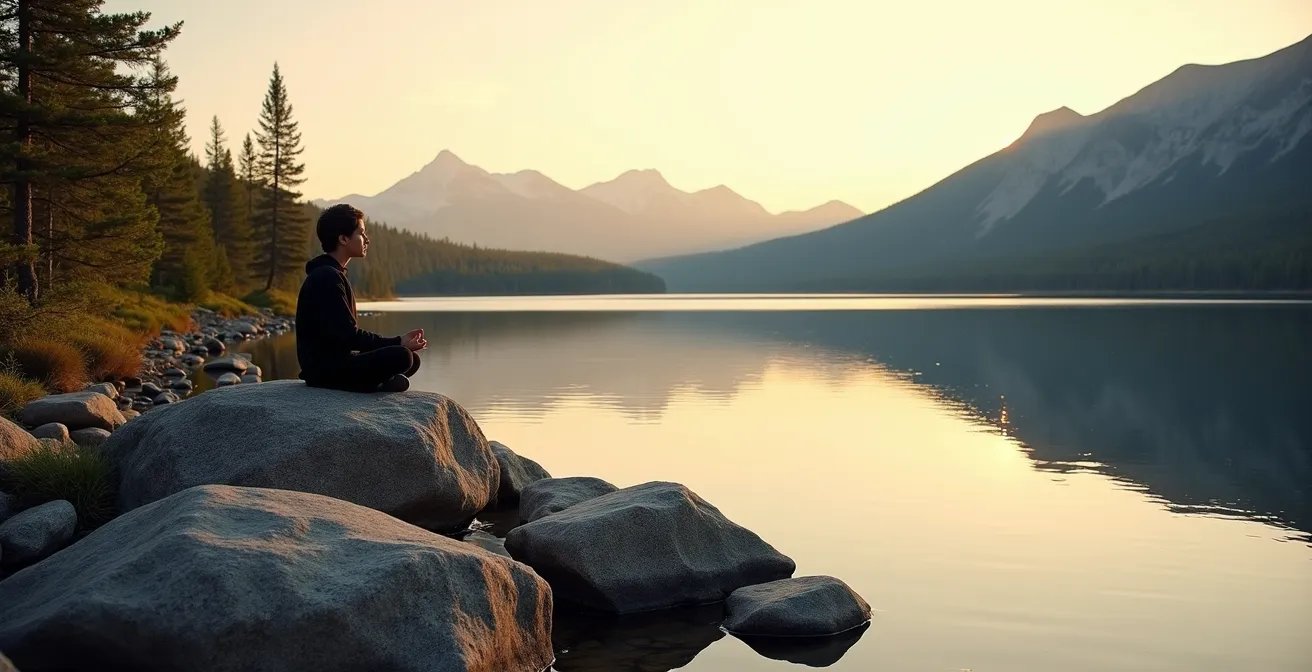
Contrary to popular belief, simply visiting Canada’s beautiful landscapes is not enough to heal urban burnout; true mental and spiritual renewal comes from intentional, mindful practices that foster a deep, reciprocal connection with the wilderness.
- Forest bathing (Shinrin-Yoku) and stargazing are not passive activities but structured practices that reduce stress and inspire awe.
- Disconnecting in an off-grid cabin resets your body’s natural rhythms, while creative observation connects you to the land on an artistic level.
Recommendation: Instead of planning a trip around what you will see, plan it around how you will engage your senses and mindfully participate in the landscape.
The hum of the city lingers long after you’ve left it behind—a low-frequency stress that settles deep in your bones. For many stressed urbanites, the standard prescription is a “getaway,” a trip to see mountains or forests, as if the mere sight of nature is a cure. We book flights, drive for hours, and stand at scenic lookouts, phone in hand, capturing proof of our escape. Yet, we often return feeling just as depleted, the solace we sought as fleeting as a photograph.
The common advice—to “disconnect” or “get some fresh air”—misses the point. These are passive acts. True healing doesn’t happen by simply being *in* nature, but by being *with* it. It’s an active, intentional process. What if the key wasn’t the destination itself, but the mindset you bring to it? What if the path to rejuvenation lies not in sightseeing, but in a series of specific, mindful practices that transform the wilderness from a beautiful backdrop into an active partner in your well-being?
This guide moves beyond the postcard views to explore the profound “how” of natural healing. We will delve into ancient practices adapted for Canada’s unique ecosystems, from the boreal forests of Ontario to the sacred groves of British Columbia. This is your invitation to trade passive observation for intentional immersion and find a more lasting form of peace.
This article provides a roadmap for transforming your relationship with the Canadian wilderness. Each section offers a specific practice or perspective to help you move from a mere visitor to a mindful participant, unlocking the deep, restorative power of nature.
Summary: A Journey into Canada’s Healing Landscapes
- How to Practice Shinrin-Yoku in Ontario’s Boreal Forests
- The Mental Health Benefits of Stargazing in Jasper’s Dark Sky Preserve
- Why an Off-Grid Cabin Stay in Quebec Can Reset Your Circadian Rhythm
- Chasing the Light: Visiting the Landscapes That Inspired Canada’s Painters
- The Safety of Solo Female Hiking on Well-Trafficked Canadian Trails
- Why Dead Trees Are More Important Than Live Ones in the Rainforest
- How to Hike Rainforest Trails Without Damaging Ancient Moss Beds
- Visiting Cathedral Grove: How to Avoid Crowds and Respect the Roots
How to Practice Shinrin-Yoku in Ontario’s Boreal Forests
Shinrin-Yoku, or “forest bathing,” is more than just a walk in the woods. It is the conscious and contemplative practice of being immersed in the sights, sounds, and smells of the forest. Originating in Japan, this practice is a cornerstone of preventive health and healing. The goal is not to hike for miles, but to slow down and connect with nature through all five senses. It’s about finding a reciprocal connection, where the forest is not a gym, but a therapist. The boreal forests of Ontario, with their dense canopies of pine, spruce, and fir, are a perfect setting for this intentional immersion.
The air here is rich with phytoncides, aromatic compounds released by trees that have been shown to boost immune function and reduce stress hormones. The practice is simple: find a trail, turn off your phone, and begin to walk slowly. Pause frequently. Notice the texture of bark, the pattern of light filtering through the leaves, the scent of damp earth. Scientific research backs up the profound benefits; a landmark study found that individuals who spent at least 120 minutes per week in nature reported significantly better health and psychological well-being.
To fully embrace Shinrin-Yoku, adapt your practice to the seasons. In spring, focus on the scent of the thawing ground and newly opened buds. Summer is the time to engage with the peak release of phytoncides from White Pine and Balsam Fir, ideally during a quiet dawn session. In autumn, let your senses feast on the vibrant colours and the crisp sound of falling leaves. Even winter offers a unique experience: practice “snow silence” meditation and feel the quiet, dormant energy of the trees through your gloved hands. It’s about being present with what the forest offers in each moment.
By shifting your focus from distance covered to sensory details absorbed, you transform a simple walk into a powerful healing ritual.
The Mental Health Benefits of Stargazing in Jasper’s Dark Sky Preserve
In our light-polluted urban lives, we have forgotten the profound and humbling power of a truly dark night sky. Jasper National Park, an 11,000-square-kilometre sanctuary for darkness, offers a powerful antidote. As one of the world’s largest and most accessible Dark Sky Preserves, it provides a unique opportunity for mental and spiritual rejuvenation. Stargazing here is not just an astronomical curiosity; it’s a therapeutic experience that triggers the “awe effect”—the feeling of being in the presence of something vast that transcends your understanding of the world.
This experience of awe has been shown to reduce anxiety, decrease rumination, and foster a greater sense of connection to others and the world at large. The sheer scale of the Milky Way, visible with the naked eye in Jasper, can shrink your worries and shift your perspective in a way few other experiences can. It’s a form of landscape therapy that uses the cosmos as its mirror.

As the image above suggests, the experience is deeply personal and meditative. The annual Jasper Dark Sky Festival further deepens this connection by weaving in cultural and spiritual dimensions. Visitors can listen to Cree and Stoney Nakoda star stories, learning how Indigenous peoples have navigated and understood the cosmos for millennia. This adds a layer of human history and wisdom to the silent spectacle above, transforming it from a collection of stars into a tapestry of stories and meaning.
Ultimately, gazing into the depths of the universe in a place like Jasper reminds you of your place within a vast, interconnected system, offering a sense of peace and belonging that is difficult to find elsewhere.
Why an Off-Grid Cabin Stay in Quebec Can Reset Your Circadian Rhythm
The modern world runs on an artificial clock, governed by screens, deadlines, and the blue light that disrupts our natural sleep-wake cycles. An off-grid cabin stay, particularly in the quiet wilderness of Quebec, offers a radical solution: surrendering to the sun. By removing artificial light and digital distractions, you allow your body to recalibrate its circadian rhythm, the internal 24-hour clock that governs everything from sleep and mood to metabolism. This isn’t just a vacation; it’s a biological reset.
The process is grounded in simple, powerful environmental cues. Waking with the natural light of dawn, spending your days outdoors, and letting your evenings be lit by fire or candlelight sends clear signals to your brain. Morning sunlight exposure, in particular, helps to suppress melatonin and anchor your body’s clock for the day ahead. As dusk falls and you retreat into the warm, analog glow of a cabin, your brain naturally begins producing melatonin, preparing you for a deep, restorative sleep. This sensory anchoring to the cycles of day and night is something a city apartment can never replicate.
To make this reset truly effective, it requires a commitment to a full digital detox. Resisting the urge to check your phone allows your mind to quiet down and become more attuned to the subtle rhythms of the natural world around you. This is an opportunity to rediscover analog pleasures: the focus required for fire-making, the simple satisfaction of cooking on cast iron, or the lost art of evening storytelling.
Your Digital Detox Protocol for a Cabin Retreat
- Pre-Arrival Phase: In the week leading up to your trip, gradually reduce daily screen time and set your phone to grayscale mode to lessen its stimulating appeal.
- Initial Immersion (Days 1-2): Upon arrival, store all electronic devices in a designated drawer. Use an analog clock and ensure you get direct morning sunlight within 30 minutes of waking.
- Establishing Natural Rhythms (Days 3-4): Structure your days around natural light. Engage in outdoor activities during peak daylight hours and embrace candlelit evenings after sunset.
- Deepening the Connection (Days 5-7): Incorporate traditional cabin activities like building a fire, reading a physical book, or simply listening to the sounds of the night.
- Post-Return Integration: To maintain the benefits, continue the habit of morning sun exposure and implement a “sunset shutdown” for your devices in the evening.
By intentionally aligning your daily life with the rising and setting of the sun, you don’t just get a better night’s sleep—you restore a fundamental connection to the planet’s rhythm.
Chasing the Light: Visiting the Landscapes That Inspired Canada’s Painters
Canada’s wilderness has not only shaped its identity but also its art. The dramatic landscapes that captivated the Group of Seven and Tom Thomson are not just historical sites; they are living galleries that offer a unique pathway to a deeper connection with nature. To “chase the light” as they did is to engage in a form of active observation, transforming a passive gaze into a dynamic, creative, and healing practice. It’s about seeing the landscape not just as a whole, but as a composition of light, colour, texture, and form.
Algonquin Park, for example, is forever intertwined with the legacy and mystery of Tom Thomson. Paddling the same canoe routes he traveled, you can begin to see the world through his eyes. Instead of simply noting a “beautiful sunset,” you might observe how the fading light turns the water from sapphire to liquid gold, or how the stark silhouette of a jack pine creates a powerful focal point against the sky. This practice of deconstructing a scene into its artistic elements quiets the analytical mind and awakens a more intuitive, sensory part of your brain.
This artistic pilgrimage is a powerful form of mindfulness. It forces you to be intensely present and observant. Parks Canada has even begun to recognize this synergy, promoting artistic journeys as part of their national wellness initiatives. They understand that connecting with these landscapes through a creative lens fosters a profound sense of place and stewardship. Tom Thomson’s work and his mysterious end in Algonquin Park serve as a metaphor for the wilderness itself—a source of immense beauty and inspiration, but also a powerful force that demands respect and humility.
Visiting these iconic locations becomes less about recreating a famous painting and more about participating in the same creative process, finding your own personal expression in the light and shadow of the Canadian Shield.
The Safety of Solo Female Hiking on Well-Trafficked Canadian Trails
The call of the wild can be a powerful force for healing, yet for many women, the idea of hiking alone is fraught with apprehension. However, the narrative around solo female hiking is shifting from one of fear to one of empowerment. On Canada’s well-trafficked and well-maintained trails, hiking alone is not only a reasonably safe endeavor but also a profoundly transformative one. It offers a unique opportunity for self-reliance and quiet introspection, allowing for an unfiltered, personal connection with the landscape that is often diluted in a group setting.
The key to a safe and rewarding solo journey lies in preparation and knowledge. Canada’s vast network of national and provincial parks offers an excellent infrastructure for solo hikers. Start with popular, well-marked trails like those on the Bruce Trail in Ontario or around Lake Louise in Alberta. The presence of other hikers provides a passive safety net without intruding on your solitude. The growing recognition of nature’s therapeutic benefits is clear; the PaRx program, Canada’s national nature prescription initiative, now reports that over 11,000 licensed healthcare providers are prescribing time in nature to their patients, underscoring its importance for well-being.

Empowerment comes from preparation. Before you go, register your trip plan with a service like AdventureSmart.ca, download offline maps via the Parks Canada app, and consider investing in a satellite messenger like a Garmin InReach for areas without cell service. Importantly, educate yourself on wildlife safety specific to the region—knowing the difference between how to react to a black bear versus a grizzly is crucial. Connecting with online communities like ‘Women Who Explore Canada’ can also provide invaluable, location-specific advice and a sense of solidarity.
By taking these sensible precautions, you can confidently step onto the trail alone, ready to embrace the solitude and strength that comes from navigating the wilderness on your own terms.
Why Dead Trees Are More Important Than Live Ones in the Rainforest
In our tidy, human-centric view of the world, a dead, fallen tree can look like decay or waste. But in the intricate ecosystem of a temperate rainforest, such as those on Canada’s West Coast, a dead tree is a vibrant epicenter of life. Understanding the role of this “coarse woody debris” is a profound lesson in ecological wisdom and a shift in perspective. It teaches us that health and vitality in nature do not always look the way we expect. A standing dead tree, or “snag,” and a fallen “nurse log” are arguably more critical to the forest’s long-term health than many of their living counterparts.
A snag is a condominium for the forest. Woodpeckers excavate cavities for nests, which are later used by dozens of other species, from owls and squirrels to small mammals. Insects burrow into the decaying wood, providing a crucial food source for birds. When the tree finally falls, its work is far from over. As a nurse log, it becomes a cradle for new life. Its slowly decomposing wood acts like a sponge, holding moisture through dry summer months and releasing a steady stream of nutrients that the forest floor, often thin and leached by heavy rains, cannot provide on its own.
Walk through the rainforests of Vancouver Island and you will see it everywhere: perfectly straight lines of towering hemlock and spruce trees, their roots still straddling the ghost of the giant log that gave them their start centuries ago. These fallen giants are the foundation of the next generation. Recognizing their importance requires us to let go of our aesthetic biases and see the forest as a complete, cyclical system where death is inextricably linked to birth. This understanding fosters a deeper respect and a sense of reciprocity.
You want to protect what you love.
– Dr. Melissa Lem, Director of PaRx, Canada’s nature prescription program
By learning to see the beauty and function in decay, we move closer to understanding the true, untamed intelligence of the wild.
How to Hike Rainforest Trails Without Damaging Ancient Moss Beds
The lush, green carpet of a West Coast rainforest floor feels magical, a soft, ancient blanket covering rocks and roots. But this vibrant moss is a delicate and ancient community. A single footstep can crush centuries of slow, patient growth and damage the fragile cryptobiotic crust and underlying mycelial networks that form the forest’s foundation. Hiking with consciousness in these sensitive environments is not just about “Leave No Trace”; it’s about actively practicing a form of reverence and care.
The first principle is to stay on the trail. This seems obvious, but the temptation to step around a puddle or get a better photo can cause irreversible damage. Trail widening is one of the biggest threats to these ecosystems. Walking single-file, directly through the middle of the path—even when it’s muddy—is a critical act of preservation. Before a hike, take a moment to visualize the vast, hidden network of mycelium beneath your feet, the “wood-wide web” that connects the trees and transfers nutrients. This simple mental exercise can transform your hike from a recreational activity into a mindful passage through a sacred space.
Using trekking poles with rubber tips can help distribute your weight and prevent piercing the delicate moss beds beside the trail. If you must venture off-trail for a specific reason, do so with extreme care. Follow durable surfaces only, such as exposed rock slabs or large, dry roots. This is not about limiting your experience, but about deepening it. It’s an invitation to move through the world with more awareness, noticing the intricate details of the life you are protecting with every carefully placed step.
By adopting these conscious hiking techniques, you honor the ancient life of the forest and ensure that its magic remains for generations to come.
Key Takeaways
- True healing in nature stems from intentional practice, not passive sightseeing.
- Engaging all your senses through practices like Shinrin-Yoku and stargazing fosters a deep, perspective-shifting connection.
- Respecting nature as a living entity, by hiking consciously and understanding its cycles, transforms your relationship with the wild from consumptive to reciprocal.
Visiting Cathedral Grove: How to Avoid Crowds and Respect the Roots
Cathedral Grove in MacMillan Provincial Park is a place of pilgrimage. To stand among its 800-year-old Douglas Firs is to feel a sense of profound awe and humility. Yet, its popularity presents a challenge: how do you experience its sacred tranquility amidst the crowds, and how do you ensure your visit honours, rather than harms, this ancient place? The answer lies in a blend of strategic timing and a shift in mindset, moving from a tourist to a respectful guest.
For Coast Salish peoples, this grove is a sacred site, a living relative. Park management is increasingly incorporating this Indigenous perspective, moving beyond “Leave No Trace” to the concept of “Ethical Space.” This framework asks us to recognize the grove’s inherent right to exist and flourish, independent of its value to us. Our role is not just to avoid leaving garbage, but to move with a quiet reverence that minimizes our impact on the shallow root systems and the delicate forest floor. This means staying on the boardwalks at all times and resisting the urge to climb on the fallen giants.
To find the solitude the grove deserves, timing is everything. The peak tourist rush is typically from 11 a.m. to 3 p.m. Instead, plan your visit for the “golden hour”—the first hour after sunrise. In this soft light, with few others around, you can truly feel the cathedral-like atmosphere. Practice a “listening meditation,” closing your eyes for ten minutes and trying to distinguish the different natural sounds. Another option is the “blue hour” at twilight, especially in the shoulder seasons (spring and fall), when the mystical atmosphere is heightened and the crowds have long since departed.
By approaching your visit with this blend of practical strategy and deep respect, you do more than just see Cathedral Grove—you participate in its preservation and connect with its ancient, living spirit. Start planning your next journey not as an escape, but as an intentional return to yourself through the wild heart of Canada.