True support for Indigenous tourism goes beyond good intentions; it requires actively choosing experiences and products that directly empower communities and respect their sovereignty.
- Differentiate between “Indigenous-owned” and “Indigenous-themed” to prevent economic leakage from communities.
- Learn and follow cultural protocols, especially when invited as a guest to significant events like Powwows.
- Reframe your visit to colonial sites by actively seeking out the Indigenous stories they often erase or ignore.
Recommendation: Before booking any tour or buying art, verify the business’s ownership and accreditation through the Indigenous Tourism Association of Canada (ITAC).
The desire for authentic connection is a powerful motivator for travel. In Canada, this often translates into a keen interest in the vibrant, diverse, and deeply rooted cultures of First Nations, Métis, and Inuit peoples. In fact, research from Destination Canada shows that one in three international visitors expressed interest in Indigenous tourism. Yet, this desire is frequently paired with a significant fear: the fear of being disrespectful, of causing unintentional harm, or of falling for an inauthentic “tourist trap.” Many travellers stick to well-meaning but vague advice like “be respectful” or “buy local,” which offers little practical guidance.
This guide is built on a different premise. Meaningful support for Indigenous tourism isn’t about passively consuming culture from a distance; it’s about actively shifting your mindset from that of a consumer to that of a respectful guest and ally. It’s about understanding the crucial difference between authentic participation that fosters a reciprocal relationship and observation that can perpetuate harmful stereotypes. This involves recognizing the right of Indigenous Peoples to tell their own stories—what is often called narrative sovereignty—and making conscious choices that ensure the economic and cultural benefits flow back to the communities themselves. It’s also important to acknowledge the diversity of Indigenous Peoples in Canada, who comprise three distinct groups: First Nations, with diverse cultures and over 50 language families; Inuit, the Indigenous Peoples of the Arctic; and Métis, who have a unique mixed ancestry and culture.
Throughout this article, we will explore the practical steps you can take to engage responsibly. We will unpack the real-world impact of your choices, from the souvenirs you buy to the tours you book, providing you with the tools to move beyond uncertainty and toward a more profound and ethical travel experience. This is your opportunity to not just see Canada, but to connect with it on a deeper level.
Summary: A Traveller’s Guide to Respectfully Supporting Indigenous Tourism in Canada
- Why Buying “Native-Style” Souvenirs Can Hurt Local Communities
- How to Visit a Powwow as a Guest: 5 Etiquette Rules to Follow
- Indigenous-Owned vs. Indigenous-Themed: Which Operator Benefits the Community?
- The Historical Myth About “Totem Poles” That Many Tourists Believe
- When to Visit Canada for the Best Indigenous Cultural Festivals
- How to Interpret Colonial Statues in the Era of Reconciliation
- Why an Elder-Led Aurora Tour Offers a Deeper Connection
- Exploring Colonial Heritage Sites: A Critical Look at History
Why Buying “Native-Style” Souvenirs Can Hurt Local Communities
Walking through a tourist shop, it’s easy to be drawn to a colourful “Native-style” dreamcatcher or a mass-produced “totem pole” carving. They seem like a tangible connection to the culture you’ve come to experience. However, these items are often the face of cultural appropriation and cause significant harm. When you purchase an inauthentic, mass-produced souvenir, the money rarely, if ever, reaches the Indigenous artists or communities whose designs were copied. This phenomenon, known as economic leakage, diverts essential income away from the creators and into the pockets of non-Indigenous businesses.
The damage isn’t just financial. It contributes to cultural dilution, where sacred designs and stories are stripped of their meaning and turned into generic trinkets. This misrepresents and devalues the rich, living traditions they are meant to symbolize. For many Indigenous communities, tourism is a vital economic driver, but it is incredibly vulnerable. For example, some projections warned of a potential 70% drop in US tourist bookings for some operators, highlighting how crucial every dollar spent on authentic goods is. Choosing authentic art is a direct investment in cultural preservation and economic self-determination. It ensures artists are fairly compensated and empowered to continue their craft, passing down skills and stories to the next generation.
Your Action Plan: How to Identify Authentic Indigenous Art
- Look for the ‘The Original Original’ mark, a seal from the Indigenous Tourism Association of Canada (ITAC) certifying at least 51% Indigenous ownership.
- Check for the artist’s name and their specific Nation or community affiliation, which should be clearly marked on the item or its tag.
- For Inuit art, verify the presence of the Igloo Tag, which certifies the piece as authentic and handmade by an Inuit artist.
- Don’t be afraid to ask vendors directly about the artist, their story, and the origin of the piece. Authentic sellers are proud to share this information.
- Before you shop, confirm if a business is ITAC-accredited by checking their official online registry of recommended businesses.
How to Visit a Powwow as a Guest: 5 Etiquette Rules to Follow
A Powwow is a vibrant and powerful celebration of Indigenous culture, filled with drumming, singing, and dancing. Being invited to attend as a guest is a profound honour and an incredible opportunity to witness a living tradition. However, it’s crucial to remember that you are entering a sacred space, not a performance. Adopting a guest-ally mindset means showing deep respect for the protocols that govern the event. The most important person to pay attention to is the Master of Ceremonies (MC), who acts as the host and guide for the entire event, announcing the songs, dances, and what is expected of visitors.
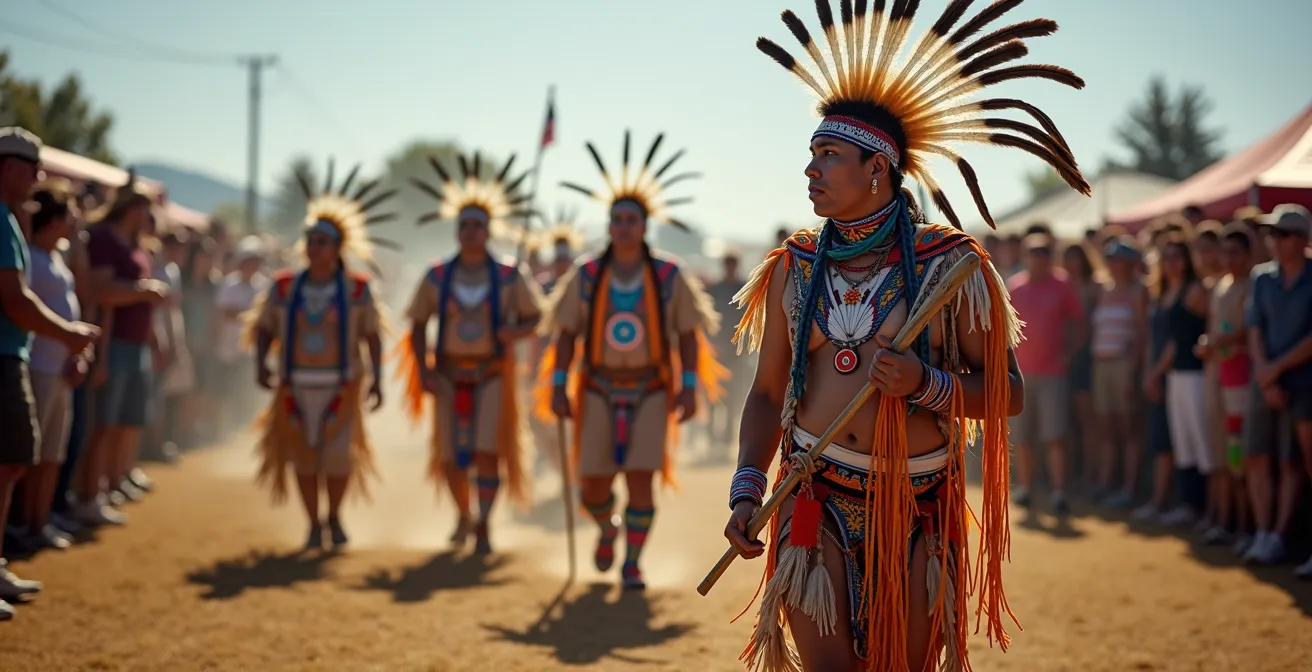
The clothing worn by dancers, known as regalia, is not a costume. Each piece is spiritually significant, often handmade over many years, and holds personal and family stories. Never touch a dancer’s regalia. Similarly, photography rules vary; the MC will announce when it is appropriate to take photos or videos. Certain ceremonies, like the Grand Entry, are moments of deep reverence. Here are five essential rules to follow:
- Listen to the MC: They are your guide. They will tell you when to stand, when to sit, when you can take photos, and when it’s appropriate for guests to dance.
- Regalia is Sacred: Never touch a dancer or their regalia. These items are deeply personal and spiritually significant.
- Stand in Respect: Always stand and remove your hat during the Grand Entry, Flag Songs, Veterans Songs, and any Memorial or Prayer Songs.
- Dance Only When Invited: The MC will announce “Intertribal” songs, which are open to everyone. This is the only time guests should enter the dance arena, unless specifically invited otherwise.
- Respect the Circle: The dance arena is sacred ground. Never walk across it. Always walk clockwise around the outside to get to the other side.
Indigenous-Owned vs. Indigenous-Themed: Which Operator Benefits the Community?
As a conscious traveller, one of the most impactful choices you can make is who you hire for a tour, a stay, or an experience. The marketplace is filled with options, but they fall on a spectrum of authenticity and community benefit. On one end, you have 100% Indigenous-owned businesses, where the economic and cultural control remains firmly within the community. On the other, you have “Indigenous-themed” businesses, which are non-Indigenous owned and profit from cultural motifs without any community involvement or benefit. Choosing the latter contributes directly to economic leakage and perpetuates a colonial model of tourism.
The key is to look for operators where Indigenous people have sovereignty over their own narrative. This means they are the ones deciding which stories to share, how to share them, and how their culture is represented. An Indigenous guide from the local Nation sharing stories passed down through generations offers an experience that is fundamentally different from a non-Indigenous guide reciting facts from a book. To help navigate this, the Indigenous Tourism Association of Canada (ITAC) provides an accreditation program that certifies businesses as being at least 51% Indigenous-owned and meeting quality standards. This serves as a “gold standard” for travellers seeking genuine experiences.
The following table, based on guidelines from organizations like ITAC, breaks down the different types of businesses you might encounter.
| Business Type | Indigenous Involvement | Community Benefit | Recommendation |
|---|---|---|---|
| 100% Indigenous-owned (ITAC certified) | Full ownership & operation by Indigenous peoples | Direct economic & cultural benefits to communities | Gold standard – strongly recommended |
| Indigenous/Non-Indigenous Partnership | Shared ownership with clear Indigenous stake | Partial benefits if partnership terms are equitable | Good if Indigenous partner has significant control |
| Non-Indigenous owned with Indigenous staff | Employment only, no ownership | Limited to wages, no business control | Better than nothing, but seek Indigenous-owned first |
| Indigenous-themed with no involvement | Zero Indigenous participation | Cultural appropriation, economic leakage | Avoid completely |
A Common Myth About ‘Totem Poles’ That Many Tourists Believe
For many visitors to Canada, especially the Pacific Northwest, the image of towering, intricately carved poles is synonymous with Indigenous culture. However, a widespread myth persists: that these are “totem poles” created by all First Nations as objects of worship. This is incorrect on several levels. Firstly, these monumental carvings are specific to a handful of coastal First Nations in British Columbia, such as the Haida, Tsimshian, and Kwakwaka’wakw. They are not a universal Indigenous practice. Secondly, and most importantly, they are not religious idols. They are complex narrative documents, akin to a European coat of arms or a visual library of a family’s history, lineage, rights, and stories.
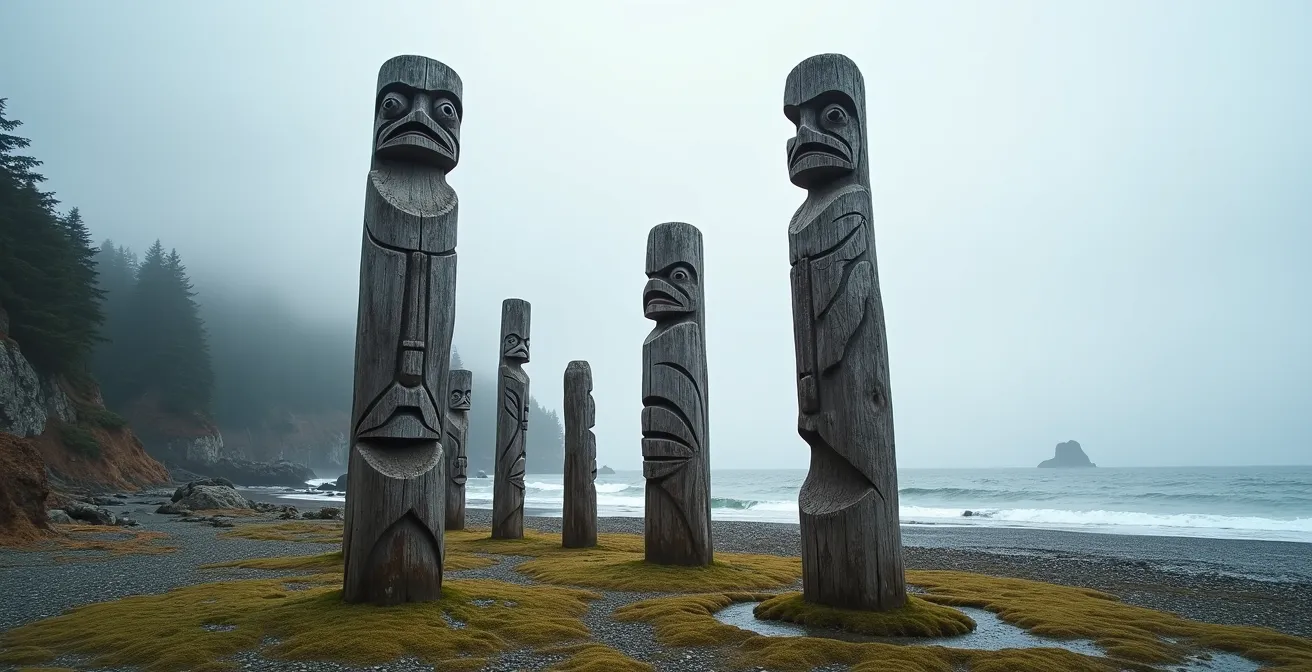
Each figure on a pole represents a character or crest from a story, marking a significant event, a territorial claim, or a connection to the supernatural world. Some are memorial poles honouring a deceased chief, while others are house frontal poles that serve as an entrance and declare the status of the family within. To see them as mere “decorations” or objects of worship is to erase their profound legal, social, and historical significance. Understanding this is a critical step in moving from a superficial glance to a deeper appreciation of the culture.
Case Study: The Living History of SGang Gwaay
SGang Gwaay, a former Haida village on an island in Haida Gwaii, is a UNESCO World Heritage Site that powerfully illustrates the true context of these carvings. After disease devastated the population, many villages were abandoned, and settlers later removed countless cultural items for museum display without consent. SGang Gwaay is unique because it’s one of the only village sites that still has its original carved poles standing where they were raised. Today, when visitors arrive, they are greeted by a Haida Watchman—a guardian from the community—who guides them, explaining the stories carved into the poles and the history of the village, ensuring the narrative is shared with accuracy and respect.
When to Visit Canada for the Best Indigenous Cultural Festivals
Engaging with Indigenous culture through festivals and events offers a dynamic, celebratory, and immersive experience. While many people associate these events with summer, vibrant celebrations happen year-round across Canada, each reflecting the unique traditions and environment of the host Nations. Timing your visit to coincide with a public festival can provide a unique window into contemporary Indigenous life. However, it’s crucial to always check official sources before you go. Some ceremonies are private and for community members only, and respecting that privacy is paramount.
From the large, open-air Powwows on the Prairies to film festivals in major cities, the calendar is rich with opportunities. A seasonal approach can help guide your travel planning. This allows you to connect with events that are deeply tied to the land and the time of year, offering a more authentic glimpse into the cultural rhythm of the region you are visiting. The key is to plan ahead, confirm that an event is open to the public, and arrive with an open heart and a willingness to learn and participate respectfully when invited.
A Seasonal Guide to Indigenous Festivals Across Canada
- Summer (June-August): This is peak season for large gatherings, especially the Prairie Powwows in Saskatchewan and Alberta, which draw dancers and drum groups from across North America. In the Yukon, the Adäka Cultural Festival in July is a highlight.
- Fall (September-October): In the Atlantic provinces, this is a time for reflection and education, with many events held during Mi’kmaq History Month in October. In Toronto, the imagineNATIVE Film + Media Arts Festival showcases global Indigenous-made screen content.
- Winter (December-February): In the Northwest Territories, this season offers unique experiences like traditional Dene Hand Games tournaments, often paired with unforgettable aurora viewing tours led by local Indigenous guides.
- Spring (March-May): On the West Coast, spring is a time of renewal, and you may find opportunities to visit Coastal First Nations gatherings or cultural centres as they prepare for the coming season.
- Before You Go: Always check the event’s official website or community page to confirm dates, locations, and whether the public is welcome. Respecting ceremonial privacy is key.
How to Interpret Colonial Statues in the Era of Reconciliation
As you travel through Canadian towns and cities, you will inevitably encounter colonial statues and monuments—figures of explorers, politicians, and soldiers celebrated as founders and heroes. In the era of Truth and Reconciliation, however, the presence of these statues is deeply contested. For many Indigenous Peoples, these figures represent not heroism, but the architects of devastating policies, land theft, and cultural genocide. To view them without this critical lens is to accept a one-sided and often false version of history. A respectful traveller must learn to ask: Whose story is being told here, and whose is being silenced?
Interpreting these sites involves an active process of “unlearning.” Instead of simply reading the plaque, seek out the counter-narrative. Use an app like ‘Whose Land’ to identify the traditional territory you are on. Visit a local Indigenous-run museum or cultural centre to hear the history from the perspective of the people who were there long before the statue was erected. This approach transforms a passive sightseeing moment into an act of solidarity and education. It’s about recognizing that history is not a static object cast in bronze, but a living, contested story with multiple truths.
This contrasts sharply with the experience of authentic Indigenous tourism, which is about shared participation rather than one-sided observation. As Indigenous tourism operator Erkloo explained to National Geographic:
Visitors aren’t just watching from the outside—they’re part of the community for that moment. That’s very different from traditional tourism. It’s shared, and it’s real.
– Erkloo, National Geographic on Indigenous Tourism in Canada
Why an Elder-Led Aurora Tour Offers a Deeper Connection
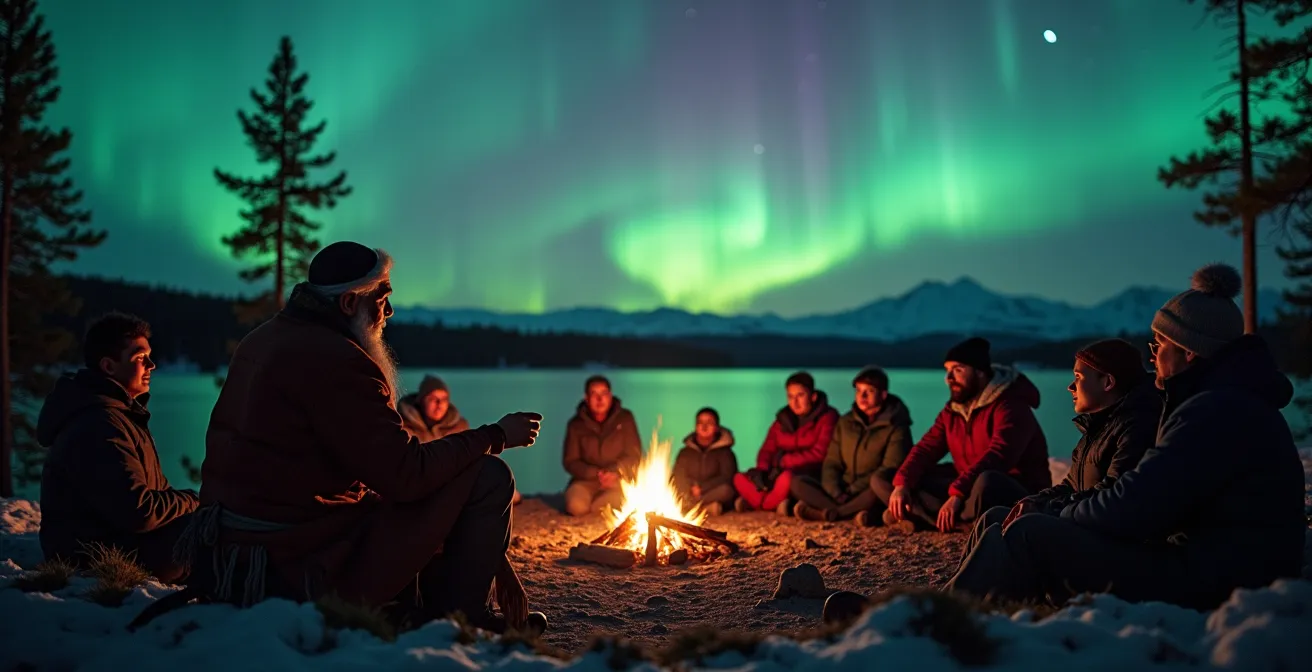
Seeing the Aurora Borealis is a bucket-list item for many travellers to Canada’s north. You can book a tour with any number of operators who will drive you to a dark location and provide hot chocolate. However, choosing an Elder-led or Indigenous-owned aurora tour offers something profoundly different: connection and context. For the Dene, Inuit, and other Northern peoples, the aurora is not just a scientific phenomenon; it is woven into ancient stories, beliefs, and spiritual traditions. It is a living part of their worldview.
An Elder-led tour transforms the experience from a light show into a story. You might hear traditional legends about the spirits dancing in the sky or learn how the aurora’s movements were used to predict weather. This is land-based learning in its purest form, where knowledge is shared on and about the traditional territory by its original stewards. This approach provides a depth of connection that a standard tour can never replicate. It supports Indigenous operators who, as one tourism professional noted, have historically served international guests and are now rebuilding their businesses. Your choice directly supports their economic resilience and the perpetuation of their unique cultural knowledge.
The Canadian government recognizes the immense value of these experiences. Through programs like the Signature Indigenous Tourism Experiences (SITES) fund, it has invested in the sector, with government projections indicating that a $10 million investment could draw an additional 187,000 tourists. By choosing these signature experiences, you are part of a movement that values deep, authentic connection over simple sightseeing.
Key Takeaways
- Vote with Your Wallet: Prioritize businesses certified as at least 51% Indigenous-owned to ensure economic benefits stay within the community.
- Be a Guest, Not a Spectator: At cultural events like Powwows, follow the lead of the Master of Ceremonies and observe protocols with humility and respect.
- Seek Counter-Narratives: Actively challenge the celebratory stories of colonial monuments by learning about their impact on Indigenous Peoples from Indigenous sources.
Exploring Colonial Heritage Sites: A Critical Look at History
Canada is dotted with National Historic Sites—forts, trading posts, and mission schools—that narrate the story of the country’s formation. For a long time, that story was told from a single perspective: that of the European settlers. Today, a critical part of respectful travel is learning to see these places with “two eyes,” recognizing both the settler history and the often-erased Indigenous history that runs alongside and beneath it. Parks Canada and other organizations are increasingly working with First Nations, Métis, and Inuit communities to integrate Indigenous perspectives into these sites, but the onus is still on the traveller to seek them out.

When you visit a historic trading post, for instance, don’t just focus on the colonial architecture. Ask yourself: Who were the Indigenous trading partners essential to this fort’s survival? What technologies and knowledge did they bring? What was the ultimate impact of this trade on their society and sovereignty? This critical approach doesn’t diminish the historical record; it enriches it, creating a more complete and honest picture. It shifts the focus from a one-sided celebration of “pioneering spirit” to a more nuanced understanding of complex cultural and economic intersections. It is the final, crucial step in moving from a passive tourist to an engaged, informed, and respectful ally.
Your journey toward being a better ally begins before you even leave home. Start by researching the traditional territories you plan to visit and seek out the stories, businesses, and experiences offered by the Indigenous Peoples who have stewarded those lands for millennia.
Frequently Asked Questions About Indigenous Tourism in Canada
Is your business accredited by the Indigenous Tourism Association of Canada (ITAC)?
ITAC accreditation ensures the business is at least 51% Indigenous-owned and meets quality standards for authentic cultural experiences.
Are your guides from the local Nation on whose traditional territory this tour takes place?
Local Indigenous guides provide authentic cultural interpretation and ensure stories are shared with proper permission and context.
How does your business contribute to the local Indigenous community beyond employment?
Look for businesses that support language revitalization, youth programs, Elder care, or cultural preservation initiatives. True partners invest back into their communities.
What questions should I ask when viewing a colonial statue or monument?
Ask whose story is being celebrated and whose is being erased. Research the figure’s role in policies affecting Indigenous peoples, such as residential schools or the signing of treaties.
How can I learn the Indigenous history of a colonial site?
Use apps like ‘Whose Land’ to identify the traditional territory you are on. Then, visit local Indigenous-run museums, cultural centres, or friendship centres for the untold stories and true history of the area.
What are examples of Indigenous counter-narratives in Canadian cities?
Look for Indigenous-led public art installations, reconciliation monuments, and land-based art projects in cities like Vancouver, Winnipeg, and Ottawa. These powerful works reclaim space and tell different stories, often right in the shadow of colonial symbols.