In summary:
- Beating peak-season crowds isn’t about finding secret spots, but mastering the logistical systems (booking, transit, passes).
- Use the Parks Canada shuttle system in Banff (“Park and Ride”) as a strategic tool to guarantee access to Lake Louise and Moraine Lake without parking stress.
- For trips under a week, buying daily park passes is almost always more cost-effective than an annual Discovery Pass.
- Leverage campsite cancellation scanners like Campnab as a backup plan if you miss the initial booking window.
You’ve seen the photos: a lone canoe on a turquoise lake, a serene mountain vista. But the reality of visiting Banff and Jasper in July or August is often a bumper-to-bumper crawl up to a full parking lot, only to be turned away. The common advice—”wake up at 4 a.m.” or “visit in the shoulder season”—is useless for families on a summer road trip. You’re here now, and you need a real strategy, not wishful thinking.
Most visitors treat the parks like a simple destination, but they’re complex systems. They fail because they don’t understand the rules of the game. They see the shuttle bus as a hassle, not a key. They buy the wrong park pass, assuming it covers everything. They give up on camping when their first choice is booked, unaware of the thriving second-hand market for reservations.
But what if the key wasn’t to avoid the crowds, but to outsmart the systems they create? This guide offers an insider’s perspective from right here in the Bow Valley. It’s not about finding empty trails; it’s about mastering the logistics of booking, transport, and passes so you can spend your time enjoying the mountains, not your dashboard. We will deconstruct the systems that frustrate most tourists and turn them to your advantage.
This article provides a complete strategic breakdown. We’ll cover everything from the “battle plan” needed to secure a campsite to the simple math that determines the right park pass for your trip, ensuring you navigate the Rockies like a local, even in the heart of peak season.
Summary: A Strategic Guide to Navigating Canada’s Busiest National Parks
- Why You Fail to Book Parks Canada Campsites (And How to Fix It)
- Banff vs. Jasper: Which Town Vibes Better with Your Travel Style?
- The “Park and Ride” Strategy That Saves 2 Hours of Stress in Banff
- How to Navigate the Rockies Using Only ROAM Transit and Shuttles
- Daily Pass vs. Discovery Pass: The Math for a 4-Day Trip
- Does the Discovery Pass Cover Provincial Parks? The $100 Mistake
- Peyto Lake vs. Bow Lake: Where to Stop for the Best Photo?
- Mastering the Parks Canada System: Fees, Rules, and Access
Why You Fail to Book Parks Canada Campsites (And How to Fix It)
Securing a campsite in Banff or Jasper during peak season feels less like a reservation and more like a digital lottery you’re destined to lose. The truth is, you’re not just competing with other families; you’re up against thousands of people clicking “book” at the exact same moment. In fact, according to camping reservation experts, the most popular campgrounds are often fully booked for the entire summer within minutes of reservations going live. Failure isn’t a sign of being slow; it’s a sign of being unprepared for the system.
Success requires a tactical approach. You need a pre-launch checklist and a solid backup plan. This isn’t just about logging on at the right time; it’s about having your account ready, your choices pre-selected, and your payment information at hand to navigate the virtual queue and 20-minute cart timer flawlessly. For those who still come up empty-handed, the insider’s secret is to not give up. An entire ecosystem exists to help you snag cancelled spots. Services like Campnab, founded in 2017, constantly scan the reservation system and send you an alert the second a site becomes available. With over 5.3 million alerts sent, it’s a proven “Plan B” that turns others’ changed plans into your opportunity.
Your Parks Canada Campsite Booking Battle Plan
- Create your Parks Canada account at least 48 hours before launch day and verify login credentials the night before.
- Log in between 7:30 am and 7:59 am MT on reservation launch day to enter the virtual queue.
- Use a laptop (not a mobile device) and have all camper and equipment information ready for quick entry.
- Be prepared with at least 5 backup campsite options (dates or locations), as you can book a maximum of 5 sites in one transaction.
- Complete your payment within 20 minutes of adding the first campsite to your cart, or you will lose your selection.
By treating the reservation process as a strategic operation rather than a casual booking, you dramatically increase your chances of success. And with a solid backup plan, you’re covered even if luck isn’t on your side initially.
Banff vs. Jasper: Which Town Vibes Better with Your Travel Style?
The choice between Banff and Jasper is more than a geographical one; it’s about matching the town’s personality to your travel style. Many visitors make the mistake of treating them as interchangeable, but their “vibe” is fundamentally different. As The Banff Blog wisely points out, this is a key distinction for repeat visitors. In their “Ultimate Jasper Itinerary,” they note:
If you’ve already visited Banff, you’ll likely notice that the town has a much more laid-back, less touristy, and less commercial vibe.
– The Banff Blog, The Ultimate Jasper Itinerary 2025 Update
This contrast is immediately visible. Banff is the cosmopolitan heart of the Rockies, buzzing with energy, high-end boutiques, and a vibrant nightlife. It’s polished and packed with amenities, but that also means more people and higher prices. It’s the place for those who want a wide variety of activities and restaurants right at their doorstep.
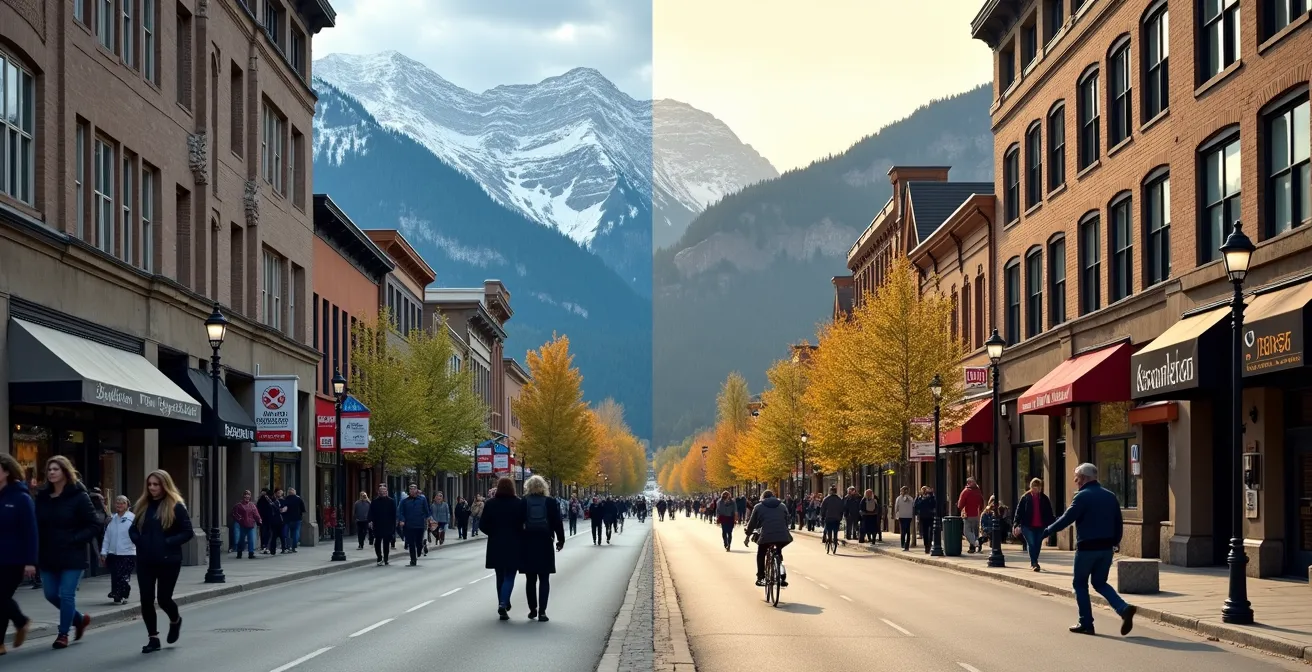
Jasper, on the other hand, exudes a more rugged, small-town authenticity. It’s quieter, more laid-back, and feels more connected to the vast wilderness that surrounds it. It’s the preferred base for those seeking a deeper wilderness experience, with easier access to remote trailheads and unparalleled wildlife viewing opportunities. This difference in atmosphere comes with a tangible difference in cost and visitor numbers.
This comparative data, drawn from a recent analysis of travel costs and atmosphere, clearly illustrates the trade-offs. Choosing the right base camp is the first step in crafting a trip that aligns with your expectations.
| Aspect | Banff | Jasper |
|---|---|---|
| 3-Night Hotel Stay (3-4 star) | $2,000+ | $1,000 |
| Annual Visitors (2023) | 4.3 million | 2.8 million |
| Town Vibe | Cosmopolitan, bustling nightlife, high-end boutiques | Laid-back local feel, rugged authenticity, quieter evenings |
| Distance from Major City | 90 minutes from Calgary | 3+ hours from Edmonton |
| Best For | Access to Lake Louise, Moraine Lake, variety of activities | Wildlife viewing, remote trailheads, wilderness experience |
Ultimately, there’s no “better” choice, only a “better fit.” Do you want the vibrant hub with endless options, or the quiet outpost on the edge of the wild? Answering that question honestly is the key to a more fulfilling Rockies adventure.
The “Park and Ride” Strategy That Saves 2 Hours of Stress in Banff
The single biggest point of frustration for visitors to Banff National Park is the illusion of choice at Lake Louise and Moraine Lake. The reality is simple: the parking lots at both locations are full before 6 a.m. in July and August. Attempting to drive yourself is a rookie mistake that results in being turned away by traffic flaggers, wasting precious hours of your vacation. The solution isn’t to wake up earlier; it’s to embrace the system designed to solve this exact problem: the Parks Canada Park and Ride.
Instead of viewing the shuttle as an inconvenience, locals see it as a strategic tool for guaranteed access. This is logistical arbitrage in its purest form. You book a reserved time slot online, drive to the large, stress-free parking lot at the Banff Gondola or the Lake Louise Ski Resort, and board a comfortable bus that takes you directly to the lakeshore. There’s no circling for parking, no traffic jams, and no uncertainty. The cost is minimal compared to the value of your time and sanity.
Moreover, the Park and Ride system includes the Lake Connector shuttle, which links Lake Louise and Moraine Lake. This means with one reservation, you can easily visit both iconic spots in a single day without ever returning to your car. This integrated system is your ticket to bypassing the single greatest bottleneck in the park. By letting go of the need to have your car at the lakeshore, you trade a frustrating and unpredictable experience for a smooth and efficient one, saving you hours of potential stress.
Think of it this way: the shuttle isn’t a limitation; it’s your express pass. While others are stuck in traffic or arguing over the last parking spot, you’ll be on your way to that perfect turquoise-lake photo, calm and on schedule.
How to Navigate the Rockies Using Only ROAM Transit and Shuttles
While the Park and Ride is essential for Lake Louise, a truly crowd-proof strategy involves expanding your reliance on public transit for your entire stay. Parking in the town of Banff itself can be just as challenging as at the lakes. The secret that Canmore and Banff locals live by is ROAM Transit, a remarkably efficient and scenic public bus system that connects the key hubs of the Bow Valley.
ROAM Transit offers routes that link the town of Canmore to Banff, and within Banff, it services major attractions like the Banff Gondola, the Hot Springs, and Johnston Canyon. For a family, a day pass is an incredibly cost-effective way to explore. You can leave your car at your hotel or campground and eliminate parking from your list of worries entirely. The buses are clean, run on a predictable schedule, and the journey itself offers stunning views of the surrounding peaks, turning a simple commute into a scenic tour.
Combining ROAM with the Parks Canada shuttles creates a powerful, car-free network. You can take a ROAM bus from your hotel to the Banff High School transit hub, then seamlessly transfer to a Parks Canada shuttle for Johnston Canyon or Lake Louise. For destinations not covered, like Moraine Lake during specific hours, private operators such as the Moraine Lake Bus Company fill the gaps. By mastering this multi-layered transit system, you opt out of the traffic and parking competition altogether. It requires a small amount of pre-planning but pays massive dividends in a relaxed, flexible, and more immersive mountain experience.
This approach transforms your trip from a series of stressful drives into a seamless journey, allowing you to focus on the landscapes instead of the logistics.
Daily Pass vs. Discovery Pass: The Math for a 4-Day Trip
One of the most common points of confusion at the park gates is which pass to buy. Many visitors default to the Parks Canada Discovery Pass, an annual pass that grants access to all national parks. It feels comprehensive, but for many, it’s an unnecessary expense. This is a simple case of “pass-onomics,” and doing the quick math can save you money.
A Discovery Pass is priced for a group or family (up to 7 people in one vehicle) and is valid for a full year. A Daily Pass, as the name suggests, is valid for one day for the same group size. The critical question is: what’s the breakeven point? As of 2024, the breakeven point is typically seven days. If your stay in the national parks is six days or less, buying daily passes is the cheaper option. If you plan to stay for seven days or more, or if you plan to visit another Canadian national park within the year, the Discovery Pass becomes the better value.
For the specific scenario of a 4-day trip, the math is clear. Four daily passes will cost significantly less than one annual Discovery Pass. Visitors often purchase the Discovery Pass out of a fear of missing out or a simple misunderstanding of the options, effectively overpaying for their stay. The best strategy is to calculate the exact number of days you will be *inside* the park boundaries and purchase accordingly. You can buy daily passes at the park gates or online in advance for convenience.
Don’t fall into the trap of buying more than you need. A smart decision here is your first easy win in mastering the park system and keeping more money in your pocket for the experiences that truly matter.
Does the Discovery Pass Cover Provincial Parks? The $100 Mistake
Absolutely not, and this misunderstanding is one of the most expensive mistakes a visitor can make. The Parks Canada Discovery Pass is exclusively for national parks like Banff, Jasper, Yoho, and Kootenay. It provides zero access or benefits in the adjacent and equally stunning provincial parks, most notably Kananaskis Country.
Many visitors, after leaving Banff, drive into the Kananaskis region—a vast network of provincial parks beloved by locals for its incredible hiking and wildlife—assuming their Discovery Pass is still valid. They park at a trailhead like Ha Ling Peak or Grassi Lakes and return to find a hefty fine on their windshield. Kananaskis Country requires its own separate pass, the Kananaskis Conservation Pass. This pass is also purchased on a daily or yearly basis and its revenue directly funds the services and conservation efforts within that specific region.
The confusion is understandable; the mountain landscapes look identical, and the boundaries are invisible to the naked eye. But the jurisdiction is completely different. Before heading out for a hike, always double-check whether your destination is in a national park or a provincial park. A quick search on Google Maps will clarify this. Forgetting this crucial detail can turn a beautiful day in the mountains into a frustrating and costly lesson. The $100 mistake refers not just to the potential fine, but the cumulative cost of buying the wrong pass and then having to pay again.
Treat the two systems as completely separate countries with their own entry requirements. This simple mental model will save you both money and a significant amount of frustration.
Peyto Lake vs. Bow Lake: Where to Stop for the Best Photo?
Along the iconic Icefields Parkway, Peyto Lake and Bow Lake are two essential, yet very different, photo opportunities. Choosing between them—or how to approach them—depends on your goals: are you after the quick, jaw-dropping panoramic shot, or a more immersive, ground-level experience?
Peyto Lake is famous for its high viewpoint, offering a stunning aerial perspective of the wolf-shaped, brilliantly turquoise lake. The access is a short, paved, uphill walk from the parking lot to the main wooden viewing platform. This is where you will get that iconic, postcard-perfect shot. However, its ease of access also makes it one of the most crowded spots on the entire parkway. To get a clear shot without a dozen strangers in it, you need to apply the “reverse commute” strategy: visit before 9 a.m. or after 6 p.m. when the tour buses are gone.
Bow Lake, just a few minutes down the road, offers a completely different experience. The parking lot is situated right at the lakeshore, offering immediate, beautiful views of Bow Glacier and the surrounding peaks. While the initial view is lovely, the “best” photo here requires more effort. A walk along the flat, expansive shoreline toward the back of the lake will reward you with unparalleled compositions and a sense of solitude that is impossible to find at the Peyto Lake viewpoint. It’s a photo you have to work for, making it feel more personal and unique.
The verdict? For the guaranteed “wow” shot with minimal effort (if timed right), choose Peyto. For a quieter, more personal photo session where you can truly connect with the landscape, choose Bow Lake and be prepared to walk.
Key Takeaways
- The key to a stress-free trip is mastering the park’s systems: booking, transit, and passes.
- ROAM Transit and the Parks Canada shuttle are not inconveniences; they are strategic tools to bypass traffic and parking chaos.
- Always distinguish between National Park passes (Discovery Pass) and Provincial Park passes (Kananaskis Pass) to avoid costly fines.
Mastering the Parks Canada System: Fees, Rules, and Access
Navigating Banff and Jasper in peak season is not a battle against the crowds, but a challenge to master the systems in place. The frustration most visitors feel stems from a fundamental misunderstanding of how access is managed. By shifting your perspective from a passive tourist to an active strategist, you can transform your experience. The core of this strategy lies in understanding and leveraging the three key pillars of park management: reservations, transit, and passes.
We’ve seen how a tactical “battle plan” can secure a coveted campsite, and how cancellation scanners provide a powerful second chance. We’ve deconstructed the transit network, reframing the Park and Ride and ROAM buses not as limitations, but as your express ticket past traffic jams and full lots. Finally, we’ve done the simple “pass-onomics” to ensure you’re paying the right price for your stay, and highlighted the critical distinction between national and provincial jurisdictions to avoid costly penalties.
These systems are not in place to frustrate you; they are there to manage the immense pressure on a fragile ecosystem and ensure a quality experience is still possible. By learning the rules of this game—by booking your shuttle, buying the right pass for your trip length, and having a plan for your campsite—you are no longer at the mercy of the crowds. You are working with the system, not against it.
Embrace this strategic mindset. Plan your logistics with the precision of a local, and you’ll be rewarded with the freedom to immerse yourself in the awe-inspiring beauty of the Rockies, leaving the stress and the crowds behind in your rearview mirror.