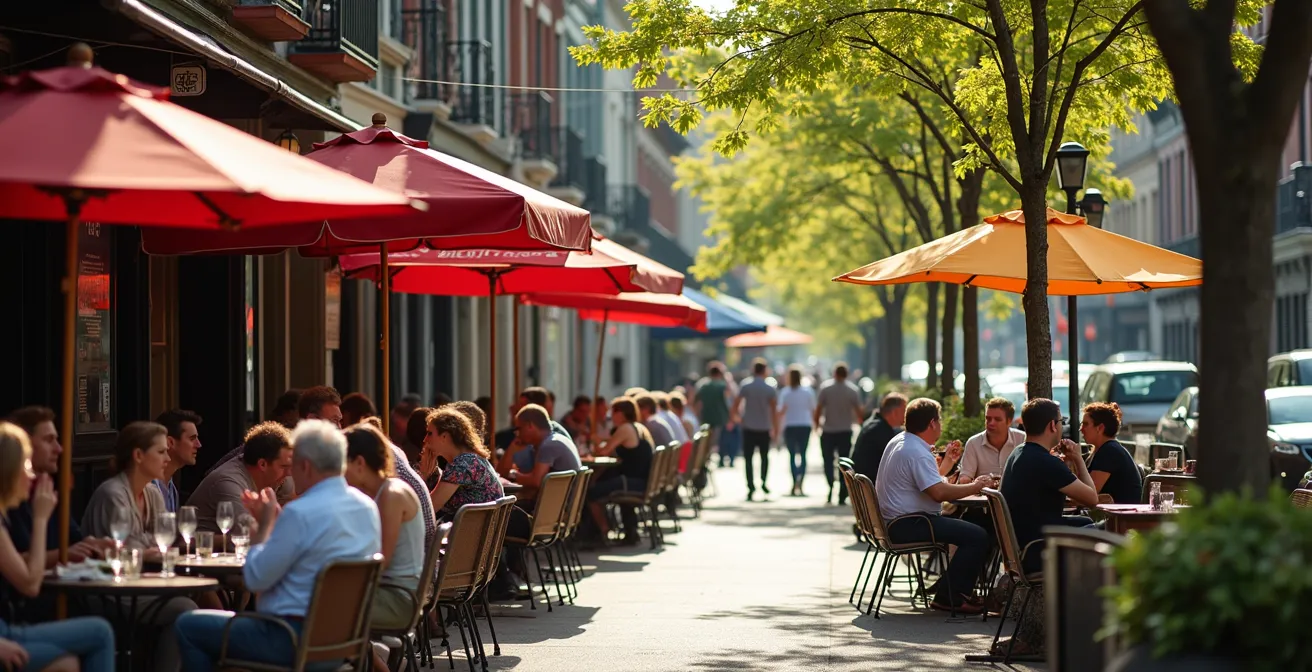
Experiencing French Canada’s “joie de vivre” is not about ticking off landmarks, but about participating in its living cultural rituals. This guide moves beyond clichés like poutine and Old City walls to decode the social grammar behind daily life—from the nuanced “Bonjour-Hi” greeting to the sacred summer terrasse culture and the after-work “5 à 7.” By understanding the why behind these practices, you can shift from a tourist to an active participant in one of North America’s most unique cultural landscapes.
You’ve heard the term “joie de vivre.” It’s that infectious, effervescent spirit often associated with French culture. In Canada, particularly in Quebec, this isn’t just a marketing slogan; it’s the vibrant, rhythmic pulse of daily life. Many guides will tell you to learn a few French words, visit the historic streets of Old Montreal, and of course, eat poutine. While these are all part of the experience, they are merely the surface of a much deeper cultural ocean.
These checklists miss the essential truth: the francophone vibe is less about what you see and more about what you *do*. It’s a social grammar, a series of rituals that play out on sun-drenched patios, in bustling shops, and during city-wide celebrations. But what if the key to unlocking this world wasn’t in a phrasebook, but in understanding the unwritten rules of these daily interactions? What if you could participate, not just observe?
This article is your guide to that deeper connection. We will move beyond the postcard and explore the living, breathing rituals that define francophone Canada. We’ll decode the linguistic handshake of a Montreal greeting, explore why the “terrasse” is a cornerstone of summer, and understand the profound difference between national holidays. We’ll find the authentic sounds of the city and learn the art of the after-work social hour. Finally, we’ll journey into the countryside and back in time to grasp the historical roots that give this culture its unique resilience and flavour. Get ready to truly soak up the joie de vivre.
This guide breaks down the essential elements of the francophone Canadian experience, from daily social codes to deep-rooted cultural traditions. The following sections will provide you with the insights needed to connect with the local culture on a more authentic level.
Summary: Living the “Joie de Vivre”: How to Soak Up the Francophone Vibe
- Bonjour-Hi: How to Navigate Bilingual Greetings in Montreal Shops
- Why the “Terrasse” Culture is Essential to Summer in French Canada
- Canada Day vs. Saint-Jean-Baptiste: Understanding the Cultural Difference
- Where to Hear Local Chansoniers Instead of Top 40 Hits?
- The Art of the “5 à 7”: How to Do Happy Hour Like a Local
- How to Visit Rural Heritage Sites in Quebec with Basic French
- Cheese and Chocolate: Driving the Route des Saveurs in Quebec
- Exploring Quebec’s History: Beyond the Walls of Old Quebec
Bonjour-Hi: How to Navigate Bilingual Greetings in Montreal Shops
The first and most fundamental cultural ritual you’ll encounter in Montreal is the greeting: “Bonjour-Hi.” This is not just a casual salutation; it’s a linguistic handshake that sets the tone for your entire interaction. In a city where nearly 64% of the population is bilingual, this two-word opening is a masterful act of social navigation. It’s an offer, not a command, immediately establishing that the service can proceed in either of Canada’s official languages. Your response is the acceptance of that offer, signaling your preference.
So, how do you respond? It’s simpler than you think, and there is no wrong answer. This interaction is designed for comfort and efficiency, not to test your French. Responding with “Bonjour” will likely continue the conversation in French, while “Hi” or “Hello” will switch it to English. Think of it as choosing your own adventure. The key is simply to respond. A silent nod can be seen as awkward or even rude, so engaging in this brief verbal dance is part of fitting in.
It’s also important to understand the geographic context. While “Bonjour-Hi” is a hallmark of Montreal’s cosmopolitan and bilingual identity, you’re more likely to be greeted with a simple, confident “Bonjour” in Quebec City and other regions where French is more dominant. Conversely, in officially bilingual cities like Moncton, New Brunswick, you might hear a mix of French, English, and the local Chiac dialect. Understanding this greeting is your first step from being a passive observer to an active participant in the local culture.
Why the “Terrasse” Culture is Essential to Summer in French Canada
When the last patch of snow finally melts, a collective sigh of relief ripples through French Canada, and almost overnight, the streets blossom with tables and chairs. This is the beginning of terrasse season. More than just outdoor seating, the “terrasse”—or patio—is a sacred cultural institution, the primary stage for social life from May to September. After a long, cold winter, the chance to soak up the sun is not a luxury; it’s a necessity, and terrasses are where the city comes alive.
This isn’t an accident of culture, but a feature of urban design. Montreal, for instance, has systematically prioritized this outdoor lifestyle, as seen in its pedestrianization of major streets like Mont-Royal and Wellington. According to an analysis by Outlook Travel Magazine, the city has made significant investments in downtown landmarks and public installations to enhance the outdoor urban experience. This philosophy fosters a vibrant ecosystem of social spaces, from chic rooftop bars in Old Montreal to relaxed neighbourhood hangouts on the Plateau, all contributing to the city’s effortlessly cool reputation, especially during the summer months when tourism peaks.

The result is a city that lives outdoors. Friends gather for a drink, couples share a meal, and solo patrons read a book with a coffee. It is the heart of the summer’s “joie de vivre.” The energy is palpable as streets buzz with conversation and laughter, especially during the golden hour when the sun sets late. For a traveler, choosing a spot on a busy terrasse isn’t just about getting a drink; it’s about plugging directly into the city’s vibrant, social bloodstream.
Canada Day vs. Saint-Jean-Baptiste: Understanding the Cultural Difference
To truly grasp the soul of Quebec, you need to understand its celebrations. The week between June 24th and July 1st is perhaps the most telling period in the calendar. While most of the country is gearing up for Canada Day on July 1st, Quebec is still recovering from its own massive party: La Fête Nationale du Québec, or Saint-Jean-Baptiste Day, on June 24th. The former celebrates the Canadian confederation, while the latter celebrates Quebec’s distinct francophone identity. In Montreal, the difference is stark.
Saint-Jean-Baptiste Day is an explosion of blue and white, the colours of the Quebec flag. The city hosts massive free concerts and parades featuring exclusively Quebecois and francophone music. It is a powerful, public affirmation of a unique culture. In contrast, Canada Day in Montreal is famously muted. For many locals, July 1st is not a day for patriotic celebration but is known colloquially as “Moving Day.” It’s the traditional date when most residential leases turn over, resulting in a chaotic city-wide ballet of moving trucks and discarded furniture that largely overshadows any national festivities.
This contrast is not just a scheduling quirk; it’s a reflection of history and identity. The choice of symbols, music, and even the level of public participation tells a story about where allegiances lie. Understanding this duality is crucial for any visitor wanting to look beyond the surface. The following table provides a clear comparison of these two significant, yet very different, holidays.
| Aspect | Canada Day (July 1) | Saint-Jean-Baptiste (June 24) |
|---|---|---|
| Primary Significance | National holiday celebrating confederation | Quebec’s national holiday celebrating Francophone identity |
| Local Reality in Montreal | Known as ‘Moving Day’ – residential lease turnover date | Major celebration with parades and concerts |
| Colors & Symbols | Red and white, maple leaves | Blue and white, Fleur-de-lys flag |
| Music Style | Broad mix of Canadian artists | Exclusively Quebecois and Francophone music |
| Celebration Beyond Quebec | Celebrated nationwide | Franco-Ontarians and Acadians celebrate with own traditions |
Where to Hear Local Chansoniers Instead of Top 40 Hits?
While Montreal is a global city with a music scene that embraces every genre, to truly connect with its francophone soul, you need to look beyond the Top 40. Quebec has a rich and fiercely independent music tradition, rooted in the French “chansonnier” (singer-songwriter) style but with its own unique rock, folk, and electro-pop evolutions. Thanks to regulations from the Canadian Radio-television and Telecommunications Commission (CRTC), Canadian radio stations are required to play a certain quota of Canadian content, which has helped foster a thriving local industry.
This means that on any given night, you can find incredible local artists performing in their native language. The key is knowing where to look. Forget the massive arenas for a moment and focus on the legendary mid-sized venues that are the lifeblood of the local scene. For a visitor, this offers a chance to experience the culture in its most poetic and contemporary form. You might not understand every word, but you will absolutely feel the passion and energy. This is the living, breathing sound of modern Quebec.
From internationally acclaimed artists like Charlotte Cardin and Alexandra Stréliski to the raw energy of Hubert Lenoir, the scene is diverse and exciting. And it’s not just limited to Quebec; the Acadian music scene in the Maritimes offers its own unique flavour with artists like Lisa LeBlanc. To dive in, you just need a starting point.
Your Action Plan: Discovering Quebec’s Modern Music Scene
- Visit modern venues like MTelus and Club Soda in Montreal for contemporary Quebec artists.
- Look for current internationally recognized artists like Charlotte Cardin, Alexandra Stréliski, and Hubert Lenoir.
- Attend the Festival acadien de Caraquet for authentic Acadian fiddle and ‘kitchen party’ music.
- Check out Les FrancoFolies de Montréal, a massive festival celebrating francophone music from around the world.
- Tune into local radio stations to discover emerging artists thanks to CRTC Canadian content rules.
- Explore venues featuring Lisa LeBlanc and other Maritime Acadian artists for a different francophone sound.
The Art of the “5 à 7”: How to Do Happy Hour Like a Local
Across North America, the hours between 5 and 7 PM are known as “happy hour,” a time for discounted drinks and appetizers. In French Canada, this period is known as the “5 à 7” (cinq à sept), and while it occupies the same time slot, its cultural significance is far deeper. The 5 à 7 is not primarily about discounts; it’s a cherished social ritual marking the crucial transition from the structured world of work to the relaxed realm of personal life.
This is a time to decompress, connect, and converse. Unlike a happy hour that might lead into a long night of partying, the 5 à 7 is often a more contained affair. It typically involves one or two drinks, accompanied by light snacks or “grignotines,” before people head home for dinner or onto their evening plans. The focus is on the conversation and the social connection itself. This ritual is so ingrained that it forms a significant part of the local economy; in 2019, Montreal’s nightlife sector generated $2.25 billion in direct expenditures, with the 5 à 7 culture being a key driver.

The 5 à 7 can happen anywhere—a neighbourhood pub, a downtown wine bar, or a sun-soaked terrasse. It can even take place in more formal settings. Museums like the Montreal Museum of Fine Arts (MMFA) often host evening vernissages (opening receptions) that perfectly capture this after-work social vibe, blending culture with conversation. For a visitor, joining in is as simple as finding a bustling spot around 5 PM and ordering a drink. It’s an open invitation to participate in the city’s daily rhythm and witness the “joie de vivre” in its most natural, relaxed state.
How to Visit Rural Heritage Sites in Quebec with Basic French
While Montreal offers a comfortably bilingual experience, the true historic heartland of Quebec lies in its countryside. Venturing into these rural regions can feel intimidating if your French is limited, but it’s here that you’ll find some of the most authentic and beautiful expressions of the culture. The key is to know that effort is highly valued. Simply mastering a few key phrases—“Bonjour,” “Excusez-moi,” and “Merci”—goes a long way in showing respect and opening doors.
Fortunately, you don’t have to go it alone. Quebec has a well-developed tourism infrastructure designed to guide visitors through its heritage. Following designated tourist routes like the Chemin du Roy (The King’s Road), one of North America’s oldest roads, or the Route des Navigateurs along the St. Lawrence River, ensures you’re on a path well-trodden by travelers. Many of the most significant locations are National Historic Sites, which are federally managed and thus more likely to have bilingual staff and interpretation.
Technology and dedicated programs also make rural exploration more accessible. Before heading to remote areas with spotty cell service, download offline language packs for translation apps. Furthermore, initiatives like Corridor Canada, which is supported by RDÉE Canada, help bridge the language gap. According to the Office of the Commissioner of Official Languages, over 400 businesses participate in the Corridor app, offering services and information in English. This network of officially recognized tourism services provides a safety net, allowing you to explore with confidence and connect with the rich history of francophone Canada beyond the big city limits.
Cheese and Chocolate: Driving the Route des Saveurs in Quebec
Quebec’s “joie de vivre” is not just a state of mind; it’s a flavour you can taste. The concept of “terroir”—the idea that food is intrinsically linked to the land and climate it comes from—is central to the region’s culinary identity. One of the best ways to experience this is by driving one of the many “Routes des Saveurs” (Flavour Routes), particularly in the Eastern Townships or Charlevoix regions, which are famous for their artisan producers.
Quebec’s cheese scene is particularly unique within Canada. Thanks to distinct food safety laws, Quebec is the only province where the production and sale of raw milk cheeses are widely permitted. This gives its cheesemakers an advantage, allowing them to create complex, flavourful cheeses that are impossible to find elsewhere in the country. This creates a celebrated “terroir” that you can taste in everything from sharp aged cheddars to creamy, delicate bries.
The culinary journey changes with the seasons. Spring is the time of the “cabanes à sucre” (sugar shacks) for maple season. Fall is perfect for visiting cideries along the Route des Cidres in Montérégie, where you can taste another uniquely Quebecois invention: ice cider. This sweet, concentrated dessert wine is born from the cold Canadian climate and pairs perfectly with the region’s sharp cheeses. A road trip through Quebec’s countryside is a journey for the senses, offering a delicious connection to the land and its traditions.
| Season | Route des Saveurs Highlights | Best Pairings | Unique Experiences |
|---|---|---|---|
| Spring (March-May) | Maple syrup season at sugar shacks | Maple products with local cheeses | Traditional cabane à sucre meals |
| Summer (June-August) | Fresh produce and artisan markets | Fresh cheeses with local berries | Farm-to-table dining experiences |
| Fall (Sept-Nov) | Apple harvest and cider production | Ice cider with aged cheddars | Apple picking at cideries |
| Winter (Dec-Feb) | Preserved and aged products | Raw milk cheeses with preserves | Indoor tastings and workshops |
Key Takeaways
- Francophone “joie de vivre” is best understood through participation in daily cultural rituals, not just sightseeing.
- Simple interactions like the “Bonjour-Hi” greeting and the “5 à 7” after-work gathering are profound social codes.
- Understanding the context of celebrations (Saint-Jean-Baptiste vs. Canada Day) and history (Quiet Revolution, Indigenous presence) is key to a deeper cultural connection.
Exploring Quebec’s History: Beyond the Walls of Old Quebec
The stone walls of Old Quebec and the cobblestone streets of Old Montreal are beautiful, but they tell only one chapter of a much longer story. To truly understand the modern francophone identity, you must look beyond the colonial narrative of the French and British. The history of this land is deeper and more complex, starting with the Indigenous peoples who have been here for millennia and continuing through the transformative social changes of the 20th century.
A vital first step is to engage with Indigenous history. Just outside Quebec City lies Wendake, the self-governing territory of the Huron-Wendat Nation. A visit to the Huron-Wendat Museum offers authentic storytelling that provides crucial context about who the French allied with and the land’s history before European arrival. As a powerful video series by Indigenous Tourism Canada highlights, these experiences, like the Ekionkiestha’ longhouse, create vital social and economic benefits while allowing cultures to be shared in a meaningful, self-determined way.
The other essential piece of the puzzle is the Quiet Revolution of the 1960s. This period saw Quebec undergo rapid secularization and social change, breaking away from the Catholic Church’s dominance and forging a modern, progressive, and nationalist identity. As one tourism authority notes, “This period of rapid secularization and social change is the true key to understanding modern Quebec’s identity, its politics, and its ‘joie de vivre'”. Visiting sites from Expo 67 in Montreal provides a glimpse into the optimism of this era. By exploring these multiple layers—Indigenous heritage, immigrant stories like those at Grosse Île, and the Quiet Revolution—you gain a richer, more socially aware perspective on the forces that have shaped the vibrant francophone culture of today.
Frequently Asked Questions on French Canadian Culture
Why is July 1st called ‘Moving Day’ in Montreal?
July 1st coincides with the traditional date when most residential leases turn over in Quebec, creating a massive moving day that often overshadows Canada Day celebrations in Montreal. This practical, city-wide event takes precedence over the national holiday for many residents.
How do Franco-Ontarians celebrate Saint-Jean-Baptiste?
Franco-Ontarians, francophones living in the province of Ontario, celebrate their unique francophone culture on June 24th with their own green and white flags, distinct traditions, and community festivals, which are separate from Quebec’s celebrations.
What should tourists wear to fit in at each celebration?
To blend in at Saint-Jean-Baptiste celebrations in Quebec, wear blue and white, the colours of the provincial flag, often featuring Fleur-de-lys symbols. For Canada Day celebrations elsewhere in the country, opt for red and white with maple leaf motifs.