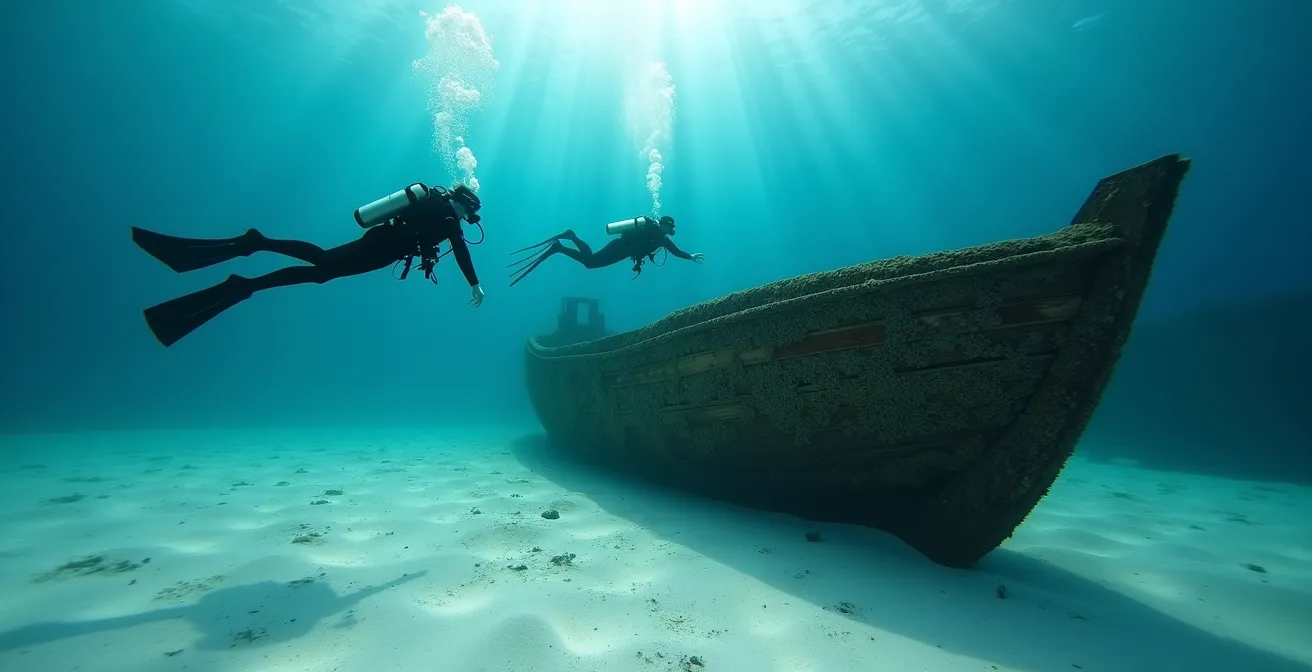
Warm-water dive skills are not enough for the unique challenges of Tobermory’s shipwrecks; mastering the environment requires a new level of technical understanding.
- The physics of freshwater dramatically alters buoyancy, demanding a complete recalculation of your weighting and trim.
- Managing “thermal debt”—the cumulative heat loss during and after a dive—is a non-negotiable safety procedure.
- Success in Canadian cold-water diving is less about temperature tolerance and more about rigorous, unforgiving procedural discipline.
Recommendation: Prioritize obtaining specific cold-water and drysuit certifications before attempting to dive Canada’s Great Lakes.
The spectral shapes of 19th-century schooners resting in crystalline water is a powerful call to any certified diver. Tobermory, Ontario, rightfully earns its reputation with visibility that can feel otherworldly. For a diver accustomed to the vibrant reefs of the Caribbean or the Red Sea, the idea of exploring these perfectly preserved historical sites is intoxicating. You already know how to manage your gear, monitor your gas, and execute a dive plan. You’re a competent diver.
But the Great Lakes don’t play by tropical rules. The common advice—”get a thicker wetsuit”—dangerously oversimplifies the challenge. The transition to Canadian cold-water diving is not merely about staying warm. It’s a fundamental shift in physics, physiology, and mindset. Success and safety in these waters are defined by your ability to master three concepts often overlooked by warm-water veterans: the radical buoyancy shift from salt to freshwater, the cumulative effect of ‘thermal debt’ on your body and mind, and an unwavering commitment to procedural discipline where small mistakes have significant consequences.
This is not a warning to stay away; it’s a divemaster’s briefing to prepare you properly. We will deconstruct the specific skills you must acquire, from recalculating your weight to understanding why post-dive safety is as critical as your time underwater. This guide is your transition plan from being a good diver to being a competent Canadian cold-water wreck diver. It’s about respecting the environment not just with your intentions, but with your technical mastery.
This article breaks down the core principles and environmental specifics you must master for a successful and safe Canadian cold-water diving experience. The following sections will serve as your detailed briefing on everything from gear selection to interacting with the unique challenges of Canada’s aquatic and coastal environments.
Summary: Master Guide to Canadian Cold-Water Environments
- Drysuit vs. 7mm Wetsuit: What Do You Really Need for Lake Huron?
- The Sweepstakes Wreck: How to Dive It Without Disturbing the Hull
- Why You Need Less Lead When Diving in the Great Lakes
- How to Interact Safely with Sea Lions off Vancouver Island
- The Hypothermia Risk After the Dive: Staying Warm on the Boat
- The “Wet Exit” Drill: What to Do If You Flip in Lake Superior
- Louisbourg vs. Halifax Citadel: Two Different Approaches to Colonial Defense
- Hiking Newfoundland’s East Coast Trail: Safety on the Edge
Drysuit vs. 7mm Wetsuit: What Do You Really Need for Lake Huron?
For a warm-water diver, a 7mm wetsuit feels like the ultimate thermal protection. In the Great Lakes, it’s often the bare minimum, and frequently inadequate. The decision between a wetsuit and a drysuit isn’t about comfort; it’s about control and endurance. Lake Huron’s water column is not uniformly cold; it’s stratified. You can expect a staggering 12°C (or 10°F) temperature drop as you cross the thermocline at around 10-12 metres (30-40 feet). A 7mm wetsuit, which relies on a thin layer of trapped water, offers diminishing protection as it compresses at depth and is continuously flushed with frigid water. This leads to a rapid accumulation of thermal debt, impairing cognitive function and fine motor skills essential for safety.
A drysuit, by contrast, keeps you completely dry, relying on insulated undergarments for warmth. This isolation from the water is the key. It allows you to maintain your core temperature, mental acuity, and physical dexterity for the entire dive. However, a drysuit is not a simple garment; it’s a piece of technical equipment. It is its own buoyancy device, requiring specific skills to manage the air bubble within it to avoid uncontrolled ascents or inversions. As the case study of Fathom Five National Marine Park shows, access to deeper wrecks like the Arabia, which sits in a constant 4°C (39°F), is contingent on operators verifying your advanced certification and proven cold-water experience. They are not just checking a box; they are managing a serious risk. For diving in Tobermory, a drysuit isn’t an upgrade; it’s the professional standard.
Action Plan: Pre-Dive Certification Checklist
- Contact your chosen Ontario-based dive operator and confirm their specific drysuit and cold-water certification requirements.
- Obtain a recognized cold-water diving specialty certification from an agency like ACUC, PADI, or SDI before booking any charters.
- Ensure your dive logbook is up-to-date, clearly documenting any recent cold-water diving experience to demonstrate proficiency.
- If you lack recent experience, schedule a refresher or pool session with a local instructor to practice drysuit skills like buoyancy control and emergency procedures.
- Verify the charter’s minimum skill level; do not assume your warm-water certification count is sufficient.
The Sweepstakes Wreck: How to Dive It Without Disturbing the Hull
The schooner Sweepstakes, sitting in just 6 metres (20 feet) of water, is one of Tobermory’s most iconic and accessible wrecks. Its apparent accessibility is also its greatest vulnerability. For the warm-water diver used to robust coral reefs, the fragility of a 19th-century wooden hull can be deceptive. The core principle here is absolute, unwavering buoyancy control. The goal is to be a silent observer, a ghost visiting another ghost, exerting zero impact on the site. Every plank and spar of the Sweepstakes is a non-renewable historical artifact.
The hull is covered in a dense layer of zebra mussels, an invasive species that has become part of the wreck’s modern identity. While they may seem like a protective shell, their tiny, sharp edges will shred gear, and any contact can dislodge them, damaging the underlying wood. Your fins are the biggest threat. One careless kick can stir up silt, ruining visibility for everyone, or worse, make direct contact with the structure. This is why Parks Canada has implemented strict rules. As their guidance clearly states, divers are no longer permitted to enter the schooner’s hull. This isn’t a suggestion; it’s a regulation born from the need to preserve the wreck from the cumulative impact of thousands of divers. The “Environmental Interface” here is a zero-contact policy. Master your trim, use precise frog kicks, and keep your hands secured. Your dive log should record what you saw, not what you touched.
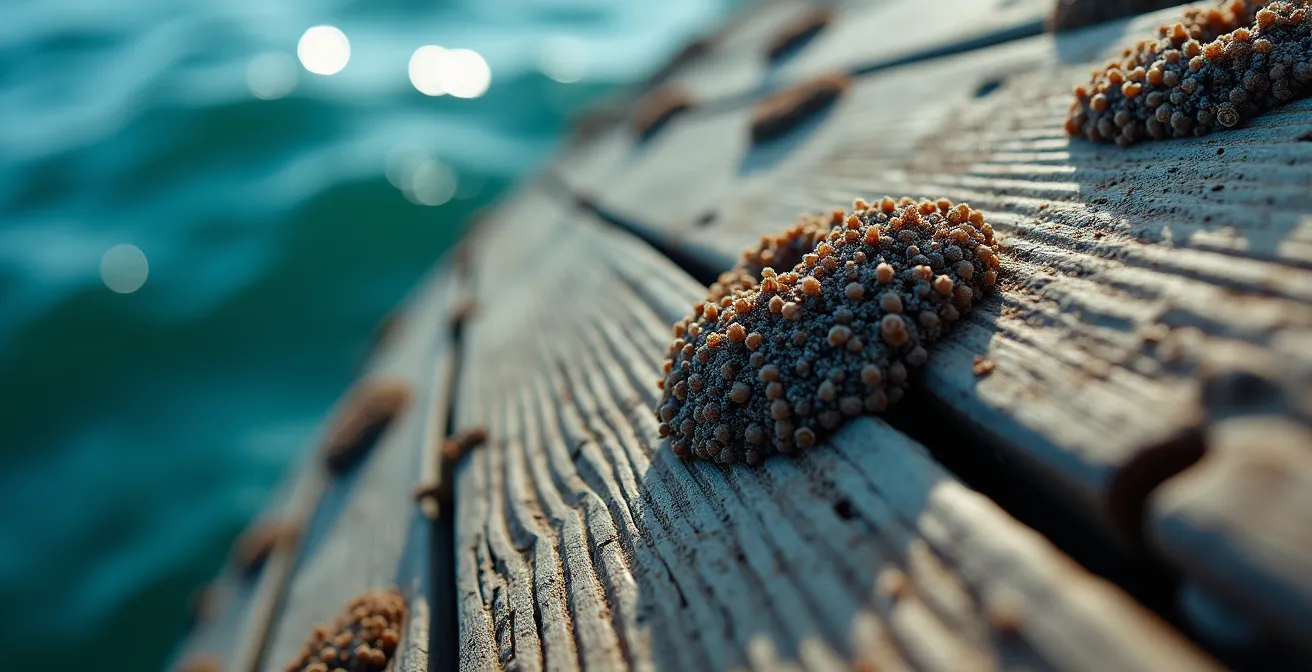
This close-up view reveals the intricate ecosystem that has formed on the wreck. Each of these tiny shells is a testament to the lake’s history, both ecological and man-made. Respecting this delicate layer is paramount. The best way to explore the Sweepstakes is by circumnavigating the exterior, observing the still-visible windlass at the bow and the fascinating decay of the stern. Your interaction is purely visual.
Why You Need Less Lead When Diving in the Great Lakes
Here is where the invisible physics of Canadian diving will humble an unsuspecting warm-water expert. You have your weighting dialled in perfectly for the Caribbean. You step into Lake Huron with the same amount of lead and immediately feel dangerously over-weighted. The reason is simple: freshwater is 2.5% less dense than salt water. This might sound like a trivial number, but it has a massive impact on your buoyancy. An object (you) is more buoyant in denser water. Therefore, when you move to less dense freshwater, you become significantly “heavier” and require less lead to achieve neutral buoyancy.
Failing to account for this buoyancy shift is one of the most common and dangerous mistakes. An over-weighted diver has to add more air to their BCD or drysuit to compensate. This creates a large, unstable air bubble that is difficult to manage, increasing the risk of an uncontrolled ascent. It also leads to poor trim, higher gas consumption, and a greater likelihood of kicking up silt or impacting a fragile wreck. The goal is to use the absolute minimum weight required to hold a safety stop with near-empty tanks. This requires a proper weight check at the beginning of your first dive in the new environment.
This comparative table, based on data from Tobermory dive operators, illustrates the practical impact of the buoyancy shift. A diver needing 20 lbs in the Caribbean might only need 15-16 lbs for the exact same 7mm wetsuit exposure setup in Lake Huron.
| Diving Location | Water Type | Weight Needed (7mm wetsuit) | Weight Needed (Drysuit) |
|---|---|---|---|
| Caribbean | Salt Water | 20 lbs | N/A |
| Lake Huron/Tobermory | Fresh Water | 15-16 lbs | 18-22 lbs |
| Difference | – | -4 to -5 lbs | Variable |
As the dive data comparison shows, the difference is significant. For drysuit diving, the weight is even more variable, depending heavily on the type of undergarment used. Never assume your old numbers will work. Always perform a weight check.
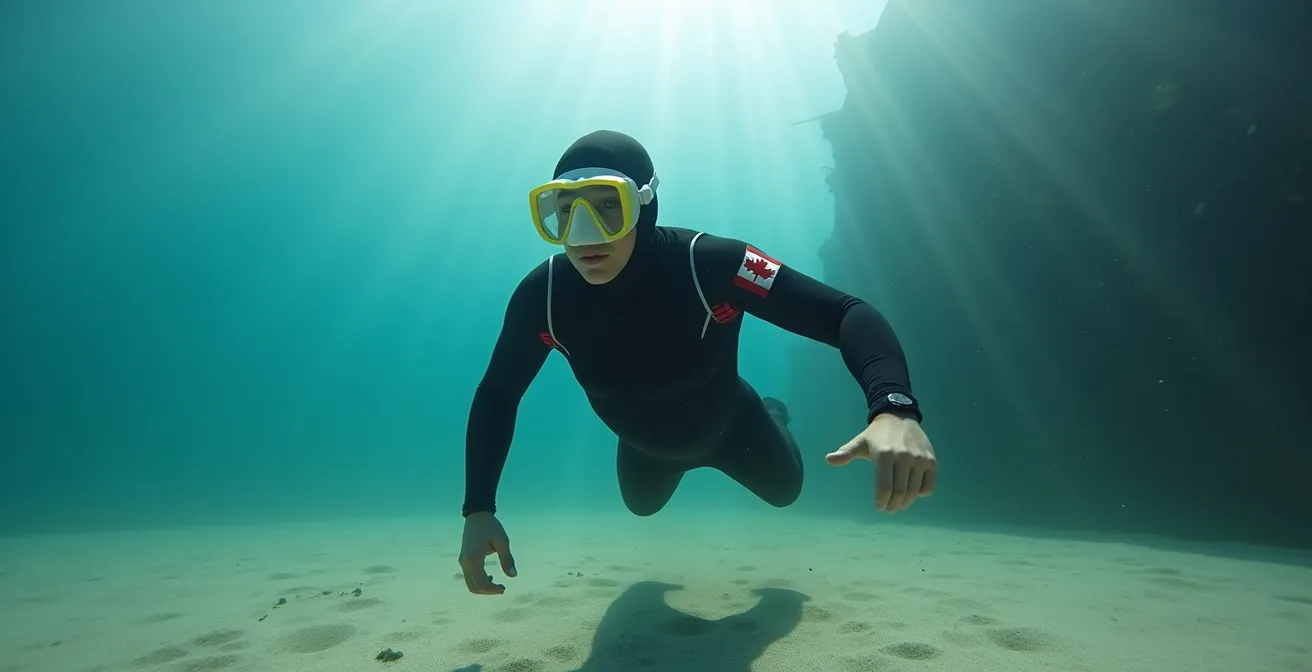
Achieving this perfect horizontal trim is the ultimate goal. It is the sign of a diver who has mastered their weighting and buoyancy. It is energy-efficient, safe, and demonstrates complete respect for the fragile environment below. This is what you strive for on every single cold-water dive.
How to Interact Safely with Sea Lions off Vancouver Island
The principles of procedural discipline and environmental respect are universal in Canadian waters, extending from the shipwrecks of the Great Lakes to the vibrant wildlife of the Pacific coast. Diving with the curious and playful Steller sea lions off Vancouver Island is an unforgettable experience, but it is not an unregulated underwater petting zoo. These are large, powerful, wild animals in their natural habitat. Safety, for both you and the animals, is dictated by passive interaction and strict adherence to federal law.
The key is to let the animals control the encounter. You are a guest in their home. The goal is to position your group of divers neutrally in the water column and wait. The sea lions, particularly the younger ones, will often approach, zipping around divers and showing off their incredible agility. Your job is to remain calm, predictable, and as unintrusive as possible. Chasing, touching, or attempting to feed the animals is strictly forbidden and dangerous. Remember that Canadian federal regulations require maintaining a 100-metre minimum distance from marine mammals, a rule that applies to your vessel’s approach. While underwater encounters can be closer if the animal initiates it, the spirit of the law is one of minimal disturbance.
Your choice of dive charter is critical. A responsible operator is your first line of defense. Before booking, you should act like the safety-obsessed diver you are and vet them. Ask if they are members of the North Island Marine Mammal Stewardship Association (NIMMSA). Inquire about their specific briefing protocols for marine mammal interactions and how they enforce passive behaviour underwater. A professional outfit will welcome these questions and have clear, safety-oriented answers. They will ensure every diver understands the regulations before ever getting in the water, setting the stage for a respectful and magical encounter.
The Hypothermia Risk After the Dive: Staying Warm on the Boat
The danger of cold-water diving doesn’t end when you surface. In fact, some of the highest risks occur on the boat deck during your surface interval. This is the concept of ‘thermal debt’ in action. During your dive, your body has been constantly losing heat, even in a drysuit. When you exit the water, your wet gear and exposure to the Canadian wind accelerate this heat loss dramatically. This ‘afterdrop’ effect can lead to shivering, loss of dexterity, and poor judgment, compromising your safety for a second dive or even the trip back to shore.
The case of winter diving in Tobermory provides an extreme but valuable lesson. A 2019 documentary of freedivers exploring the Alice G shipwreck in sub-zero conditions showed that divers could only manage about 90 seconds underwater. The divers’ bodies were burning through oxygen at a phenomenal rate just to stay warm, underscoring the physiological strain. As the Global News report highlighted, their surface intervals were meticulously planned rewarming protocols. While your summer dive won’t be this extreme, the principle is the same: you must actively fight thermal debt the moment you get out of the water. This is not optional; it’s a critical safety procedure.
A dedicated post-dive warming kit is an essential piece of your Canadian dive gear. Simply having a towel is not enough. Procedural discipline means preparing for the surface interval with the same seriousness as the dive itself. Your kit should include:
- A warm tuque (a Canadian beanie) to put on immediately, as a significant amount of heat is lost through your head.
- A windproof and waterproof shell jacket to block the wind chill on the boat deck.
- A thermos filled with a hot, non-alcoholic beverage like tea or hot chocolate.
- Chemical hot packs for your hands and feet.
- A dry robe or surf poncho to allow you to change out of wet gear easily and with privacy on an exposed deck.
- A complete set of dry clothes waiting in a pre-warmed vehicle for after the charter.
The “Wet Exit” Drill: What to Do If You Flip in Lake Superior
To fully grasp the unforgiving nature of Canada’s cold water, it’s useful to look beyond diving to another activity where immersion is a constant risk: kayaking. On Lake Superior, where Great Lakes temperature data shows the water at depth remains a shocking 4°C (39°F) year-round, an unexpected capsize is a life-threatening emergency. The principles of survival here directly mirror the mindset required for cold-water diving: procedural discipline and practiced, muscle-memory responses.
When a kayak flips in such conditions, the first enemy is the cold-water shock response—an involuntary gasp that can cause a person to inhale water. This is immediately followed by a rapid loss of muscle control. A kayaker doesn’t have time to think; they must rely on a pre-practiced ‘wet exit’ drill. This involves staying calm, pulling the grab loop to release the spray skirt, pushing off the boat with their feet, and getting out. It’s a sequence that must be second nature, drilled in calm conditions until it is automatic.
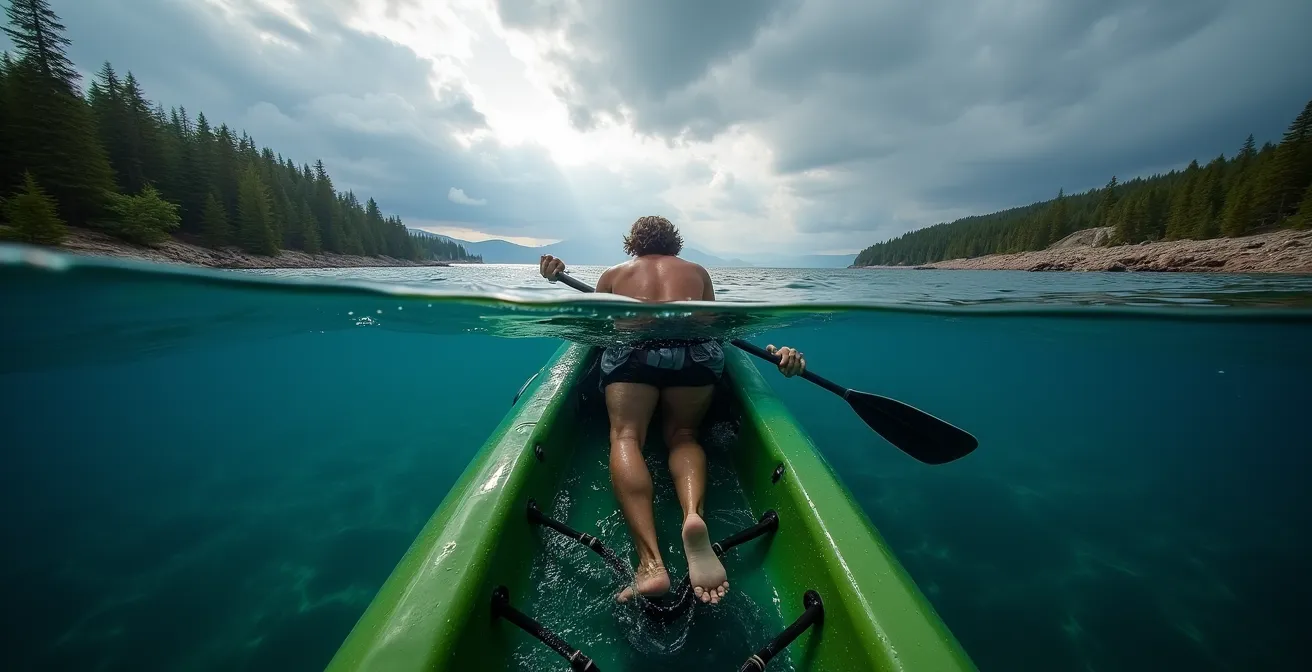
This same logic applies directly to diving emergencies. What do you do if your mask is knocked off? How do you handle a catastrophic BCD failure or a drysuit flood? In the warm, forgiving waters of the tropics, you have time to calmly assess and solve the problem. In the frigid grip of a Canadian lake, you have seconds. Your response must be immediate, correct, and automatic. This level of competence only comes from practice. It means rehearsing your emergency drills until you can perform them without thinking. It’s the essence of procedural discipline in an environment that offers no second chances.
Louisbourg vs. Halifax Citadel: Two Different Approaches to Colonial Defense
Mastering a Canadian environment, whether for military strategy or for scuba diving, demands a deep understanding of and adaptation to the unique challenges of the local geography. A lesson in this strategic mindset can be found by comparing two of Eastern Canada’s most significant colonial fortifications: the Fortress of Louisbourg in Nova Scotia and the Halifax Citadel.
These two sites represent vastly different solutions to the same problem: defending a key harbour. Louisbourg was built on a low-lying peninsula, making it vulnerable to siege from the surrounding hills—a fatal flaw the British exploited. Halifax Citadel, by contrast, was built atop a commanding drumlin, giving it a 360-degree view and making a surprise attack nearly impossible. One was a sprawling fortress that tried to defy its geography; the other was a compact stronghold that leveraged its geography to its advantage.
This historical comparison is a powerful analogy for the cold-water diver. You cannot defy the physics of freshwater buoyancy or the physiological realities of thermal debt. You must adapt your strategy, technique, and gear to the environment. The following comparison from Parks Canada data highlights how geography dictated strategy.
| Feature | Fortress Louisbourg | Halifax Citadel |
|---|---|---|
| Geographic Position | Low-lying peninsula | Commanding hilltop (Citadel Hill) |
| Harbor Characteristics | Wide entrance, fog-prone | Bedford Basin – deep, defensible |
| Strategic Weakness | Vulnerable to siege from surrounding hills | 360-degree view prevents surprise |
| Ice Conditions | Seasonal ice problems | Ice-free year-round |
| Modern Experience | Parks Canada living history | Military heritage focus |
The successful strategist, like the successful diver, doesn’t fight the environment. They study it, respect its power, and adapt their plan to its realities. The diver who shows up to Tobermory with a “Louisbourg” mindset—trying to impose their warm-water habits on a cold-water environment—is setting themselves up for failure. The diver with a “Halifax” mindset—who studies the conditions and adapts their technique—is the one who will have a safe, successful, and rewarding experience.
Key takeaways
- Buoyancy is Different: Freshwater is less dense than saltwater, requiring you to use significantly less weight to achieve neutrality. Always perform a weight check.
- Manage Thermal Debt: The cold is a cumulative problem. Staying warm on the surface, between dives, is as important as your thermal protection underwater.
- Discipline is Non-Negotiable: Cold water is unforgiving. Your response to any problem, from a lost mask to a gear malfunction, must be immediate and based on practiced drills. There is no time for hesitation.
Hiking Newfoundland’s East Coast Trail: Safety on the Edge
The mindset of environmental mastery and procedural discipline is not confined to the water. It’s a universal requirement for safely exploring Canada’s wild spaces. Consider the challenges of hiking Newfoundland’s famous East Coast Trail. Much like diving in Tobermory, it’s an experience of breathtaking beauty that carries inherent risks for the unprepared. The weather can change in an instant, and the same principles of thermal management that apply to a diver are critical for a hiker on an exposed cliff edge.
The layering system is a perfect example of this shared philosophy. A knowledgeable Newfoundland hiker would never wear cotton, as it loses all insulating properties when wet and can quickly lead to hypothermia. The same is true for the undergarments a diver wears beneath a drysuit. The system is identical in principle:
- Base layer: Merino wool to wick moisture away from the skin.
- Mid layer: Fleece for insulation that continues to work even if it gets damp.
- Outer shell: A high-quality waterproof and windproof layer to protect from the elements.
This isn’t just about clothing; it’s a safety system. This same logic of preparedness extends to the trails around Tobermory itself. As the Bruce Peninsula’s trail system demonstrates, challenging coastal hikes with rapid weather changes are a feature of the area. Trails like the Burnt Point Loop or the hike to Little Dunks Bay demand the same respect for conditions as the waters of Georgian Bay. Being prepared for the terrestrial environment is part of the holistic safety mindset of a true Canadian adventurer.
To truly transition from a warm-water tourist to a competent cold-water explorer, you must embrace this philosophy of total preparation. It means your training isn’t complete until your emergency drills are muscle memory and your respect for the environment is reflected in every action you take. Get the proper certification, practice your skills, and arrive prepared not just to see the wrecks, but to master the challenge of their environment.