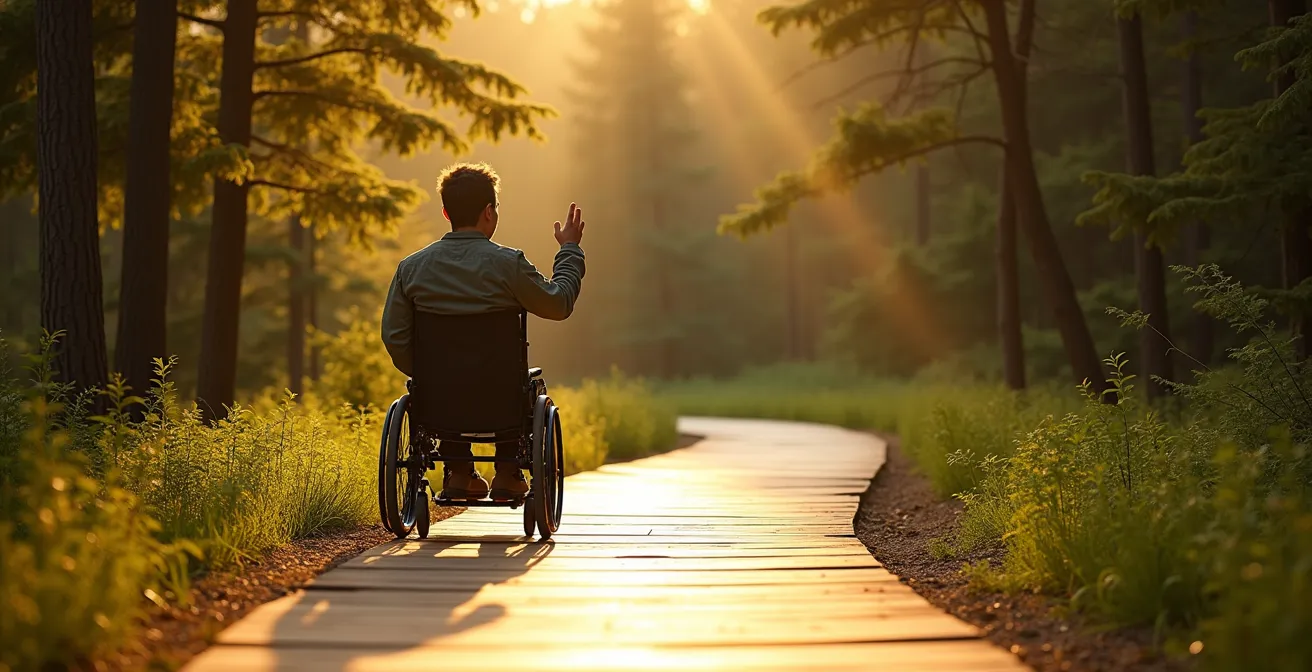
The “easy” rating on trail maps is often a misleading trap for Canadians with mobility needs.
- True accessibility requires a personal “accessibility audit” focusing on specific barriers like surface type, path width, and grade, not just trail length.
- Essential infrastructure, including washrooms, parking, and rental equipment, is just as important as the trail itself for a successful outing.
Recommendation: Shift your mindset from searching for “accessible trails” to learning the skills to determine if any trail is “accessible for you.”
The promise of Canada’s vast wilderness, from the rugged Rockies to the coastal forests, should be open to everyone. Yet for families with strollers, seniors, or individuals using mobility devices, a simple desire to connect with nature can become a frustrating exercise in navigating misinformation. You’ve likely seen it: a trail optimistically labelled “easy” on a park map, only to discover it’s a minefield of loose gravel, narrow choke points, or steep, unmarked inclines. This experience isn’t just inconvenient; it can be discouraging and unsafe.
Many guides offer simple lists of paved paths, but this approach barely scratches the surface of true accessibility. It assumes a one-size-fits-all solution and fails to address the diverse needs of the community. What about a parent pushing a double stroller, a person using a power wheelchair, or someone who needs frequent rest stops? The reality is that accessibility is not a simple checkbox. It is a spectrum of features that must align with an individual’s specific requirements.
But what if the solution wasn’t just to find a better list of trails, but to develop a new lens for seeing the outdoors? This guide moves beyond generic recommendations. Its purpose is to empower you with the knowledge and tools of an accessibility consultant. You will learn how to conduct your own personal accessibility audit on any trail in Canada. We’ll deconstruct what “accessible” truly means, from the microscopic details of a trail’s surface to the macro-level planning of a sensory-friendly experience.
By understanding the critical questions to ask and the key features to look for, you will gain the confidence to venture out, knowing you’ve chosen a path that is genuinely accessible *for you*. This is about reclaiming your right to explore Canada’s natural beauty, armed with expertise and self-assurance.
Table of Contents: Finding Your Accessible Path in Canada
- Paved vs. Gravel Dust: Which Trail Surface Works for Your Wheelchair?
- Where to Rent All-Terrain Wheelchairs in Canadian Parks for Free
- How to Check Washroom Accessibility Before Starting a 5km Trail
- Why “Easy” Doesn’t Always Mean “Accessible” on Park Maps
- Quiet Times on the Trail: Avoiding Sensory Overload in Popular Parks
- Top 3 Mountain Viewpoints You Can Drive To in the Rockies
- How to Walk the Fortifications with a Stroller or Wheelchair
- Seeking the Best Views: Accessible Lookouts Across Canada
Paved vs. Gravel Dust: Which Trail Surface Works for Your Wheelchair?
The single most overlooked factor in trail accessibility is the ground beneath your wheels. A trail’s surface dictates everything: the effort required for propulsion, stability, and even safety. A path that’s a dream for a power chair can be a quagmire for a manual chair with narrow tires. Understanding the pros and cons of different materials is the first step in your accessibility audit. Asphalt is often the gold standard for smooth rolling, but it can be prone to frost heaves in Canadian winters, creating uneven patches. Hard-packed crushed limestone can be excellent, but only when dry; a spring thaw or summer downpour can turn it into a muddy trap.
Case Study: Vancouver Seawall vs. High Rockies Trail
This contrast highlights the importance of surface-specific planning. Vancouver’s famous Seawall offers 8.8km of wide, level asphalt, making it a benchmark for accessibility for all device types. In contrast, the High Rockies Trail in Alberta’s Kananaskis Country uses hard-packed gravel. While this surface is manageable for specialized all-terrain wheelchairs, it poses a significant challenge for standard models, particularly after rain. Furthermore, the Seawall maintains a gentle grade, while sections of the High Rockies trail reach up to a 5% grade with exposed edges, requiring a higher level of user experience and confidence.
This comparative table breaks down how common Canadian trail surfaces perform throughout the seasons, helping you apply mobility-first criteria to your planning.
| Surface Type | Spring Thaw Impact | Summer Performance | Fall/Winter Conditions | Best For |
|---|---|---|---|---|
| Asphalt/Paved | Frost heaves, cracks possible | Excellent grip, smooth rolling | Ice risk, requires de-icing | Power chairs, manual chairs |
| Crushed Limestone | Can become muddy | Good when dry and packed | May freeze solid | All-terrain wheels |
| Wood Boardwalk | Minimal impact | Excellent accessibility | Can be slippery when wet/icy | All mobility devices |
| Fine Gravel | Washouts possible | Challenging for narrow wheels | Better when frozen | Wide-tire wheelchairs only |
Your choice is not just about preference; it’s about matching the trail’s engineering to your equipment’s capabilities. A wooden boardwalk, for example, is often superior for all devices but requires caution when wet.
Where to Rent All-Terrain Wheelchairs in Canadian Parks for Free
For those eager to explore beyond the pavement, specialized equipment can be a game-changer. Fortunately, you don’t always need to own it. Parks Canada and various provincial partners offer programs to rent all-terrain wheelchairs, opening up a whole new world of trails. These are not standard wheelchairs; models like the single-wheeled TrailRider are designed for rugged terrain but require assistants (often called ‘sherpas’) to guide, while the Hippocampe chair is perfect for beaches and even entering the water. The key to accessing these free rentals is planning ahead.

As the image shows, the wide, knobby tires of these chairs are designed to grip uneven surfaces like rock and compacted earth, providing a level of stability that standard wheels cannot. However, accessing this equipment requires a proactive approach. Most locations require you to book the equipment 48 to 72 hours in advance, and even earlier on long weekends. It’s also crucial to be realistic about the support needed. A TrailRider, for instance, typically requires two or three physically fit assistants to navigate challenging sections safely.
Provinces also have their own unique programs. In British Columbia, the BC Mobility Opportunities Society offers equipment loans to its members. In Quebec, many SEPAQ (Société des établissements de plein air du Québec) parks provide Hippocampe chairs, but online booking at least a week in advance is recommended. Always confirm the specific model available and the support required when you call to book. This simple phone call is a critical part of your pre-trip infrastructure-as-access check.
This forward planning transforms a potentially inaccessible trail into a shared adventure, allowing friends and family to participate directly in the experience.
How to Check Washroom Accessibility Before Starting a 5km Trail
The availability of a usable washroom can make or break an outdoor excursion. A five-kilometre trail might seem manageable, but without accessible facilities, it becomes an exercise in anxiety. This is a critical piece of the “infrastructure-as-access” puzzle that is too often ignored. In Canada, where 27% of citizens aged 15 and older reported a disability in 2022, this is not a niche concern but a fundamental requirement for public access. Simply seeing an accessibility icon on a park map is not enough; you need to dig deeper.
Before you even leave your car, your accessibility audit should include a thorough evaluation of the washroom facilities. The first question to ask park staff or determine online is whether the path from the parking area to the washroom is accessible. A brand-new facility is useless if you have to cross a muddy field or a patch of deep gravel to reach it. Next, determine if it’s a separate, universal washroom or an accessible stall inside a gendered facility. This detail is crucial for privacy and for visitors who may require assistance from a caregiver of a different gender.
Finally, inquire about the last time the facility’s accessibility was formally audited. Asking if it meets current CSA B651 standards (the Canadian standard for accessible design) is a great way to gauge its quality. A recent audit, ideally within the last two years, suggests that features like grab bar placement, door width, and sink height are more likely to be up to modern requirements. Don’t be afraid to call the park’s main office ahead of your visit; a ten-minute phone call can save you hours of frustration on-site.
Treating washroom access with the same importance as the trail itself is a hallmark of a well-planned, confident, and enjoyable outdoor adventure.
Why “Easy” Doesn’t Always Mean “Accessible” on Park Maps
The most common pitfall in planning an accessible outing is trusting the subjective “easy” trail rating. This classification is almost always based on cardiovascular effort and length, a perspective that completely ignores the very real barriers faced by people using mobility aids. A short, flat trail can still be rendered impassable by a single step, a narrow gate, or a difficult surface. This is why you must learn to look beyond the park’s classification and apply your own mobility-first criteria.
The trail-rating community is beginning to acknowledge this distinction. As the team at AllTrails notes in their official guidelines, their definition of a “wheelchair-friendly” trail is a route that can be navigated, at least in part, by those with limited mobility. As they state, this is a distinct concept from a simple difficulty rating. According to the AllTrails Accessibility Guidelines, the focus is on the physical ability to navigate the route with equipment.
Case Study: The “Easy” Trap at Johnston Canyon
Johnston Canyon in Banff National Park is a perfect example of this disconnect. The lower trail is rated ‘Easy’ by Parks Canada and heavily marketed to families. However, for a wheelchair user, it presents significant barriers. The catwalks feature metal grating that can trap narrow front wheels, there are unmarked sections with grades up to 8%, and the path narrows to less than one meter during peak season, creating impossible bottlenecks. This trail’s rating prioritizes fitness level, not compatibility with mobility devices, making it a classic example of why the “easy” label can be a dangerous assumption.
To conduct your own audit, you must learn to read between the lines of trail descriptions and user reviews. Look for keywords like “roots,” “rocks,” “narrow,” “steps,” or “scramble.” Conversely, look for positive indicators like “paved,” “boardwalk,” “wide,” and “level.” Photo galleries from park websites or user-review sites can be invaluable tools for spotting potential barriers that are never mentioned in the official text.
Ultimately, your assessment is the only one that matters, because it is the only one tailored to your specific needs and equipment.
Quiet Times on the Trail: Avoiding Sensory Overload in Popular Parks
Accessibility isn’t just about physical barriers; it’s also about the sensory environment. For many people, including autistic individuals, those with sensory processing challenges, or simply anyone seeking tranquility, crowded and noisy trails can be overwhelming. The roar of a packed parking lot, the constant chatter of passing groups, and the lack of personal space can turn a beautiful natural setting into a stressful ordeal. This is an especially vital consideration given that a 20.1% share of Canadian youth aged 15-24 reported a disability in 2022, with many experiencing challenges that benefit from quieter environments. A true accessibility audit must therefore include “sensory mapping.”
Sensory mapping is the proactive process of planning your visit to minimize overwhelming sensory input. This means strategically choosing not only where you go, but *when* you go. The most powerful tool for this is often right in your pocket. Google Maps’ “Popular Times” feature for trailheads can show you, hour by hour, the typical crowd levels. Aiming for a time slot with less than 25% of peak traffic can dramatically change the experience. Timing your visit to avoid Canadian statutory holidays like Victoria Day, Canada Day, and the August long weekend is another crucial step.
The “shoulder seasons” are your best friend. A trail in late September offers spectacular fall colours with a fraction of the summer crowds. Likewise, an early June visit, before schools let out, can provide solitude in otherwise popular parks. For an even deeper level of quiet, consider visiting one of Canada’s Dark-Sky Preserves, such as Jasper National Park in Alberta or Point Pelee National Park in Ontario. These areas are naturally quieter and have reduced light pollution. Some institutions, like the Royal Botanical Gardens, are even beginning to offer designated “sensory-friendly mornings.”
Your Action Plan: Strategic Planning for a Sensory-Friendly Trail Experience
- Check Google Maps ‘Popular Times’ for your chosen trailhead and identify hours with less than 25% typical crowd levels.
- Cross-reference with Canadian statutory holidays; avoid Victoria Day, Canada Day weekend, and the Civic Holiday Monday.
- Target shoulder seasons, such as late September for fall colours or early June before school holidays, to find fewer crowds.
- Research Dark-Sky Preserves like Jasper or Point Pelee for naturally quieter environments with reduced light pollution.
- Contact parks or botanical gardens directly to ask about any designated sensory-friendly or quiet hours they may offer.
By controlling the sensory environment, you ensure that the restorative power of nature is what you remember, not the stress of the crowds.
Top 3 Mountain Viewpoints You Can Drive To in the Rockies
The majestic peaks of the Canadian Rockies are an iconic symbol of our country’s natural grandeur, and experiencing that scale shouldn’t be limited to backcountry hikers. Fortunately, several of the most breathtaking vistas are accessible directly by vehicle or with purpose-built infrastructure. These locations prove that a world-class view doesn’t have to come at the end of a strenuous climb. For your accessibility audit, these “drive-to” viewpoints are top-tier candidates, offering maximum reward for minimal physical exertion.
First, Mount Norquay in Banff offers a spectacular vantage point overlooking the town and the Bow Valley. The access road is paved, and the viewing area near the Cliffhouse Bistro provides a safe, railed-off space to take in the panorama. Second, as Parks Canada highlights, you can “nearly drive to the top of a mountain on a paved road” at Mount Revelstoke. The “Summit Parkway” is a 26-kilometre scenic drive that climbs to parking areas just a short walk or roll from stunning subalpine meadows and viewpoints. It’s a rare opportunity to immerse yourself in a high-altitude environment without a major trek.
The Gold Standard: Sulphur Mountain Gondola’s Complete Accessibility Journey
For the ultimate accessible mountain-top experience, the Sulphur Mountain Gondola in Banff is an exemplar. The journey is step-free from the moment you arrive, with designated accessible parking spots near a level entrance. The gondola cabins themselves accommodate wheelchairs, and the summit is a marvel of accessible design. A 500-metre boardwalk with a maximum grade of 5% connects multiple viewing platforms, all equipped with lowered viewing sections at a 90cm height for seated visitors. Even the indoor facilities, including the restaurant and gift shop, are connected by an elevator, ensuring a completely integrated experience.

These locations shift the focus from the physical challenge of the ascent to the pure, unadulterated beauty of the destination.
How to Walk the Fortifications with a Stroller or Wheelchair
Canada’s historic sites offer a window into our past, but their centuries-old construction can present modern accessibility challenges. The Fortifications of Québec, a UNESCO World Heritage site, are a prime example. Navigating the cobblestones and grades of a 400-year-old defensive wall with a stroller or wheelchair seems daunting, but with the right plan, it is entirely possible. An accessibility audit of a historic site requires pinpointing the specific sections that have been modernized for access.
For the Québec City walls, the key is to start at the right place. Avoid the more rugged, tourist-heavy sections and begin your journey near the Porte Saint-Louis. Here you will find a ramped entrance that provides smooth access onto the walls. From there, the 800-metre section heading eastward is the most manageable, as it was resurfaced in 2023. Parks Canada has also installed three accessible benches with armrests every 250 metres along this stretch, providing crucial opportunities for rest and easier transfers. If the cobblestones become too trying, the nearby Promenade des Gouverneurs offers a fantastic alternative—a smooth wooden boardwalk with the same stunning cliffside views of the St. Lawrence River.
This approach of seeking out the most accessible sections can be applied to other historic fortifications across Canada. Each site presents a unique mix of preserved history and modern upgrades.
| Fortification | Accessible Features | Challenges | Best For |
|---|---|---|---|
| Quebec City Walls | Ramped entrances, some smooth sections | Cobblestones, steep grades in places | Partial access with planning |
| Halifax Citadel | Accessible visitor center, some ramped paths | Steep approach, grass surfaces | Power wheelchairs |
| Fort Henry (Kingston) | Accessible muster parade, elevator to ramparts | Some areas remain inaccessible | Most inclusive experience |
This careful planning allows you to engage with history without battling the terrain, turning a potential struggle into a memorable journey.
Key Takeaways
- Deconstruct the “Easy” Label: Never take a trail’s difficulty rating at face value; it rarely accounts for mobility-specific barriers.
- Audit the Surface: The material of the trail—asphalt, gravel, boardwalk—is the most critical factor for wheelchair and stroller accessibility.
- Plan for Infrastructure: A successful trip depends on accessible parking, washrooms, and rest spots, not just the trail itself.
- Master Your Timing: Use tools like Google’s ‘Popular Times’ and plan around holidays to manage sensory inputs and avoid overwhelming crowds.
Seeking the Best Views: Accessible Lookouts Across Canada
After learning how to deconstruct trails, plan for infrastructure, and manage the sensory environment, the final piece is applying these skills to find your own hidden gems. The goal is to move from relying on pre-made lists to becoming a confident explorer in your own right. Seeking out the best views is a powerful motivator, and accessible lookouts are often the perfect destination, offering a high-impact reward. The process of finding them combines digital scouting with local knowledge.
Start with a bird’s-eye view. Using the 3D view in Google Earth is a surprisingly effective way to scout your region. You can trace paved roads that lead to high-elevation points, identifying potential scenic lookouts that might not be advertised as formal trails. Couple this with searches on official tourism or municipal government websites for terms like “[your city] scenic lookout” or “barrier-free viewpoint.” These official sources are often the most reliable for information on paving, parking, and railings.
Next, leverage community-powered tools. Websites like AllTrails now have a “wheelchair-friendly” filter that can instantly narrow down options in your area. Read the user reviews and look at their photos—they often provide more honest and detailed ground-truth than official descriptions. Finally, don’t underestimate the power of local human connection. Contacting local accessibility organizations, adaptive sports groups, or even senior centers in your area can yield invaluable insider tips on the best-kept secrets that never make it into a travel guide.
Your Action Plan: How to Find Your Own Local Accessible Lookouts
- Use Google Earth’s 3D view to identify paved roads leading to high elevation points in your region.
- Search ‘[your municipality] scenic lookout’ or ‘viewpoint’ on government tourism websites.
- Check provincial park websites for ‘accessible’ or ‘barrier-free’ trail designations.
- Use AllTrails.com’s wheelchair-friendly filter for your area to find user-rated accessible viewpoints.
- Contact local accessibility organizations or adaptive sports groups for insider knowledge of hidden gems.
Frequently Asked Questions About Trail Accessibility in Canada
Is the accessible stall located within the gendered washrooms or is it a separate universal washroom?
This is a critical question as it determines the level of privacy and whether assistance from a caregiver of a different gender is feasible in a discreet manner. A separate universal washroom is often the preferred and most inclusive option.
What is the path surface from the parking area to the washroom – paved, gravel, or boardwalk?
The answer is crucial for determining if you can independently reach the facilities. A paved path is ideal, but a boardwalk can also be excellent. A gravel or grass path can become a significant barrier, especially after rain or snowmelt.
When was the washroom accessibility last audited and does it meet current CSA B651 standards?
p>
Asking this shows you are an informed visitor. Recent audits (within the last 2-3 years) indicate a higher likelihood of proper maintenance and compliance with modern accessibility requirements for things like grab bar height, door pressure, and turning radius.
You now have the framework to not only find great accessible trails but to advocate for better access in your own community. Start exploring your local area with these new tools, and discover the wealth of natural beauty that is waiting for you.