
Relying on a basic safety checklist in Canadian waters is a critical mistake; true safety comes from understanding the specific environmental dangers of your location.
- A recreational kayak suitable for a calm lake is dangerously inadequate for the powerful swells of the Pacific Ocean.
- Cold water, even in summer, is the single greatest threat, causing incapacitation in minutes, long before hypothermia sets in.
- Rules of the water and safety requirements are not universal, varying between federal jurisdiction, national parks, and local waterways.
Recommendation: Before your next trip, assess whether your equipment and skills truly match the specific challenges of the Canadian waters you plan to paddle.
The image is iconic: a brightly coloured kayak gliding across a glassy, turquoise lake, framed by majestic Canadian mountains. It’s a scene that inspires countless people to get out on the water. As a certified paddle instructor, I love that inspiration. But I’m also here to tell you a hard truth. That beautiful, serene image is dangerously incomplete. Most safety guides will give you a simple checklist: wear a PFD, bring a whistle, check the weather. While that advice isn’t wrong, it’s dangerously insufficient for the unique and often unforgiving nature of Canada’s waters.
The biggest mistake I see paddlers make is assuming safety is a universal checklist. It’s not. In Canada, safety is about context. It’s about understanding the profound difference between a sheltered cottage lake and the powerful, cold ocean. It’s about knowing that the real danger isn’t just drowning, but the swift, paralyzing effects of cold water shock. The key to survival isn’t just having the gear; it’s deeply understanding the physics and physiology of the specific environment you’re entering. It’s about overcoming the environmental mismatch between your boat, your gear, and the water’s raw power.
This guide isn’t another generic list. We’re going to break down the real, context-specific risks you’ll face on Canadian waters. We’ll explore why your gear might fail, what to do when you flip in near-freezing water, and how to navigate the complex rules of our most iconic paddling destinations. This is the knowledge that turns a checklist into true, life-saving skill.
text
This article dives into the critical safety considerations for kayaking in Canada’s diverse environments. The following summary outlines the key topics we will cover, from choosing the right boat for ocean swells to understanding the rules of our busiest lakes.
Summary: A Guide to Safe Kayaking Adventures
- Why Your Rec Kayak Will Sink in Tofino’s Ocean Swell
- Foam Blocks vs. J-Cradles: How to Transport a Kayak on a Rental Car
- Kayaks vs. Motorboats: Who Has the Right of Way on Muskoka Lakes?
- Packing a Sea Kayak: How to Fit 3 Days of Gear into Hatches
- The “Wet Exit” Drill: What to Do If You Flip in Lake Superior
- Can You Bring an Inflatable Kayak on the Parks Canada Shuttle?
- Zodiac vs. Large Vessel: Which Whale Tour Suits Your Stomach?
- Kayaking Moraine Lake: Rentals vs. Bringing Your Own Boat
Why Your Rec Kayak Will Sink in Tofino’s Ocean Swell
That wide, stable recreational kayak you love on the cottage lake is a death trap in Tofino. The issue is a fundamental environmental mismatch in design. Recreational kayaks have large, open cockpits. They are designed for flat water. When a Pacific swell—a powerful wave generated hundreds of miles out at sea—washes over your deck, that open cockpit instantly fills with hundreds of pounds of water. You have seconds before you’re swamped and sinking. Even if you don’t capsize, the boat becomes unmanageably heavy and unstable.
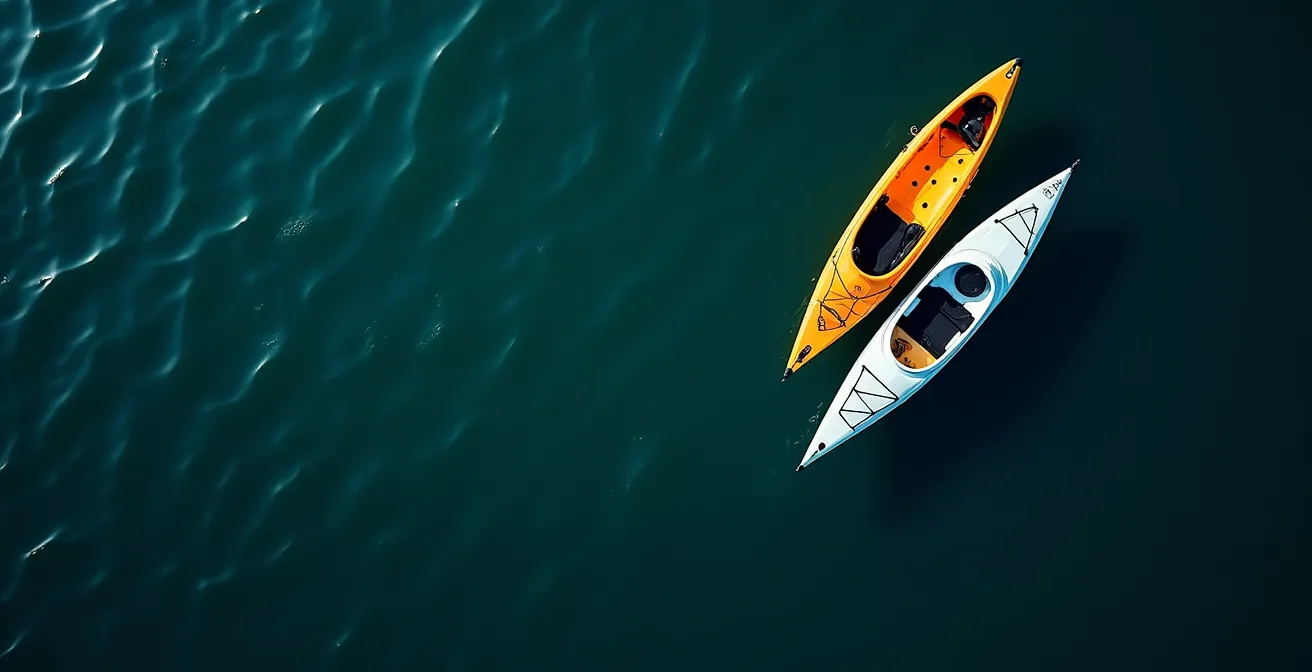
A proper sea kayak, in contrast, is designed for this exact scenario. It features a smaller cockpit sealed with a spray skirt, and most importantly, sealed bulkheads. These are watertight compartments in the bow and stern. If you flip, only the small cockpit area takes on water; the bulkheads keep the boat afloat, enabling self-rescue or assisted rescue. This is why professional standards for Class 4 waters like Tofino’s exposed coast explicitly require sea kayaks, spray skirts, and critical safety gear like a VHF radio. The environment dictates the gear, not the other way around, and the area’s seriousness is why the Tofino Coast Guard Radio monitors emergency channels continuously.
Ignoring this distinction isn’t just risky; it’s actively putting search and rescue teams in harm’s way. The Pacific’s beauty demands respect, and respect begins with the right boat.
Foam Blocks vs. J-Cradles: How to Transport a Kayak on a Rental Car
Your paddling adventure begins before you even reach the water, and a major safety blind spot is transportation. Tossing a kayak on a rental car with cheap foam blocks is a common but dangerous shortcut. While seemingly convenient, foam blocks offer minimal security against the powerful aerodynamic forces at highway speeds. On a highway like Ontario’s 401, cruising at 110 km/h, the air moving over and under the kayak creates significant aerodynamic lift on the bow, exactly like an airplane wing. A strong crosswind or the turbulence from a passing transport truck can be enough to rip a poorly secured boat from the roof, turning it into a lethal projectile.
J-cradles or dedicated saddles, when properly installed on a solid roof rack system, are infinitely safer. They secure the kayak on its strongest axis (the side) and allow for a much more robust connection with high-quality cam straps. It’s also crucial to use bow and stern lines. These two additional lines, running from the ends of the kayak down to the car’s frame, are not optional. They are what counteract the dangerous aerodynamic lift and prevent the boat from shifting forward or backward during a sudden stop. According to Transport Canada regulations, all watercraft must be securely attached, and using a temporary, unstable system like foam blocks may even void your rental car’s insurance policy in the event of an accident.
Investing in a proper transport system is not a luxury; it’s a fundamental part of responsible boat ownership and a critical safety measure for you and everyone else on the road.
Kayaks vs. Motorboats: Who Has the Right of Way on Muskoka Lakes?
On a busy Saturday in Muskoka, the water can feel more like a highway than a tranquil lake. Understanding the “rules of the road” is not just for motorboats; it’s a critical survival skill for paddlers. The official rule is that a human-powered vessel (like a kayak or canoe) is considered more vulnerable and therefore generally has the right of way over a more maneuverable powerboat. However, you must never assume the operator of a 40-foot cruiser sees you. As an instructor, I teach my students to operate under one principle: you are invisible. Your job is to stay out of the way.
To be “seen” legally, Transport Canada has mandatory equipment requirements. Between sunset and sunrise, or in periods of restricted visibility, you must have a watertight flashlight. You also need a sound-signalling device, specifically a “pealess” whistle, because the pea in a standard whistle can freeze or jam. The most important piece of gear is your PFD. Failing to have one for every person on board is not taken lightly. According to Canadian regulations, you can face a $200 fine plus an additional $100 for every missing PFD. This isn’t just a suggestion; it’s the law, and it’s there because it saves lives.
Ultimately, right of way is a legal concept, not a physical one. A fiberglass hull will always win against a plastic kayak. Paddle defensively, make yourself visible, and stay clear of the main navigation channels where large boats travel at speed.
Packing a Sea Kayak: How to Fit 3 Days of Gear into Hatches
Packing for a multi-day sea kayaking trip in Canada is an exercise in ruthless efficiency and safety-driven prioritization. Unlike backpacking, where you just carry the weight, how you pack a kayak dramatically affects its stability and performance. The golden rule is to keep the weight low and centered. Heavy items like water, food, and fuel should be packed as close to the cockpit as possible, right behind your seat or just in front of your feet. Lighter, bulkier items like sleeping bags and clothes can go in the far ends of the bow and stern hatches.

The Canadian context adds specific layers to your packing list. On the west coast, the water is cold year-round, meaning a wetsuit or drysuit is not optional—it’s essential survival gear. For any trip that goes more than a nautical mile (1.852 km) from shore, Transport Canada mandates carrying a VHF radio. In many of our pristine wilderness areas, like the Great Bear Rainforest, you’ll need bear-proof food storage like a hard-sided canister. You must also pack out everything you pack in, following Leave No Trace principles. Finally, don’t forget navigation; even in the age of GPS, carrying a physical chart in a waterproof case and a compass is a critical backup.
A well-packed boat feels stable and predictable in waves. A poorly packed boat, top-heavy and unbalanced, can become dangerously unstable when conditions get rough.
The “Wet Exit” Drill: What to Do If You Flip in Lake Superior
Flipping into the shockingly cold water of Lake Superior is a life-threatening event. The immediate danger is not hypothermia; that takes much longer to set in. The real killer is cold water shock, an involuntary gasp reflex followed by hyperventilation. If your head is underwater when this happens, you will drown. This is why you must understand the Canadian Safe Boating Council’s 1-10-1 principle. You have 1 minute to get your breathing under control. You then have 10 minutes of meaningful movement before the cold water robs your muscles of their function. Finally, you have 1 hour before you become unconscious from hypothermia.
Those first 10 minutes are your entire window for self-rescue. Lake Superior’s summer surface temperature hovers around 4°C, a temperature at which cold incapacitation happens with terrifying speed. Without a wetsuit or drysuit, your hands will become useless claws, unable to grip a paddle or a deck line. This is why practicing a “wet exit” is the most important safety drill you can learn. It involves staying calm, pulling the grab loop on your spray skirt, and pushing yourself out of the boat. As Dr. Gordon Giesbrecht, the world-renowned Canadian expert on hypothermia, explains:
Even in ice water it could take approximately 1 hour before becoming unconscious due to hypothermia
– Dr. Gordon Giesbrecht, Cold Water Boot Camp – 1-10-1 Principle
This highlights that you have time if, and only if, you can avoid drowning in the first minute and get yourself partially out of the water in the next ten.
Before you ever paddle on a large, cold Canadian lake, you must have the right thermal protection and have practiced your wet exit and re-entry skills until they are second nature.
Can You Bring an Inflatable Kayak on the Parks Canada Shuttle?
The iconic, glacier-fed lakes of Banff National Park, like Moraine Lake and Lake Louise, have become so popular that personal vehicle access is now heavily restricted. The primary way to reach them is via the Parks Canada shuttle system. This raises a common question for paddlers: can I bring my own boat? The answer for those with hard-shell kayaks is, unfortunately, no. There simply isn’t space. However, for those with more portable watercraft, the news is good.
For paddlers wanting to experience these breathtaking views from the water without paying for on-site rentals, inflatable kayaks are the perfect solution. Parks Canada officially confirms that inflatable kayaks, paddleboards, and packrafts are permitted on their shuttles, provided they are fully deflated, packed, and counted as one of your carry-on items. This opens up incredible opportunities, but it’s also important to remember that these lakes are extremely popular. If you’re looking for a quieter experience with an inflatable, consider some of Banff’s other stunning, more accessible gems:
- Two Jack Lake: Offers stunning reflections of Mount Rundle with easier access and fewer crowds.
- Johnson Lake: Known for being one of the warmer lakes in the area, making it great for families.
- Vermilion Lakes: A series of three lakes near the town of Banff, perfect for wildlife viewing, especially at sunrise or sunset.
- Lake Minnewanka: The largest lake in the park, offering plenty of space to explore with multiple launch points.
Using an inflatable kayak on the shuttle is a fantastic way to paddle these world-class locations independently, but exploring the incredible alternatives can often lead to an even more rewarding day on the water.
Zodiac vs. Large Vessel: Which Whale Tour Suits Your Stomach?
Whale watching is a quintessential Canadian coastal experience, but the type of vessel you choose dramatically impacts the adventure. The main choice is between a small, open Zodiac-style boat and a larger, covered vessel. The Zodiac offers a thrilling, at-level experience where you feel every wave and are fully exposed to the elements. It’s faster, more maneuverable, and can often get to whales more quickly. However, it’s a rough, wet ride and not suitable for those prone to seasickness, with back problems, or for young children.
A larger vessel is more of a stable viewing platform. It offers amenities like washrooms, protection from wind and rain, and a much smoother ride. While you’re higher off the water, the stability makes it a better choice for photography and for families. Regardless of your choice, all tour operators must follow strict federal laws. The Marine Mammal Regulations require operators to maintain a 100-metre distance from most whales. This distance increases to 200 metres for orcas in British Columbia and an even more protective 400 metres for the threatened beluga whales in the St. Lawrence Estuary. These rules are aggressively enforced, and kayakers are expected to abide by them as well, practicing passive observation and never approaching marine mammals.
Whether you choose the wild ride of a Zodiac or the comfort of a cruiser, going with a certified, reputable tour operator ensures both your safety and the well-being of Canada’s magnificent marine wildlife.
Key Takeaways
- Context Over Checklists: Canadian paddling safety is not one-size-fits-all. The gear and skills required for a calm lake are dangerously inadequate for the ocean or a large, cold lake.
- Cold Is the Real Killer: The greatest threat in most Canadian waters is cold water shock, which can incapacitate you in minutes. Thermal protection like a wetsuit or drysuit is non-negotiable in places like Lake Superior or the Pacific.
- Respect Regulations: From right-of-way on busy lakes to minimum distances from marine wildlife and Leave No Trace principles in our parks, understanding and following local rules is a critical part of paddling safely and responsibly.
Kayaking Moraine Lake: Rentals vs. Bringing Your Own Boat
Paddling on the surreal turquoise water of Moraine Lake is a bucket-list experience. But with the new restrictions on personal vehicles, getting on the water requires a strategic plan. You have two main options: renting a canoe from the on-site dock or bringing your own inflatable kayak on the Parks Canada shuttle. The choice comes down to a trade-off between cost, convenience, and flexibility.
Renting a canoe is incredibly convenient—you simply walk up, pay, and paddle. There’s no gear to haul or inflate. However, this convenience comes at a steep price, and you are limited to their hours of operation, missing the magical light of sunrise and sunset. Bringing your own inflatable kayak offers ultimate flexibility to paddle whenever you want, for as long as you want, at a fraction of the cost. The downside is logistics: carrying a 30-50 pound bag to the launch point and spending time inflating and deflating your boat. The break-even point is a key consideration.
| Option | Cost | Time Flexibility | Logistics |
|---|---|---|---|
| Canoe Rental | ~$140 CAD/hour | Limited to dock hours | No transport hassle |
| Inflatable Kayak | Shuttle: $8-35 | Sunrise to sunset | 30-50 lb to carry, inflation time |
| Break-even | Renting makes sense for under 90 minutes of paddling | ||
If you do bring your own boat, you are a guest in a fragile, protected ecosystem. You must adhere strictly to Leave No Trace principles to preserve this iconic landscape for future generations. This is not optional; it’s a condition of access.
Action Plan: Your Leave No Trace Checklist for Moraine Lake
- Obtain your self-certification permit from Parks Canada before launching any personal watercraft.
- Execute the “Clean, Drain, Dry” protocol for all equipment to prevent the spread of invasive species.
- Launch and land your boat only from the designated dock area to avoid shoreline erosion.
- Pack out all of your gear and waste, including food scraps and anything else you brought with you.
- Maintain a respectful distance from any wildlife. Never feed or approach animals, especially during sensitive nesting seasons.
Whether you rent for an hour or paddle your own boat all day, the privilege of being on that water comes with the responsibility to protect it. The next logical step isn’t buying more gear; it’s investing in knowledge. Find a certified Paddle Canada course near you and turn this information into life-saving skill.