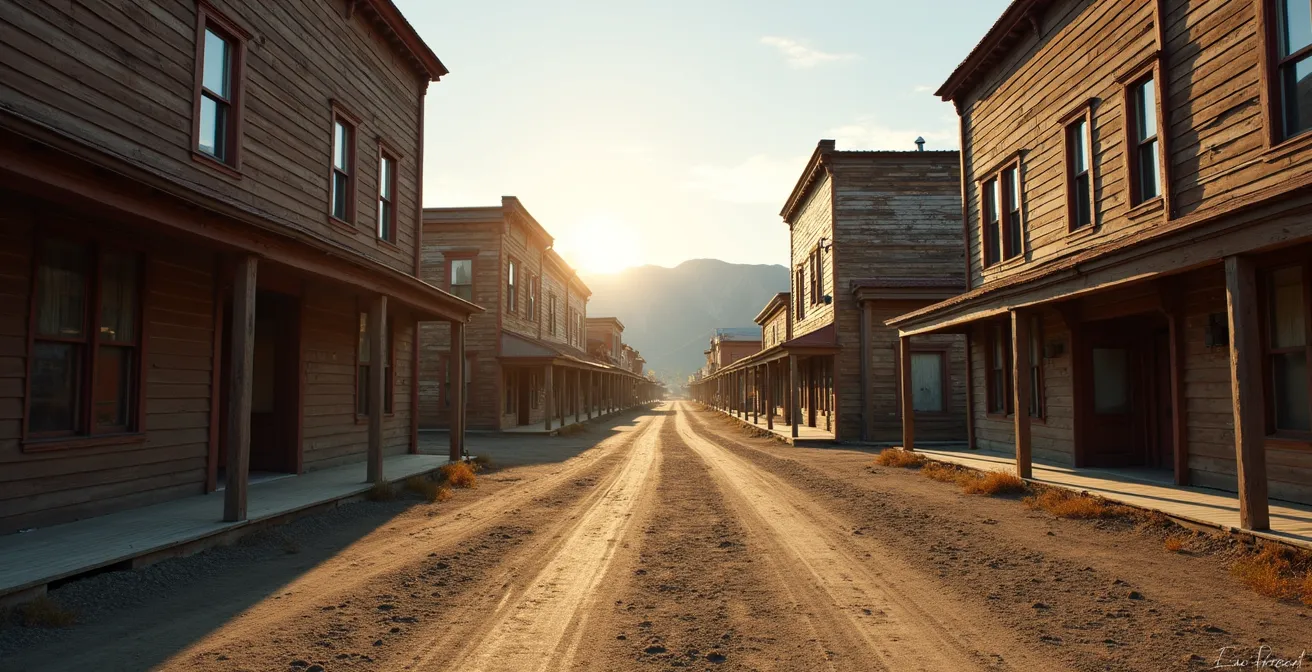
Dawson City isn’t a polished tourist town; it’s a raw frontier outpost where the bizarre spirit of the Gold Rush is still shockingly alive.
- The town’s rituals, from the infamous Sourtoe Cocktail to its historic casino, are active connections to a gritty, unconventional past.
- The surrounding landscape, with its midnight sun and harsh highways, is as much a part of the story as the gold itself.
Recommendation: To truly experience Dawson, you must embrace its challenges and oddities—that’s where its authentic history is found.
Mention Dawson City, and most people picture grizzled prospectors, muddy streets, and the frantic gleam of gold. They imagine a town frozen in time, a perfect replica of the 1898 Klondike Gold Rush. In a way, they’re right. The dirt roads and wooden boardwalks are still here. But to think of Dawson as just a historical museum is to miss the point entirely. This isn’t a place where history is quietly observed behind velvet ropes; it’s a place where the chaotic, ambitious, and often bizarre frontier grit of the past is a living, breathing part of the present.
Many guides will give you a simple checklist: see a can-can show, pan for gold, visit a cabin. But they fail to capture the town’s true spirit. They don’t explain *why* thousands of people willingly join a club that requires them to drink a whiskey with a mummified human toe in it. They don’t convey the profound silence of the Dempster Highway or the surreal feeling of hiking under a sun that refuses to set. This town’s story isn’t just about the pursuit of wealth, but about the enduring spirit required to survive—and thrive—at the edge of the world.
This guide goes beyond the typical itinerary. We’ll delve into the strange rituals, the practical challenges, and the deep cultural layers that make Dawson City one of the most unique places in Canada. We’ll explore the ‘why’ behind its most famous traditions, understand the landscape that shapes its character, and connect with a history that is far from over. Forget what you think you know about historical towns; you’re about to discover a place where the Gold Rush never truly ended.
Summary: An Insider’s Look at Dawson City’s Living History
- The Sourtoe Cocktail: Why Travelers Pay $10 to Touch a Human Toe
- Free Claim #6 & Reaching Rocky Mountain Summits: Preparation for Every Skill Level
- Dempster Highway Safety: What You Need to Drive to the Arctic Ocean
- Gambling Hall Etiquette: How to Enjoy Canada’s Oldest Casino
- How to Sleep When the Sun Doesn’t Set in July
- Hudson’s Bay Company Forts: How Fur Trade Built the Country
- Why Mistaken Point is Worth the Detour for Fossil Enthusiasts
- The Spirits in the Sky: Indigenous Legends of the Northern Lights
The Sourtoe Cocktail: Why Travelers Pay $10 to Touch a Human Toe
Let’s get this out of the way. Yes, it’s real. And no, you don’t swallow it. The Sourtoe Cocktail is arguably Dawson’s most famous tradition and one of the quintessential rituals of the North. At the Downtown Hotel, you can order a shot of your choice (traditionally Yukon Jack) served with a genuine, dehydrated human toe. The rule is simple: “You can drink it fast, you can drink it slow, but your lips must touch the gnarly toe.” Succeed, and you become a member of a surprisingly large club. The tradition dates back to 1973 and a legendary toe that supposedly belonged to a Prohibition-era rum runner named Louie Liken.
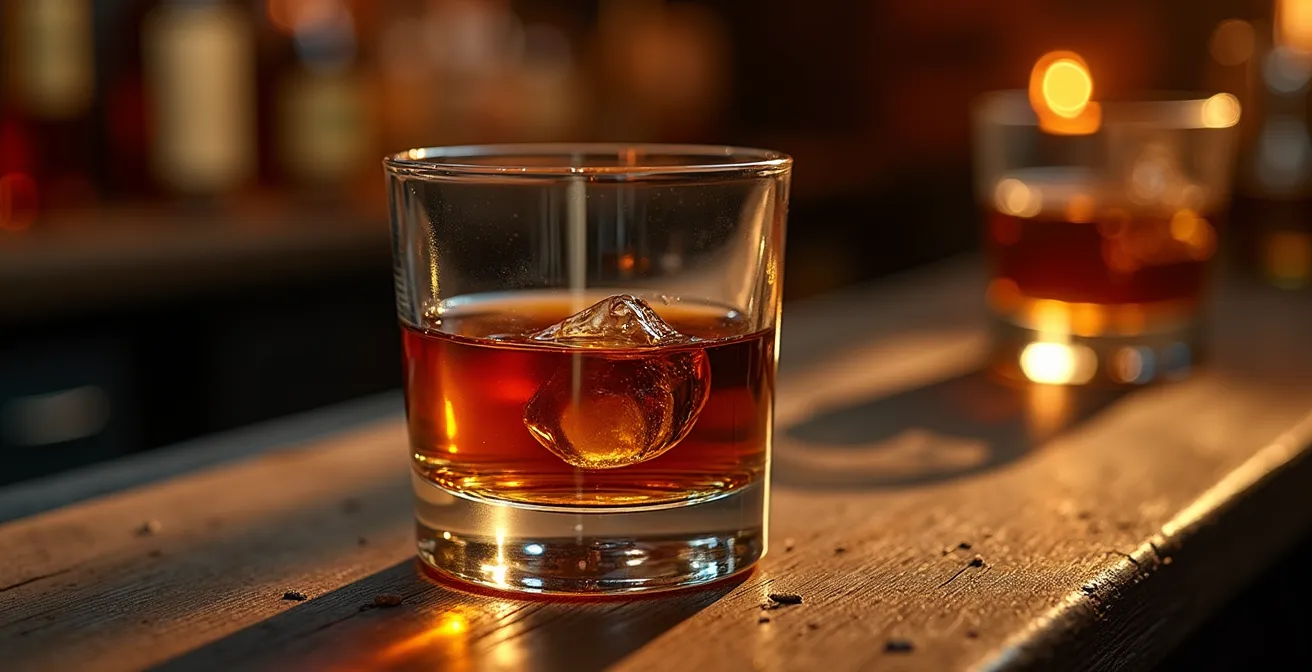
This isn’t just a gimmick; it’s a rite of passage that perfectly encapsulates Dawson’s gritty, irreverent character. It’s a story you’ll tell for the rest of your life, and it connects you to a long line of adventurers who’ve proven their mettle in the North. According to official records, there are now over 100,000 members from every corner of the world. The tradition is so ingrained in Yukon culture that in 2017, the milestone 100,000th cocktail was served to none other than the territory’s Premier, Sandy Silver, solidifying its status as an official, if bizarre, piece of Canadiana.
So, why do people do it? Because in Dawson, history isn’t something you just look at. It’s something you taste. It’s about earning your story and embracing the weird, wild heart of the frontier.
Free Claim #6 & Reaching Rocky Mountain Summits: Preparation for Every Skill Level
The promise of gold is what built this town, and that promise, however faint, still lingers in the creeks. At Free Claim #6 on Bonanza Creek Road, you can try your hand at finding it yourself. This isn’t a tourist trap with salted pans; it’s a legitimate claim open to the public. You bring your own gear (or rent it nearby), pick a spot along the historic creek, and see what you can find. It connects you directly to the back-breaking work of the original stampeders. As local expert Paul explained on PBS, this very ground has seen it all: “We’re right close to the discovery site so there was many people that came in here and hand mined it between 1896 and 1901 or so and then they had a dredge come through here.”
Action Plan: Panning for Gold at Free Claim #6
- Gear Up: Secure your own gold pans and shovels. These can be rented down the road at Claim 33 or purchased in town before you head out.
- Scout Your Spot: Head to Free Claim #6 on Bonanza Creek and pick a location that feels lucky. The gold is there, but it won’t jump into your pan.
- Master the Technique: Fill your pan with gravel from the creek bed, add water, and begin the careful process of swirling and washing away the lighter material, leaving the heavy gold behind.
- Examine Your Find: Look for the tell-tale glint of “colour” in the black sand at the bottom of your pan. Remember, any gold you find, you get to keep.
- Embrace the Addiction: Be warned—the search for gold can be an addictive thrill. Even a few tiny flakes can feel like a monumental victory.
This spirit of rugged self-reliance extends far beyond the gold fields. While the Yukon’s Ogilvie Mountains define the local landscape, that same call to adventure echoes south in the Canadian Rockies. Preparing for a summit there requires the same mindset as prospecting: careful planning, the right gear, and respect for the environment. Whether it’s an easy scramble or a technical ascent, the goal is the same: to pit yourself against the vastness of the Canadian wilderness and come away with an incredible story.
From the creeks of the Klondike to the peaks of the Rockies, the challenge is what makes the experience worthwhile. It’s about more than what you find; it’s about what you find in yourself.
Dempster Highway Safety: What You Need to Drive to the Arctic Ocean
If you truly want to experience the scale and isolation of the North, there is no better way than driving the Dempster Highway. This is the only public road in Canada that crosses the Arctic Circle, a 740-kilometre ribbon of gravel stretching from the Klondike Highway to Inuvik in the Northwest Territories, with a new extension to Tuktoyaktuk on the Arctic Ocean. This is not a casual Sunday drive; it is a true test of preparedness and a journey into a vast, empty, and surreal landscape. There is no cell service for almost the entire length, and services are few and far between.
Success on the Dempster is all about preparation. Your vehicle must be in top condition, but more importantly, you need redundancy. The number one rule of the Dempster is to carry two full-sized spare tires. The road surface is made of sharp shale, and flat tires are not a matter of ‘if’ but ‘when’. You must also carry extra fuel, as the only gas station is at Eagle Plains, roughly the halfway point. A well-stocked emergency kit is non-negotiable, including food, water, warm clothing (even in summer), and basic tools. You are your own first responder out here.
The drive itself is spectacular, taking you through the jagged Tombstone Mountains and across vast tundra. But the real experience is the feeling of self-reliance. Changing a tire on the side of a silent highway, hundreds of kilometres from the nearest town, is a profound moment. It’s the modern-day equivalent of the frontier grit that defined the original stampeders. This journey is a commitment, and completing it is an accomplishment that connects you to the raw, untamed soul of the Yukon.
It’s a powerful reminder that in this part of the world, nature is still firmly in charge, and we are merely guests who must come prepared.
Gambling Hall Etiquette: How to Enjoy Canada’s Oldest Casino
Long before Las Vegas had its glitz, Dawson City had Diamond Tooth Gertie’s. More than just a casino, Gertie’s is a living piece of Gold Rush history. While it officially holds the distinction as Canada’s first licensed casino, opening in 1971, its soul is pure 1898. The real etiquette here has less to do with the blackjack table and more to do with embracing the atmosphere. This isn’t a place for quiet, serious gambling; it’s a rowdy, joyous celebration of the boomtown spirit. The sound of the honky-tonk piano, the cheers from the tables, and the hooting for the can-can dancers are all part of the experience.
The main attraction for many isn’t the gambling, but the floor shows. Three times a night, the “Gold Rush Gals” perform high-kicking, can-can-inspired numbers, with each show getting progressively more risqué as the evening wears on. As one visitor noted:
I really enjoyed the cancan/cabaret inspired shows at Diamond Tooth Gerties. I loved the vibrant costumes and old-timey music, plus was really impressed with the talent of the Gold Rush Gals… Each show is unique and gets a little more risqué as the night goes on.
– Travel Yes Please
The best way to enjoy Gertie’s is to lean into the fun. Applaud the dancers, exchange stories with the person next to you at the table, and don’t be afraid to let out a cheer. It’s a place to be social, to imagine the release a lonely prospector must have felt coming into town after months in the wilderness. The gambling is secondary to the camaraderie and spectacle. So grab a drink, find a seat, and let yourself be transported back to a time when a lucky hand could change your life overnight.
It’s one of the few places where you can still feel the high-stakes energy that fueled the Klondike dream.
How to Sleep When the Sun Doesn’t Set in July
One of the most disorienting and magical parts of a Yukon summer is the Midnight Sun. In June and July, the sun barely dips below the horizon, bathing the landscape in a perpetual golden-hour glow for nearly 24 hours a day. This is the definition of a surreal landscape. It messes with your internal clock and makes time feel fluid and strange. A visitor might leave a lively show at Diamond Tooth Gertie’s, expecting to step into darkness, only to be met with a sky as bright as late afternoon. As one traveler recounted, “I stepped out of the noise of Gerties and onto the quiet street, I was startled to see the mountains clear as day against a pale blue sky. I glanced at my watch: it was almost midnight.”
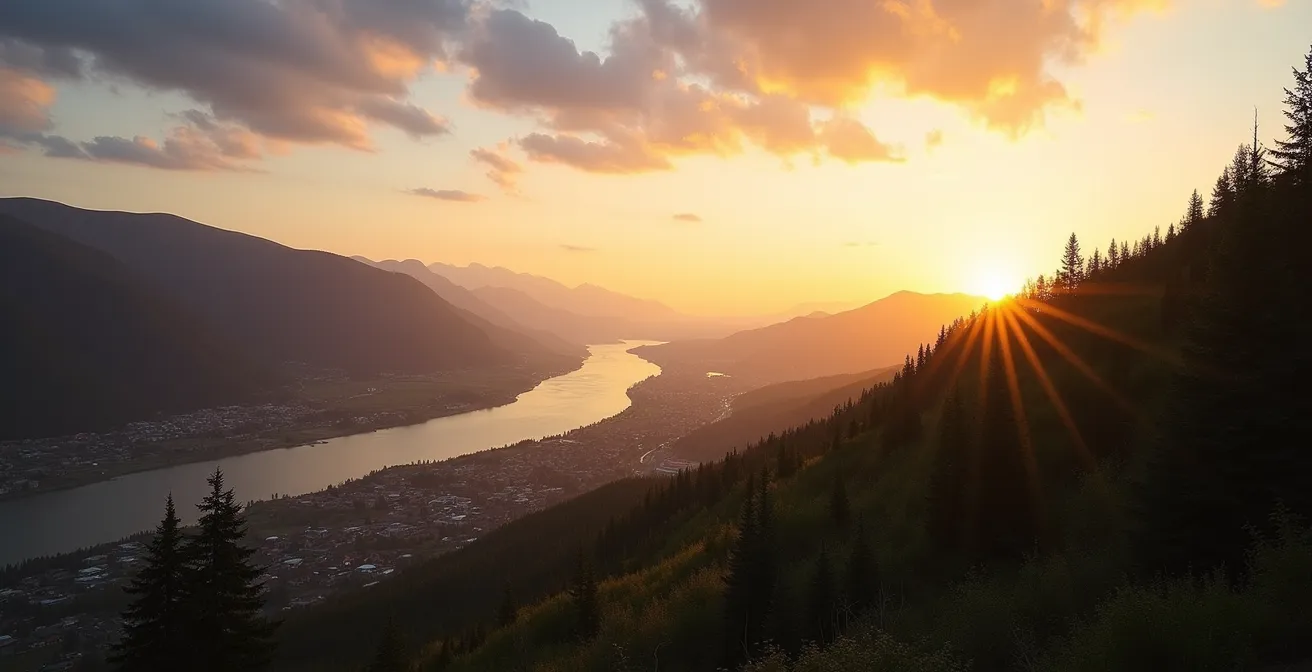
So, how do you manage to sleep? For locals, it’s second nature. For visitors, it requires a bit of strategy. The first line of defense is a good set of blackout curtains in your hotel room or RV. An eye mask is also an essential piece of gear. But the best advice is to adjust your rhythm. Don’t fight the light; use it. The Midnight Sun opens up a world of possibilities. Go for a hike up the Midnight Dome for an unforgettable view of the town and the Yukon River valley at 1 a.m. Go fishing, have a late-night picnic, or simply sit by the river and watch the world glow.
Trying to force a normal sleep schedule is a losing battle. The true Dawson experience is about leaning into the weirdness. Allow yourself to stay up late, to let the endless daylight fuel your adventures. You can sleep when you get home. Here, in the land of the Midnight Sun, there is simply too much to see.
Embracing this strange solar cycle is a core part of understanding the unique environment that has shaped life in the Yukon for centuries.
Hudson’s Bay Company Forts: How Fur Trade Built the Country
Before the first prospector ever shouted “Gold!”, another resource drove European expansion across this vast land: fur. To understand the Klondike Gold Rush, you have to understand what came before it. For over two centuries, the Hudson’s Bay Company (HBC) was the dominant force in much of what would become Canada. Its network of forts, like Fort Selkirk at the confluence of the Yukon and Pelly rivers, were the original outposts of commerce and control in the wilderness. These were not military installations, but trading posts, the epicentres of a complex economic and cultural exchange between European traders and Indigenous nations.
The fur trade laid the groundwork for the Gold Rush in several crucial ways. It established the very first transportation routes and supply lines into the remote interior. It created a population of hardy, self-sufficient traders and voyageurs who were accustomed to the harsh northern climate—the original “sourdoughs.” Most importantly, it established a pattern of resource extraction that would be repeated on a massive, frantic scale in 1898. The fur trade was a slow, methodical expansion, while the Gold Rush was an explosion.
Visiting the remains of these old forts, or even just acknowledging their history, provides a vital context. It shows that the Klondike Stampede wasn’t an isolated event. It was the chaotic, super-charged next chapter in a longer story of Canada’s relationship with its vast, resource-rich wilderness. The enduring spirit of the fur trader—resourceful, resilient, and willing to gamble everything on the frontier—was the same spirit that would soon fuel the gold fever of the Klondike.
The quest for beaver pelts may seem a world away from gold nuggets, but both are threads in the same historical tapestry of ambition and exploitation in the Canadian North.
Why Mistaken Point is Worth the Detour for Fossil Enthusiasts
As a guide to the Yukon’s history, my stories are usually written in gold, rock, and human ambition. But Canada is a land of many stories, some infinitely older. While Dawson City tells a tale of the last 150 years, a journey to the country’s opposite coast—to Mistaken Point, Newfoundland—takes you back over 565 million years. This is a detour of continental proportions, but for any true history enthusiast, it’s a pilgrimage to the very dawn of complex life on Earth.
Mistaken Point, a UNESCO World Heritage Site, is a windswept stretch of coastal cliffs. It’s not what’s above ground that’s special, but what’s underfoot. Preserved in layers of ancient mudstone are thousands of fossils from the Ediacaran Period. These are not dinosaurs or shells; they are bizarre, frond-like organisms that represent some of the earliest, largest, and most complex multicellular life forms to ever appear. Walking on these fossil surfaces, which you can only do with a licensed guide, feels like visiting another planet. You are literally standing at the beginning of animal life’s grand experiment.
Why mention this in a guide to the Klondike? Because it provides a profound sense of perspective. The Gold Rush was a frantic, fleeting moment driven by human desire. The fossils of Mistaken Point tell a story of deep time, of life’s incredible persistence and fragility, on a scale that dwarfs human history. It reminds us that the land we travel holds stories far older than our own. It’s a humbling contrast to the chaotic energy of Dawson, and it highlights the incredible diversity of historical experiences Canada offers—from the rush for wealth to the silent testament of Earth’s first large creatures.
It’s a powerful reminder that every part of this country has a deep, unique story to tell, if you only know where to look.
Key Takeaways
- Dawson City’s character is defined by “living history” rituals like the Sourtoe Cocktail, not just preserved buildings.
- True northern adventure requires embracing frontier grit, whether panning for gold or preparing for the challenges of the Dempster Highway.
- The surreal landscape, especially the Midnight Sun, is an integral part of the Dawson experience that shapes the local rhythm of life.
The Spirits in the Sky: Indigenous Legends of the Northern Lights
While the Gold Rush brought a tidal wave of stampeders to the Yukon, this land has been home to the Tr’ondëk Hwëch’in First Nation for millennia. Their story is the bedrock upon which Dawson City is built, and no visit is complete without acknowledging their deep connection to this place. This connection is beautifully expressed in their relationship with the natural world, including the awe-inspiring Aurora Borealis, or Northern Lights. While science explains them as solar particles interacting with the atmosphere, for many Indigenous cultures, they are the dancing spirits of ancestors.
To see the lights from the banks of the Yukon River is to feel a connection to something ancient and powerful. It’s a moment that transcends the history of the Gold Rush and touches a much deeper, spiritual timeline. Understanding this perspective is crucial, as the Gold Rush had a devastating impact on the Tr’ondëk Hwëch’in way of life. As Landsby Travel notes, it’s vital to connect with this living culture:
Learn about the culture and traditions of the Tr’ondëk Hwëch’in, the original inhabitants of the land, at the Dänojà Zho Cultural Centre. See the impact the gold rush had on their way of life and how the next generation is reviving traditions that were almost lost.
– Landsby Travel, Living History: The Gold Rush In Yukon’s Dawson City
This enduring presence and cultural significance were recently given global recognition. The Tr’ondëk-Klondike UNESCO World Heritage Site designation was announced in September 2023, cementing the intertwined history of the landscape and the Tr’ondëk Hwëch’in people. It acknowledges that this is not just a Gold Rush site, but a cultural landscape of profound importance. The spirits in the sky are a reminder that this land’s story is ancient, and its original people are its most important storytellers.
When you come to Dawson City, come for the gold, but stay for the history—all of it. Explore the saloons, hike under the midnight sun, and listen for the whispers of the past. This is a place that gets under your skin, and its stories will stay with you long after you’ve left.