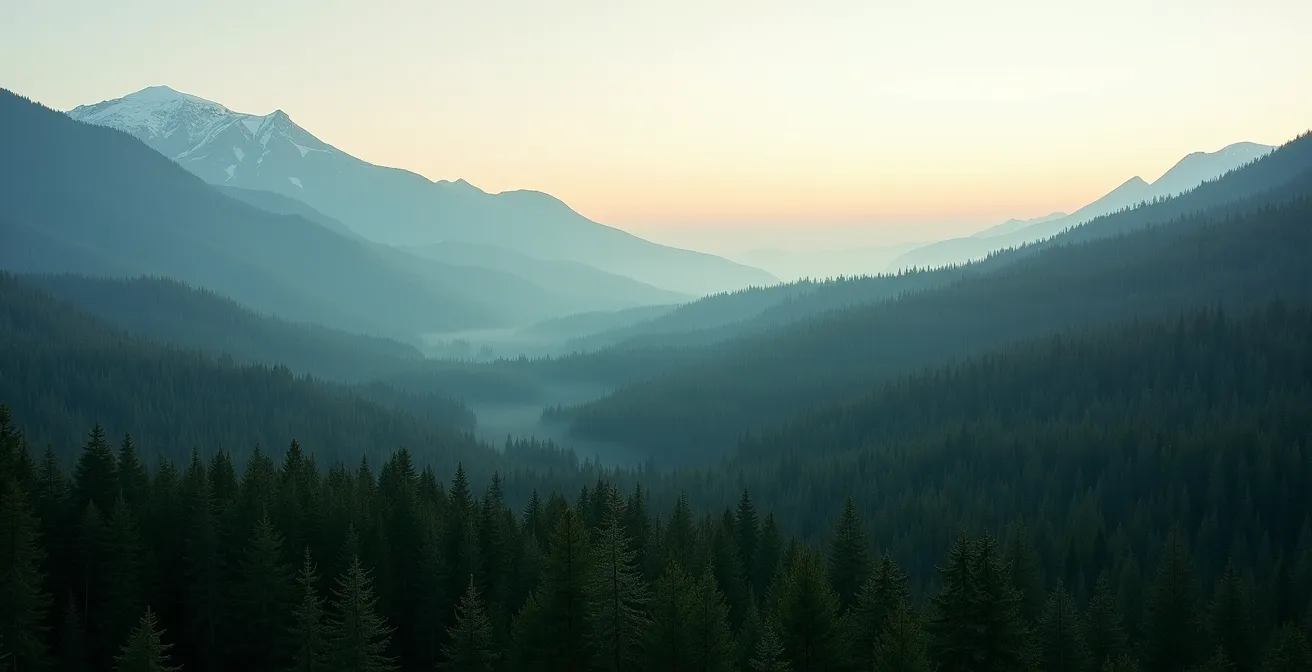
Canada’s boreal forest is more than a vast expanse of trees; it’s a dynamic superorganism driven by cycles of fire, deep cold, and unique co-dependencies.
- Essential processes like fire are not disasters but catalysts for rebirth, crucial for species like the Jack Pine.
- The ground itself, in the form of muskeg and peatlands, acts as a globally significant “carbon sponge.”
Recommendation: To truly appreciate the boreal, one must look beyond the landscape and see the intricate ecological machinery at work.
When we picture Canada’s boreal forest, the image is often one of serene, near-infinite stillness: a green band of spruce and pine stretching across the continent, silent under the watch of a billion stars. We’ve heard it called the “lungs of the world” or a pristine wilderness teeming with iconic wildlife like moose and bears. While these descriptions hold a kernel of truth, they miss the forest’s most captivating secret: it is not a static postcard but a living, breathing, and constantly changing superorganism.
The true story of the boreal is one of dramatic and powerful cycles. It’s a place where fire is a creative force, not just a destructive one; where a bitter cold of -40°C is not an obstacle to life but a master sculptor of it; and where the relationship between plants, animals, and the very ground they stand on is a masterclass in co-dependent survival. To understand the boreal is to look past the individual trees and see the intricate ecological machinery that connects them all.
This guide moves beyond the surface to explore that machinery. We will learn to see the forest as an ecologist does—deciphering the stories told by tree needles, understanding the life-giving role of fire, meeting the ingenious inhabitants who have mastered this environment, and discovering how to immerse ourselves in this landscape in a way that is both profound and respectful. This is the boreal forest, not as a simple place, but as a complex and fascinating process.
This article delves into the specific, interconnected systems that define the boreal ecosystem. From identifying trees by their needles to understanding the role of insects and the profound experience of “forest bathing,” the following sections reveal the hidden life of Canada’s great northern forest.
Summary: The Dynamic Systems of Canada’s Northern Forest
- Black Spruce or Balsam Fir: How to ID Trees by Their Needles
- Why Forest Fires Are Essential for Jack Pine Reproduction
- Why the Gray Jay is the “Camp Robber” of the Boreal Forest
- Black Flies vs. Mosquitoes: Surviving the June “Bug Season” in the North
- Why Walking on Muskeg is Like Walking on a Carbon Sponge
- How to Hike Boreal Trails Without Damaging Ancient Moss Beds
- How to Practice Shinrin-Yoku in Ontario’s Boreal Forests
- Healing in Nature: Finding Solace in Canada’s Vast Landscapes
Black Spruce or Balsam Fir: How to ID Trees by Their Needles
To the casual observer, the boreal canopy is an undifferentiated sea of green conifers. But to an ecologist, every needle tells a story of adaptation. Distinguishing between Black Spruce (Picea mariana) and Balsam Fir (Abies balsamea) is a fundamental skill that opens up a deeper understanding of the forest’s structure. It’s not just about naming species; it’s about recognizing how form follows function in one of Earth’s most demanding climates. Balsam Fir, for instance, is a testament to this resilience; it is one of the most cold-hardy trees known, surviving at temperatures as low as -45°C (-49°F).
The key differences are tactile and visual. A spruce needle, when rolled between your fingers, is squarish and sharp—often described as “spiky spruce.” A fir needle, by contrast, is flat and soft, impossible to roll, leading to the mnemonic “flat, friendly fir.” This simple test reveals two different strategies for survival. The visual cues are just as distinct, offering a clear guide to the tree’s identity.
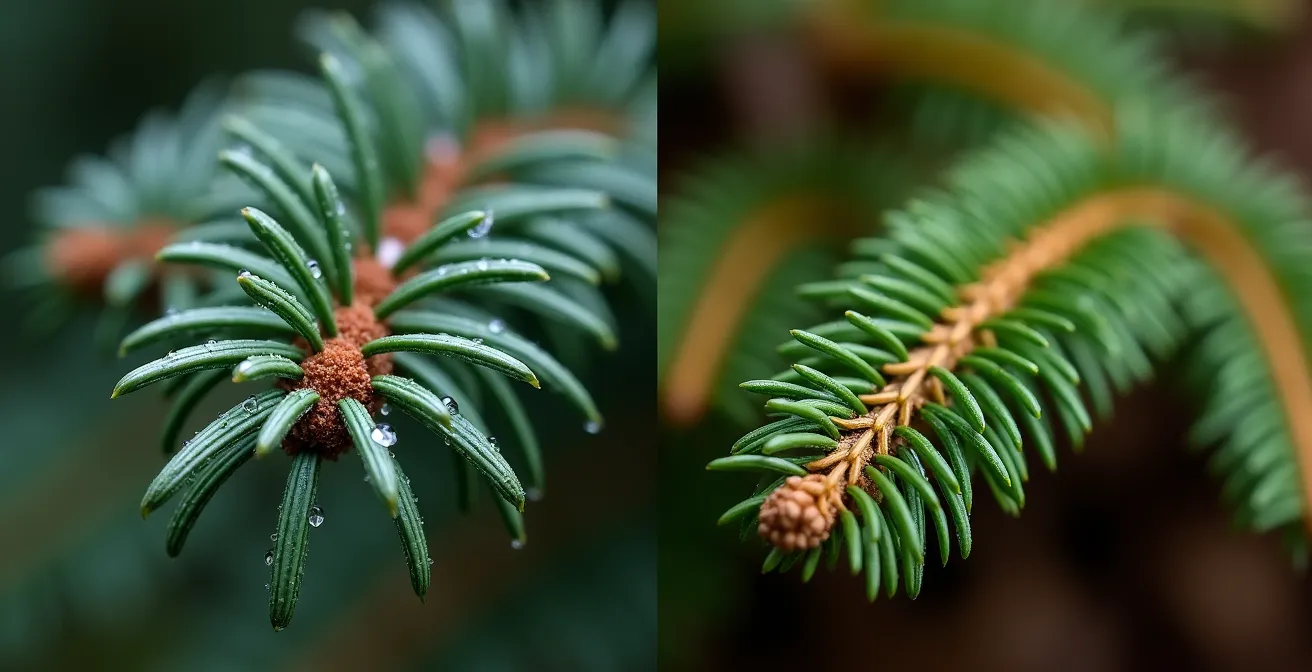
The comparison in the image above highlights the structural differences. Fir needles are flat, with two distinct white bands of stomata on their underside, and attach to the twig with a small, suction-cup-like base. Spruce needles are four-sided and attach via a small, woody peg that remains on the twig even after the needle falls. Even their cones tell different tales: fir cones stand upright and disintegrate on the branch, while spruce cones hang down and fall to the ground whole. Learning to spot these details transforms a simple walk in the woods into an active process of discovery.
Why Forest Fires Are Essential for Jack Pine Reproduction
The modern human instinct is to view fire as a purely destructive force—an enemy of the forest. In the boreal ecosystem, however, this view is incomplete. Here, fire is a powerful and essential agent of renewal, a key part of the “dynamic cycle” that drives the forest’s health. For certain species, most notably the Jack Pine (Pinus banksiana), fire is not the end of life; it is the absolute requirement for its beginning. This seemingly brutal co-dependency is a cornerstone of boreal ecology. The scale of this process is immense; in a single recent year, wildfires in Canada shaped the landscape across a record 17.3 million hectares.
The secret to this relationship lies in a remarkable adaptation known as serotiny. Jack Pine trees produce resin-sealed cones that can remain closed on the branch for years, or even decades, protecting the seeds within. They are, in effect, a patient seed bank waiting for a specific trigger: the intense heat of a forest fire. When a fire sweeps through a stand of Jack Pine, the resin melts, the cone scales spring open, and millions of seeds are released onto the newly cleared, sun-drenched, and nutrient-rich ash bed below. The fire eliminates competing vegetation and creates the perfect nursery for a new generation of pines to germinate.
This process ensures the long-term survival of the species, allowing it to out-compete others in a post-fire environment. Far from being a catastrophe, a fire in a Jack Pine stand is a dramatic and necessary spectacle of rebirth. It demonstrates a profound principle of the boreal forest: what appears to be destruction is often the engine of creation, ensuring the forest’s resilience and perpetual regeneration over millennia.
Why the Gray Jay is the ‘Camp Robber’ of the Boreal Forest
Anyone who has spent time camping in Canada’s north has likely met the Gray Jay (Perisoreus canadensis). Known for its bold, curious nature and its uncanny ability to appear silently the moment food is unpacked, it has earned the nickname “camp robber.” But this behaviour isn’t mischief; it’s a sophisticated survival strategy honed by millennia in the harsh boom-and-bust environment of the boreal forest. This resilient corvid is a true northern specialist, known to withstand temperatures as low as -30°F (-34°C) by relying on its cached food.
The Gray Jay is a non-migratory, food-caching bird. Unlike other species that fly south, it remains in the boreal through the brutal winter. To do this, it spends the summer and fall gathering and hiding thousands of individual food items—insects, berries, fungi, and scraps from friendly campers. It uses its sticky saliva to glue these morsels into crevices in tree bark and under lichen, creating a distributed pantry it can access during the lean winter months. Its remarkable spatial memory allows it to relocate these caches, even under a blanket of snow. Its “camp robber” persona is simply an extension of this relentless, opportunistic foraging that is essential for its survival.
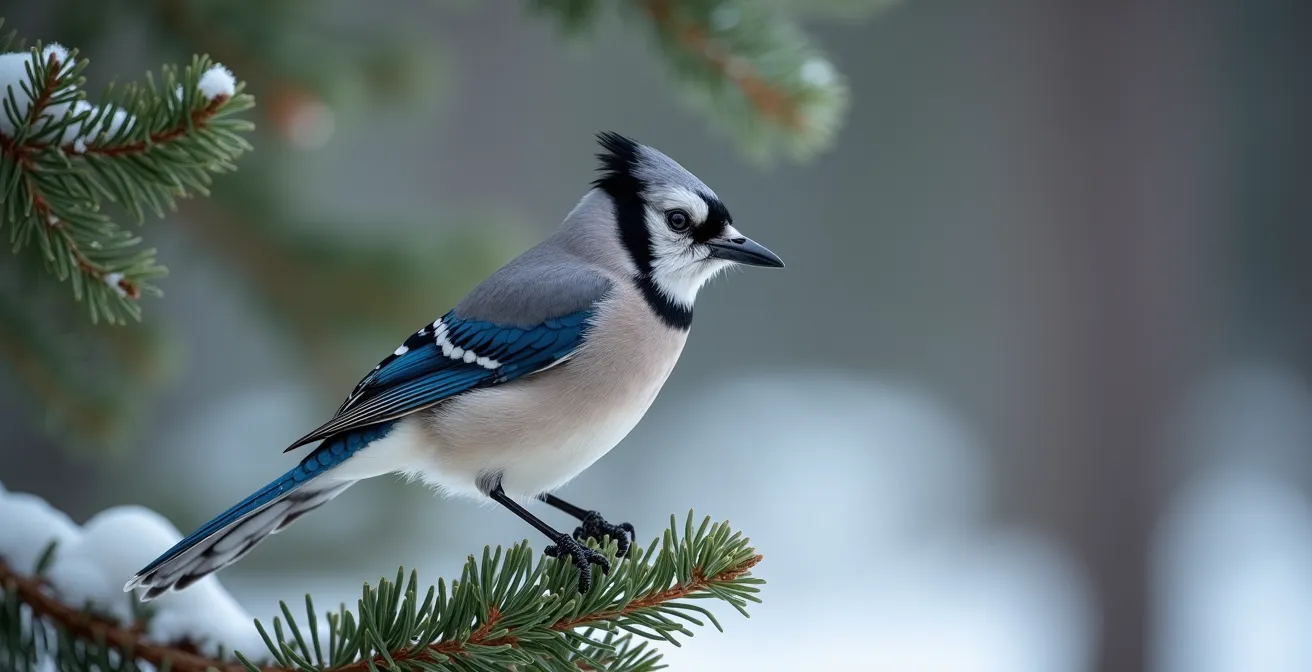
This bird’s connection to Canada runs deep, extending even to its name. The common moniker “Whiskey Jack” is not a reference to alcohol but a fascinating piece of linguistic history, as explained by Canadian Geographic.
The common moniker ‘whiskey jack’ has nothing to do with grain-based alcohols, but is rather an anglicization of the Cree Wisakedjak and similar variations used by nations in the Algonquian language family, which makes the gray jay Canada’s only bird commonly referred to by a traditional Indigenous name.
– Canadian Geographic, Meet our national bird: the gray jay
The Gray Jay, or Wisakedjak, is therefore not just a clever survivor, but a living link to the cultural and ecological history of the boreal forest itself.
Black Flies vs. Mosquitoes: Surviving the June ‘Bug Season’ in the North
For many, the mention of the boreal forest in early summer conjures a single, visceral image: a buzzing cloud of biting insects. The infamous “bug season” is a defining feature of the northern experience, driven primarily by two antagonists: black flies and mosquitoes. While they are often lumped together as a general nuisance, they are distinct creatures with different habits, habitats, and ecological roles. To the ecosystem, they are not a pest but a massive, predictable pulse of biomass—a critical food source that fuels the entire food web, from fish to migratory songbirds. For the science-curious traveler, understanding their differences is the first step to surviving, and even appreciating, this intense natural phenomenon.
Black flies (Simuliidae family) and mosquitoes (Culicidae family) occupy different niches. Black flies breed in cold, fast-flowing rivers and streams, making them prevalent in the rocky Canadian Shield terrain of Northern Ontario and Quebec. Mosquitoes, on the other hand, lay their eggs in stagnant, standing water, thriving in the wetlands and muskeg of Manitoba and the Northwest Territories. As the following comparison shows, their behaviour is just as distinct.
As this comparative analysis from The Canadian Encyclopedia illustrates, knowing your foe is key to mitigating their impact.
| Characteristic | Black Flies | Mosquitoes |
|---|---|---|
| Peak Season | Late May – June | June – July |
| Preferred Habitat | Fast-flowing rivers (Northern Ontario, Quebec) | Wetlands and standing water (Manitoba, NWT) |
| Active Time | Daytime, especially morning | Dawn and dusk primarily |
| Ecological Role | Key food for migratory songbirds | Critical for fish populations |
Action Plan: Navigating Canada’s Boreal Bug Season
- Plan your visit timing: Target late May for the window before most bugs emerge, or late July and August after the peak season has passed.
- Choose appropriate gear: Wear light-colored, tightly woven clothing to deter black flies, which are attracted to dark colors and crawl into openings. Opt for loose-fitting layers against mosquitoes.
- Select Canadian-made repellents: Look for products from brands like Muskol or Watkins, which are specifically formulated for the intense conditions of the Canadian north.
- Understand the zones: When planning your trip, anticipate black flies near rivers and rapids in Shield country, and prepare for mosquitoes in areas with extensive muskeg and wetlands.
Why Walking on Muskeg is Like Walking on a Carbon Sponge
In the vast expanse of the boreal, some of the most important work happens not in the towering canopy, but underfoot. Much of the forest floor is a unique type of wetland known as muskeg or peatland—a damp, spongy, moss-covered landscape that can feel like walking on a waterbed. This seemingly barren terrain is, in fact, one of the planet’s most efficient and important carbon storage systems. Boreal peatlands are a colossal “carbon sponge,” locking away more carbon than all the world’s tropical rainforests combined. In Canada, this critical ecosystem is vast; these peatlands, primarily located in boreal regions, comprise 12% of Canada’s land area.
The secret to muskeg’s carbon-storing power is its unique chemistry. It is dominated by Sphagnum moss, a remarkable plant that creates a highly acidic, low-oxygen, waterlogged environment as it grows. When plants in the muskeg die, they do not fully decompose. The cold, acidic, and anaerobic conditions dramatically slow down the process of decay. Instead of releasing their carbon back into the atmosphere, the dead organic matter slowly compacts over millennia, forming deep layers of peat. This makes the boreal peatlands a massive carbon archive, holding onto organic matter that is thousands of years old.
Case Study: The Hudson Bay Lowlands Carbon Bank
The Hudson Bay Lowlands, located primarily in northern Ontario and Manitoba, represent the third-largest wetland complex in the world. This immense expanse of muskeg and peatland serves as a globally significant carbon sink. Scientists estimate that these lowlands store more carbon in their deep peat layers than the entire Amazon rainforest. This carbon has been slowly accumulating for thousands of years, with organic material decomposing at an incredibly slow rate in the cool, wet, and acidic conditions, creating a living archive of carbon several meters thick.
Walking on muskeg is therefore a profound experience. You are not just walking on a bog; you are treading lightly on a living, breathing, and globally vital system that has been performing a critical climate-regulating service for eons.
How to Hike Boreal Trails Without Damaging Ancient Moss Beds
As we’ve seen, the moss-covered ground of the boreal forest is not just a decorative carpet; it’s a functional part of the ecosystem’s machinery, especially in peatland environments. These ancient moss beds, particularly fragile Sphagnum moss, are the architects of the carbon sponge. They grow incredibly slowly and can be easily damaged by a single misplaced footstep, leaving a scar that can take decades or even centuries to heal. For the nature lover and science-curious traveler, responsible hiking is not just about “leave no trace”—it’s an act of preserving a vital, living system. The goal is to experience the forest’s beauty without disrupting the delicate work it performs.
The primary rule is simple: stay on the trail. Established trails, whether they are packed earth, boardwalks, or bare Canadian Shield granite, are designed to concentrate impact and protect the surrounding vegetation. When you step off the path to get a closer look at a flower or a better photo angle, you risk compacting the soil and crushing the delicate, interwoven communities of mosses, lichens, and fungi. This is especially true in damp areas where the ground is softest. Protecting these moss beds is crucial for maintaining the hydrology and carbon-storing capacity of the forest floor.
For photographers and those keen on observing details, this requires a mindful approach. Instead of stepping on the moss, use tools and techniques that respect its fragility:
- Use telephoto lenses: A lens of 100mm or longer allows you to capture stunning details of moss textures and forest floor life from the established trail without needing to get physically closer.
- Secure tripods on durable surfaces: Set up your tripod only on bare rock, hardened soil, or designated lookouts. Never place tripod legs directly onto a carpet of moss.
- Seek natural viewpoints: Look for naturally elevated positions like granite outcrops or fallen logs at the edge of the trail to get a wider perspective without leaving the path.
- Learn to identify fragile zones: Take a moment to distinguish between very fragile, water-logged Sphagnum moss and more resilient ground covers like reindeer lichen, and be extra cautious around the former.
How to Practice Shinrin-Yoku in Ontario’s Boreal Forests
Beyond the scientific analysis of its ecological machinery, the boreal forest offers a profound opportunity for healing and connection. The Japanese practice of Shinrin-yoku, or “forest bathing,” is a powerful way to engage with this ecosystem on a sensory level. It is not about hiking or exercise; it is the simple, meditative act of immersing oneself in the forest atmosphere. The goal is to slow down and consciously connect with the sights, sounds, smells, and textures of the environment. The boreal forest, with its distinct sensory profile, is a perfect setting for this practice.
Practicing Shinrin-yoku is about engaging your five senses. Find a comfortable spot on a trail and begin to notice the details. Observe the way sunlight filters through the canopy of a Jack Pine. Listen for the subtle difference between the sound of wind rustling through birch leaves versus whooshing through pine needles. Feel the texture of rough spruce bark, smooth birch, and the cool, dampness of a moss bed. Crush a spruce or fir needle and inhale the sharp, resinous scent. This practice of sensory ecology transforms the forest from a backdrop into an active, engaging partner in a meditative experience.
Case Study: Forest Bathing in Algonquin Provincial Park
Algonquin Provincial Park in Ontario, a classic boreal and mixed-woodland landscape, has embraced this connection between nature and well-being. The park has developed dedicated forest bathing trails and programs, inspired by both the Japanese practice of Shinrin-yoku and the artistic legacy of the Group of Seven painters who immortalized its landscapes. These guided experiences lead visitors through specific sensory exercises: distinguishing the haunting call of the Common Loon across a lake, identifying the earthy smell of petrichor after a rain shower, feeling the varied textures of lichen on Canadian Shield granite, and experiencing the profound ‘boreal silence’ found on the park’s interior trails.
You can create your own Shinrin-yoku experience by following a simple five-senses guide:
- Sight: Focus on the intricate patterns of light filtering through the canopy and the subtle gradients of green and brown in the moss carpets at your feet.
- Sound: Close your eyes and try to isolate individual sounds. Can you hear the call of a loon, the drone of an insect, the rustle of a squirrel?
- Touch: Experience the temperature and texture of different surfaces—the cool, smooth surface of a granite boulder, the rough bark of a pine, the spongy give of moss.
- Smell: Breathe deeply. Identify the resinous scent of pine or spruce, the damp earthiness of the soil, or the clean smell of the air after rain.
- Taste: If you are with a guide or have expert knowledge, you might safely sample a wild blueberry or raspberry in season. Even the “taste” of the clean, cool air is part of the experience.
Key Takeaways
- The boreal forest is a dynamic system, not a static landscape, defined by cycles like fire and deep cold.
- Species like Jack Pine and the Gray Jay have evolved unique, co-dependent relationships with these seemingly harsh conditions.
- Boreal peatlands (muskeg) represent one of the world’s most important terrestrial carbon stores, acting as a massive “carbon sponge.”
Healing in Nature: Finding Solace in Canada’s Vast Landscapes
By understanding the boreal forest’s intricate ecological machinery—the life-giving fires, the carbon-sponging muskeg, the ingenious survival strategies of its inhabitants—we transform our relationship with it. It ceases to be a simple landscape and becomes a place of profound complexity and resilience. This deeper knowledge enriches our experience, allowing us to find not just beauty, but also solace and a powerful sense of connection within its vastness. This connection is not new; it is ancient. The boreal forest has been home, provider, and a place of cultural and spiritual significance for Indigenous Peoples for millennia. In Canada, this link is foundational, as approximately 70% of Aboriginal communities are located in forested regions.
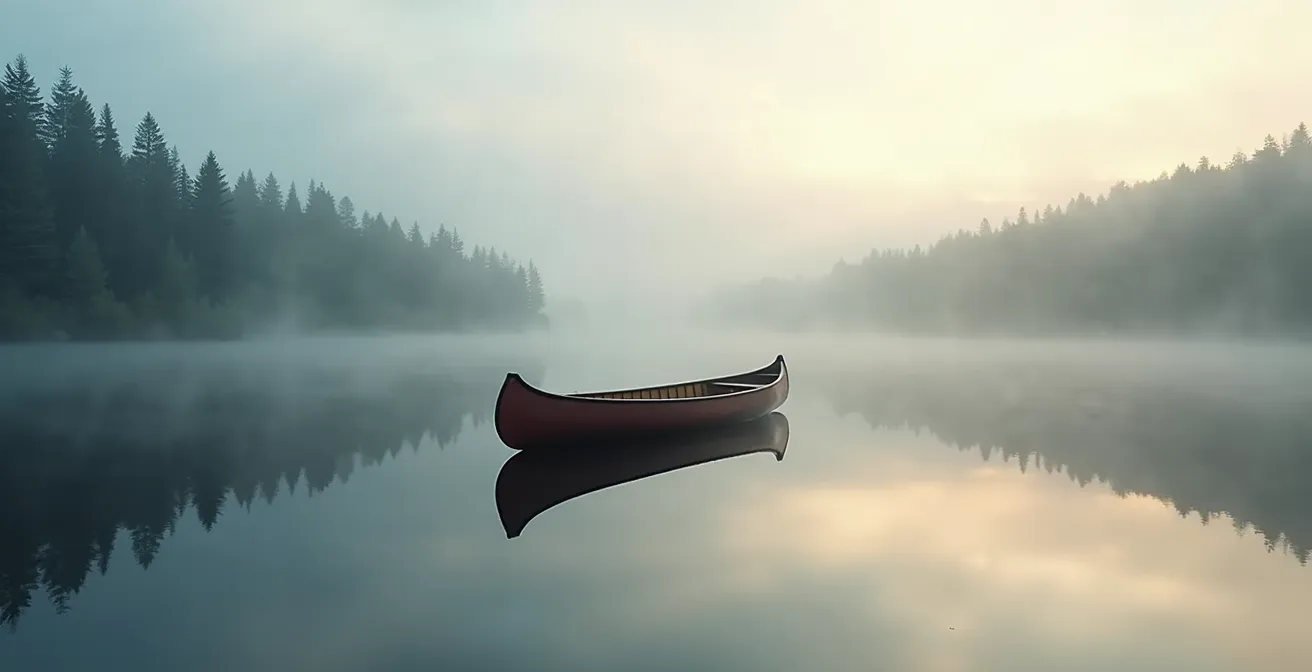
This enduring human presence underscores that the forest’s health and human well-being are deeply intertwined. Finding solace in nature is not just about escaping modern life; it is about tapping into an ancient, reciprocal relationship. Whether it’s the quiet paddle of a canoe on a misty lake at dawn, the meditative practice of Shinrin-yoku under a canopy of pines, or simply the act of listening to the wind, these moments are made more powerful by an understanding of the billion tiny processes that make them possible.
The boreal forest is more than the lungs of the north; it is its heart and its soul. It is a living testament to the power of adaptation and the beauty of dynamic, interconnected systems. It teaches us that resilience often comes from embracing cycles of change, and that even in the harshest conditions, life finds a way not just to survive, but to thrive in spectacular fashion.
The next logical step is to experience this ecosystem for yourself, armed with this new perspective. Plan a visit to one of Canada’s many boreal provincial or national parks, and see if you can identify the ecological stories unfolding around you.