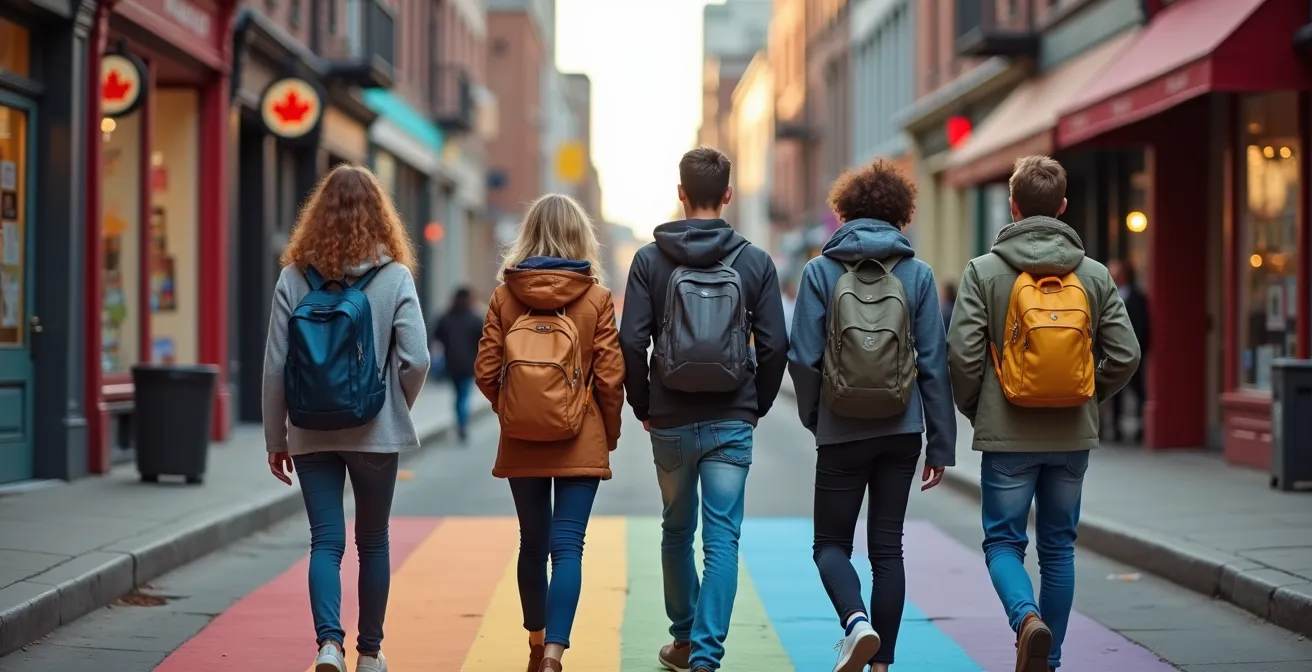
Canada’s reputation for inclusivity goes far beyond legal rights; it’s a living ‘cultural mosaic’ best experienced through its diverse and intersecting communities.
- Authentic travel means exploring the history and “living history” of queer spaces, not just visiting them.
- Inclusivity thrives in unexpected places, from rural Pride festivals to the heart of cultural events like Caribbean Carnival.
Recommendation: Prioritize experiences that directly support local LGBTQ+ and BIPOC-owned businesses to truly engage with the country’s diverse spirit.
For many travelers, Canada stands as a global beacon of inclusivity and a top-tier destination for the LGBTQ+ community. It’s easy to see why: the country is friendly, the scenery is breathtaking, and its cities boast vibrant, well-known queer districts. The standard advice often revolves around visiting Toronto’s Church-Wellesley Village or Montreal’s Le Village gai, grabbing a rainbow flag, and joining a Pride parade. And while these are fantastic experiences, they only scratch the surface of what it means to travel inclusively in this country.
The true magic of Canada lies not in a single, monolithic “welcoming” culture, but in its commitment to being a cultural mosaic. Unlike a melting pot that blends everything together, a mosaic celebrates each piece for its unique colour and shape. For the LGBTQ+ traveler, this means the most profound experiences are found at the cultural intersections—where queer identity meets Caribbean tradition, where Francophone heritage blends with jazz culture, and where community spirit thrives far from urban centres.
But what if the key to an unforgettable trip wasn’t just about finding the designated queer spaces, but about understanding how to navigate and celebrate these rich, overlapping identities? This guide is built on that premise. We’ll move beyond the rainbow crosswalks to explore the living history, the nuanced debates, and the authentic participation that define inclusive travel in Canada. We will uncover how to engage with the mosaic, not just observe it.
This article will guide you through the diverse layers of Canada’s inclusive landscape. We’ll explore the historical heart of its queer communities, compare its most famous festivals, and venture into its more surprising corners to help you build a trip that is both celebratory and deeply meaningful.
Summary: A Traveler’s Guide to Canada’s Intersecting Cultures
- More Than a Party: The History of Toronto’s Church-Wellesley Village
- Toronto Pride vs. Fierté Montréal: Which Festival Has the Best Vibe?
- Is Rural Canada Safe for LGBTQ+ Travelers?
- Caribbean Carnival: How to Participate in North America’s Largest Street Festival
- Why Canada Calls Itself a Cultural Mosaic (and What That Means for Tourists)
- Free Outdoor Shows vs. Place des Arts: Where is the Real Jazz?
- Why You Won’t Find a Starbucks in Kensington Market
- Conquering the EdgeWalk: Is Toronto’s Scariest Attraction Worth It?
More Than a Party: The History of Toronto’s Church-Wellesley Village
The Church-Wellesley Village is more than just the vibrant, party-filled heart of LGBTQ+ Toronto; it’s a place of living history shaped by decades of struggle and resilience. To walk its streets is to trace the story of Canada’s queer rights movement. This history isn’t just in a museum; it’s in the bookstores, the community centres, and the very intersections that were sites of protest. Understanding this past transforms a simple visit into an act of connection with the community’s legacy.
The Village wasn’t always a celebratory space. Its identity was forged in defiance, most notably in response to the 1981 bathhouse raids, a massive police operation that targeted the gay community and sparked Canada’s own “Stonewall.” The ensuing protests galvanized a movement that fought for the rights and acceptance many enjoy today. This spirit of community and activism is woven into the fabric of the neighbourhood, where organizations like The 519 Community Centre continue to provide essential services and a safe haven.
For today’s traveler, engaging with this history is key to authentic participation. It means visiting places like The ArQuives, Canada’s LGBTQ2+ Archives, to see the documented stories, or browsing the shelves of Glad Day Bookshop, the world’s oldest surviving LGBTQ+ bookstore. This context is supported by a general societal shift, as a UNWTO Global Report on LGBT Tourism notes that 86% of Canadian millennials believe homosexuality should be accepted. Experiencing the Village with this knowledge allows you to appreciate it not just as a destination, but as a testament to a community’s enduring strength.
- Start at The ArQuives (Canada’s LGBTQ2+ Archives) to understand the community’s documented history.
- Visit the site of the 1981 bathhouse raids protests at the Church and Wellesley intersection.
- Explore Glad Day Bookshop, the world’s oldest surviving LGBTQ bookstore.
- Stop by The 519 Community Centre for current programs and services.
- End at historic bars like Woody’s or Crews & Tangos to experience living history.
Toronto Pride vs. Fierté Montréal: Which Festival Has the Best Vibe?
In Canada, the two largest LGBTQ+ celebrations, Toronto Pride and Fierté Montréal, offer vastly different experiences, each reflecting the unique character of its city. Choosing between them isn’t about which is “better,” but about finding the vibe that best matches your travel style. It’s a classic Canadian cultural showdown: the massive, Anglophone-driven street party versus the bilingual, arts-focused city-wide festival.
Toronto Pride, held in June to coincide with the Canada Day long weekend, is an explosive, high-energy behemoth. It draws over a million people, transforming the downtown core into one of North America’s largest street parties. The energy is electric, with the massive Dyke March, Trans March, and grand finale Parade as its anchors. While it has faced criticism for its heavy corporate presence, there’s no denying its scale and celebratory power. It’s a pure, unadulterated expression of queer joy on a massive scale.
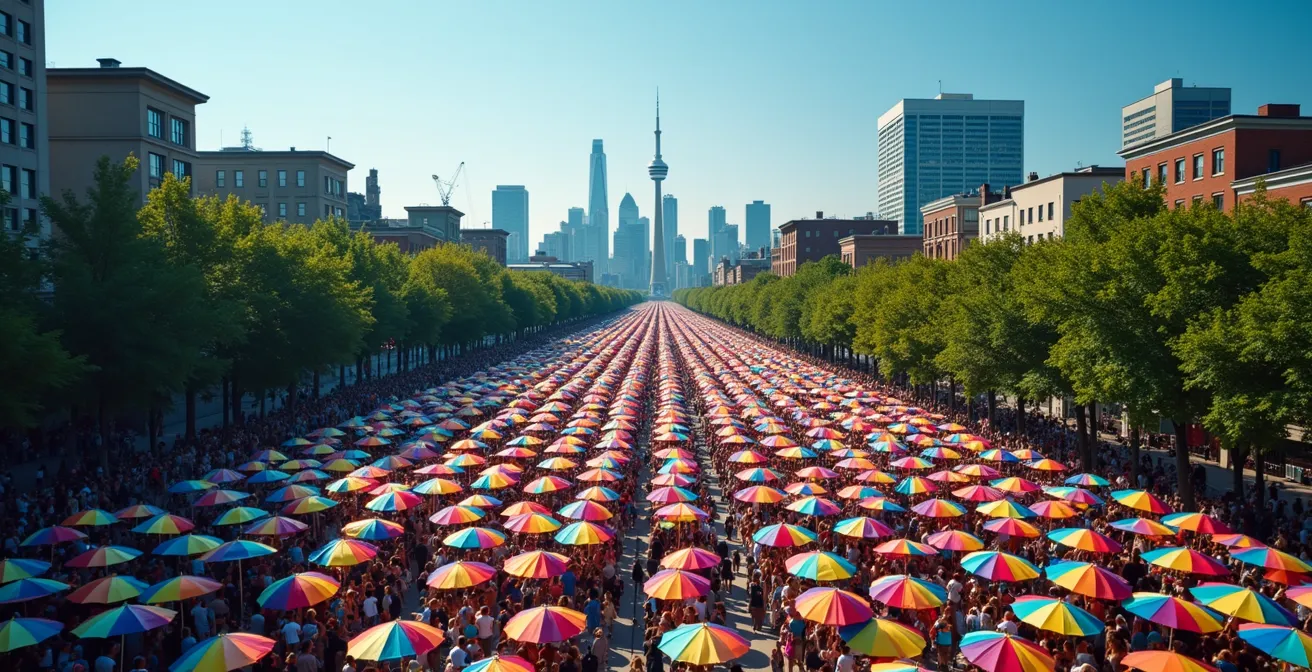
Fierté Montréal, taking place in August, feels more like a cultural festival that happens to be a Pride celebration. It’s distinctly bilingual, infusing every event with Quebec’s unique Francophone flair. While the parade is a major highlight, the festival is equally known for its Community Days in the Gay Village and its massive free outdoor shows at the Olympic Park Esplanade. It has a more grassroots, arts-focused atmosphere, weaving music, performance, and political discourse into its programming. The following table highlights some of the key differences to help you decide.
This comparison table, sourced from IGLTA data, breaks down the core differences in atmosphere and logistics.
| Factor | Toronto Pride | Fierté Montréal |
|---|---|---|
| Attendance | Over 1 million | 500,000+ |
| Language | English-dominant | Bilingual (French/English) |
| Timing | June (Canada Day weekend) | August |
| Main Events | Dyke March, Trans March, Main Parade | Community Days, Olympic Park shows |
| Atmosphere | Massive street party, corporate presence | City-wide cultural festival, grassroots feel |
Is Rural Canada Safe for LGBTQ+ Travelers?
The question of safety for LGBTQ+ travelers often extends beyond the comfort of urban “gayborhoods.” While major Canadian cities are unequivocally welcoming, what about the vast stretches of small towns and rural landscapes in between? The answer is nuanced but overwhelmingly positive. While you may not find a rainbow flag on every corner, a growing spirit of inclusion is making rural Canada an increasingly safe and celebratory space for queer visitors.
As a diversity and inclusion consultant, I always advise looking for the substance behind the symbols. In rural areas, this substance is found in the form of local Pride celebrations and community-led initiatives. These events may be smaller, but their impact is immense, signaling a powerful grassroots acceptance. This trend shows that inclusivity isn’t just a top-down mandate from Ottawa; it’s a value being actively cultivated in communities across the country. It’s important to acknowledge the context, as one expert guide points out.
The International LGBTQ+ Travel Association offers a balanced perspective on this:
Attitudes remain a bit more conservative in the northern and rural regions but they are still welcoming and very safe to visit.
– IGLTA Travel Guide, International LGBTQ+ Travel Association Canada Guide
Case Study: Small-Town Pride Celebrations Across Canada
This shift is not just anecdotal. Several small Canadian towns have embraced LGBTQ+ tourism with their own Pride celebrations. Jasper, Alberta, hosts an annual Pride festival against the stunning backdrop of the Rocky Mountains. Prince Edward County in Ontario combines its famous wine country tours with vibrant LGBTQ+ events. In British Columbia’s Okanagan Valley, communities like Kelowna have installed rainbow crosswalks and foster year-round welcoming atmospheres with inclusive businesses, demonstrating that rural Canada can offer safe and celebratory spaces for LGBTQ+ travelers.
Traveling to these areas provides a unique opportunity to support local queer communities and witness a different, more intimate form of Canadian inclusivity. It’s about moving beyond the rainbow crosswalk to find the genuine connections that make travel meaningful.
Caribbean Carnival: How to Participate in North America’s Largest Street Festival
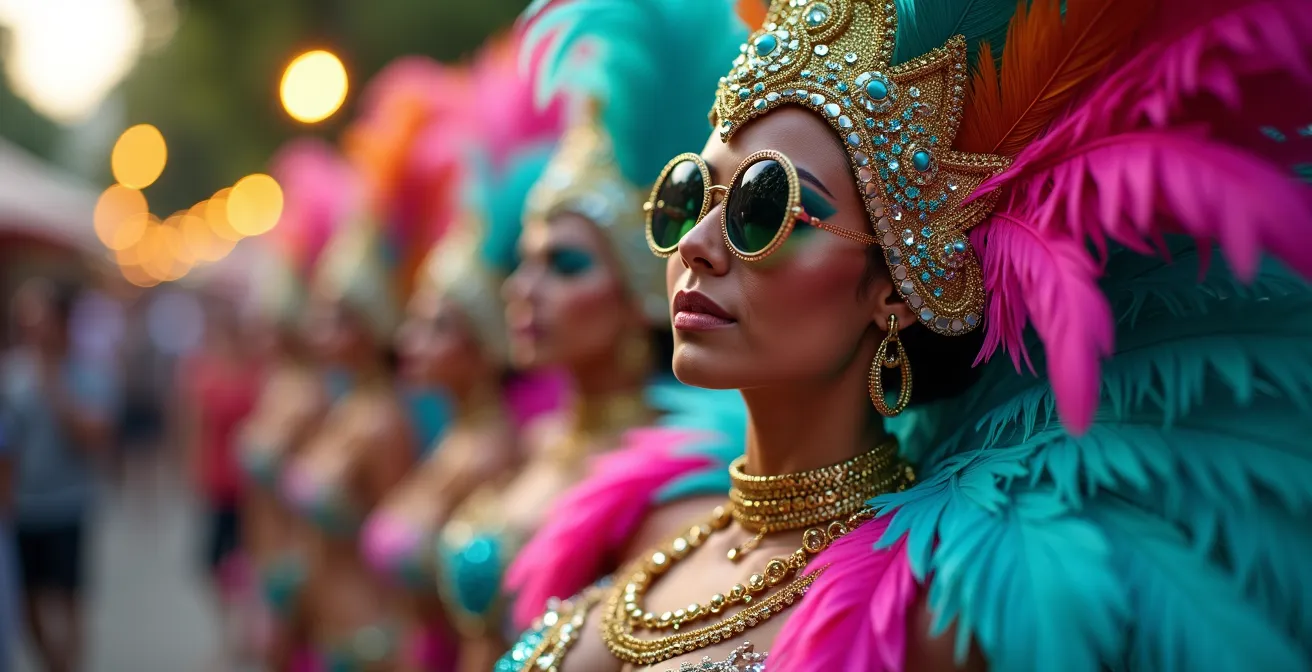
True inclusive travel is about finding your community within other communities. In Toronto, there’s no better example of this cultural intersection than the Toronto Caribbean Carnival. As North America’s largest street festival, it’s a spectacular explosion of music, colour, and culture. For the LGBTQ+ traveler, and especially for QTBIPOC (Queer, Trans, Black, Indigenous, People of Colour) visitors, it offers a powerful space to celebrate both queer and Caribbean identities simultaneously.
The Carnival is far more than a parade to be watched from the sidelines; it’s a participatory spectacle. The tradition of “playing mas” involves joining a masquerade band (a “mas band”), donning an elaborate costume, and dancing through the streets as part of the procession. This is the heart of authentic participation. In recent years, there has been a growing movement to create explicitly inclusive and safe spaces within the Carnival for the LGBTQ+ community.
This intersection of identities is also formally recognized during Pride Month. Blockorama, a staple of Pride Toronto for over two decades, is a dedicated space celebrating Black queer and trans communities, often serving as a vibrant precursor to the main Carnival events in August. Participating in Carnival as a queer person means seeking out these spaces, supporting QTBIPOC-led mas bands, and attending the fetes and boat rides hosted by queer Caribbean organizations. It’s a chance to connect with a culture on its own terms, finding a joyful and empowering welcome within its rhythms.
Here’s how you can actively and respectfully participate:
- Research QTBIPOC-led mas bands that explicitly welcome LGBTQ+ participants.
- Attend pre-carnival “fetes” and boat rides hosted by queer Caribbean organizations.
- Connect with Blockorama, the official Black Queer event during Pride Toronto, to engage with the community beforehand.
- Look for “Playing Mas” workshops that teach costume-making and the cultural significance of carnival.
- Join post-parade celebrations in the Church-Wellesley Village for queer after-parties that bridge the two communities.
Why Canada Calls Itself a Cultural Mosaic (and What That Means for Tourists)
The term “cultural mosaic” is fundamental to understanding the Canadian identity, and it’s a concept that directly shapes the travel experience. Unlike the American “melting pot,” which implies that immigrants and diverse groups should assimilate into a single, uniform culture, the mosaic suggests that they should retain their unique identities, creating a richer, more complex whole. For a tourist, this means Canada doesn’t offer one single “Canadian experience”; it offers a multitude of them, side-by-side.
This official policy of multiculturalism, adopted in the 1970s, has had a profound impact on the country’s social fabric. It has fostered an environment where communities, including the LGBTQ+ community, could build and maintain their own distinct cultures, businesses, and social hubs. This legal and social framework is a key reason why queer rights advanced relatively early in Canada. As a landmark example, a report from Destination Canada highlights that Canada became the 4th country in the world to legalize same-sex marriage in 2005, cementing its commitment to equality as a core part of its national identity.
What does the mosaic mindset mean for your itinerary? It means you can have dim sum in a vibrant Chinatown in the morning, explore a historic Italian neighbourhood in the afternoon, and dance the night away in a queer-owned club. It’s about seeing diversity not as a novelty, but as the default setting. This is beautifully illustrated in cities like Montreal, where different cultural worlds don’t just coexist, but actively blend.
Case Study: Montreal’s Gay Village and Francophone Integration
Montreal’s Gay Village (Le Village) is a prime example of the cultural mosaic in action. Since the 1970s, the LGBTQ+ community has flourished on and around rue Sainte-Catherine Est, in the heart of a predominantly Francophone city. The neighborhood doesn’t exist in a bubble; it seamlessly blends queer-owned businesses, art installations, and nightlife with a deeply rooted French-Canadian heritage. The result is a unique cultural intersection: Fierté Montréal is proudly bilingual, drag queens perform in both English and French, and the entire atmosphere showcases how two powerful identities can coexist and enrich one another, creating something uniquely Montrealais.
Traveling in Canada is an invitation to hop from one tile of the mosaic to another, appreciating the distinct beauty of each while admiring the stunning picture they create together.
Free Outdoor Shows vs. Place des Arts: Where is the Real Jazz?
In Montreal, a city synonymous with jazz, a fascinating cultural dynamic plays out every summer. The internationally renowned Montreal International Jazz Festival draws huge crowds to its massive free outdoor stages and prestigious ticketed shows at Place des Arts. But for travelers seeking a more intimate and inclusive experience, the “real” jazz—the kind that pulses with the city’s diverse soul—is often found in the smaller, community-oriented clubs and queer-friendly spaces scattered across its neighbourhoods.
This isn’t a criticism of the main festival, which offers incredible performances. Rather, it’s an invitation to explore the cultural intersections where Montreal’s thriving LGBTQ+ community and its rich musical heritage meet. The spirit of jazz, rooted in improvisation and counter-culture, aligns perfectly with the ethos of many queer spaces. In neighbourhoods like the Mile End and Saint-Henri, you’ll find underground jazz clubs and bars where the atmosphere is inclusive by nature, and the focus is on raw, authentic musical expression.
This search for authenticity is a core part of the mosaic traveler’s mindset. It’s about looking beyond the main stage to find a more personal connection. It might mean catching a set from an up-and-coming queer jazz artist in an intimate venue, or stumbling upon a drag bar’s open mic night that features a surprisingly soulful saxophonist. It is in these moments of unexpected discovery that the true, multi-layered culture of Montreal reveals itself. The following plan provides a roadmap for a night of such discovery.
Your Roadmap for a Queer Jazz Night in Montreal
- Start with dinner at a queer-owned restaurant in the Gay Village like Tendresse.
- Check listings for LGBTQ+ jazz artists performing at intimate Mile End venues.
- Explore Saint-Henri’s underground jazz clubs known for their inclusive atmospheres.
- Visit Bar Notre-Dame-des-Quilles for queer open mic nights that sometimes feature jazz.
- End the night at Stereo after-hours club for house music with deep jazz influences, as recommended by local travel guides.
Finding the “real” jazz is less about a specific location and more about an approach: one that values community, intimacy, and the beautiful fusion of different cultural worlds.
Why You Won’t Find a Starbucks in Kensington Market
To understand the soul of Toronto, you must visit Kensington Market. And to understand Kensington Market, you must notice what isn’t there: a Starbucks. The neighbourhood’s fierce and successful resistance to corporate chains is a defining feature, and it speaks volumes about the city’s cultural mosaic. This isn’t just about coffee; it’s a powerful statement about preserving identity, community, and independence—values that resonate deeply within the LGBTQ+ community.
Kensington Market’s anti-corporate ethos has allowed it to remain a haven for independent businesses, many of which are owned by immigrants and members of various cultural communities. This spirit of self-determination and the creation of alternative spaces runs parallel to the history of the queer community itself. Places like the Church-Wellesley Village were born from the need to create safe, independent spaces away from a hostile mainstream. Kensington embodies that same energy, making it an essential stop for any traveler seeking authentic, non-commercial experiences. This independent spirit extends to other parts of the city as well, like Queen Street West, which IGLTA notes is also known as “Queer West” for its high concentration of LGBTQ+-friendly establishments.
Case Study: Kensington Market’s Independent Spirit
The market is a microcosm of Toronto’s multiculturalism, where vintage shops, cheesemongers, bakeries, and street food stalls from around the world coexist in a vibrant, chaotic harmony. Among them are numerous queer-owned businesses, from vintage clothing stores to independent cafes and cultural spaces. By choosing to spend your money here, you are directly supporting the very fabric of the community. Shopping in Kensington is an act of cultural and economic solidarity. It’s a tangible way to participate in the city’s mosaic, supporting the small, independent pieces that make the entire picture so beautiful.
So when you visit Kensington Market and grab a coffee from a local roaster instead of a global chain, you’re doing more than just getting a caffeine fix. You are participating in a living act of cultural preservation. You are experiencing the mosaic mindset in its purest form, where celebrating difference is the most cherished value of all.
Key takeaways
- True inclusive travel in Canada involves understanding the history and resilience behind its queer communities.
- The richest experiences are found at “cultural intersections,” where LGBTQ+ identity meets other traditions like Caribbean Carnival or local music scenes.
- Authentic participation means actively supporting local, queer-owned, and independent businesses over corporate alternatives.
Conquering the EdgeWalk: Is Toronto’s Scariest Attraction Worth It?
As a traveler, every dollar you spend is a vote for the kind of experience you value. In Toronto, this choice is starkly presented by the CN Tower EdgeWalk. It’s undeniably a bucket-list thrill: a hands-free walk on an open-air platform 356 meters above the city. It offers unparalleled views and a massive adrenaline rush. But for the traveler seeking to engage with Canada’s cultural mosaic, the question arises: is this corporate attraction the best use of your time and money?
The EdgeWalk is an incredible feat of engineering, but it exists largely outside the community fabric of the city. It’s a pre-packaged, standardized thrill. The cost of one ticket could, alternatively, fund an entire weekend of grassroots, community-focused experiences. This could mean multiple drag shows, meals at several queer-owned restaurants, entry fees to community events, and unique souvenirs from independent shops in Kensington Market or Queer West. These choices represent a direct investment in the local LGBTQ+ economy and a deeper engagement with the city’s living culture.
This isn’t to say you shouldn’t do the EdgeWalk. The “right” choice is a personal one. However, the mosaic traveler should make that choice consciously. It’s about weighing the value of a singular, spectacular moment against the cumulative value of multiple, smaller, more intimate community connections. The decision itself becomes an expression of your travel philosophy.
To put this choice in perspective, travel resource data from misterb&b helps to frame a value comparison for an LGBTQ+ traveler in Toronto.
| Option | Cost | Experience | Community Impact |
|---|---|---|---|
| EdgeWalk CN Tower | $200+ CAD | 20-minute thrill, city views | Corporate attraction |
| Weekend of LGBTQ+ Experiences | $200+ CAD | Multiple drag shows, queer-owned restaurants, community events | Direct support to LGBTQ+ businesses |
| Combination Approach | $300+ CAD | EdgeWalk plus one evening in Church-Wellesley Village | Mixed corporate and community support |
Ultimately, the most rewarding trip might involve a mix of both. But by consciously allocating your resources, you ensure that your travels not only create personal memories but also contribute positively to the communities that make Canada’s mosaic so vibrant and resilient.
Your journey through Canada’s cultural mosaic is a chance to connect, celebrate, and contribute. By planning your trip with this mindset of authentic participation, you move beyond being a tourist to become a true mosaic traveler. Start planning your journey today to experience the incredible diversity that defines this nation.