
Successfully skiing Whistler and golfing in Squamish in a single day is a triumph of logistics, not just athleticism.
- Timing is everything: Leaving Vancouver before 5:45 AM on a weekday is non-negotiable to beat the Lions Gate Bridge gridlock.
- April is the “Golden Window” when Whistler’s deep snowpack perfectly overlaps with the opening of Squamish’s green fairways.
- Use the “Squamish Dinner Delay” strategy—a leisurely meal after your round—to bypass the brutal southbound evening rush hour.
Recommendation: Treat the day like a mission with precise timings and transition plans, not a casual road trip, to guarantee success.
The dream is an iconic British Columbian fantasy: carving fresh tracks on Whistler’s slopes in the morning and sinking a putt on a sun-drenched Squamish green in the afternoon. It’s a challenge born from Vancouver’s unique geography, a city squeezed between the Pacific Ocean and the soaring Coast Mountains. Many active travellers are drawn to this ultimate “Sea to Sky” doubleheader, believing it’s a simple matter of ambition and an early start. They often focus on the physical stamina required for the sports themselves.
But the truth is, the success of this venture has almost nothing to do with your ski technique or your golf handicap. The real challenge is a battle against the clock. Pulling off this perfect day is a military-grade logistical operation where minutes matter. The enemy isn’t fatigue; it’s traffic bottlenecks, inefficient gear transitions, and unpredictable mountain weather. Without a precise plan, your epic day can devolve into a frustrating crawl through traffic with two sets of expensive gear you never get to use properly.
This guide reframes the Sea-to-Sky challenge. It’s not just an adventure; it’s a logistical puzzle. We will dissect the day into a series of timed missions: from identifying the perfect seasonal window and mastering traffic choke points to executing seamless transitions between mountain and fairway. Forget simply “winging it”—this is your operational playbook for conquering Vancouver’s most legendary multi-sport day.
This article provides a complete logistical breakdown for executing the perfect ski-and-golf day. The following sections offer a strategic, step-by-step guide to navigate every phase of the challenge, from initial urban planning concepts to the final drive home.
Summary: Your Operational Playbook for the Sea-to-Sky Ski & Golf Mission
- Vancouverism: How Urban Design Created the City of Glass
- Why April is the Golden Month for the Sea-to-Sky Double Header
- The “Lions Gate Bridge” Bottleneck: When to Leave to Avoid Gridlock
- How to Handle the Drive from Vancouver to Whistler in Changing Weather
- Squamish Lunch Stops: Where to Refuel Between the Slopes and the Sea
- Where to Store Your Skis While You Golf in Squamish?
- Epic Pass vs. Ikon Pass: Which Saves More Money on the Powder Highway?
- Architecture by the Water: The Best Route to See the Glass Towers
Vancouverism: How Urban Design Created the City of Glass
Before you even start your engine, it’s crucial to understand why this challenge is both possible and so difficult. The answer lies in “Vancouverism,” the city’s world-renowned urban design strategy. Unlike sprawling North American cities, Vancouver is geographically constrained by the ocean on three sides and mountains to the north. This limitation forced the city to grow upwards, creating a dense, livable downtown core filled with the iconic glass towers that define its skyline.
This very density is the source of the ski-and-golf dream. You can be in the heart of a major metropolitan area and, within minutes, be on a highway bound for world-class wilderness. The close proximity of urban life to epic nature is the city’s greatest asset. However, this same geography creates immense logistical bottlenecks. A limited number of bridges and highways serve as the arteries connecting the dense urban core to the mountains. The entire population funnels through these few choke points.
Therefore, the Sea-to-Sky challenge isn’t just a trip; it’s a direct interaction with the principles of Vancouverism. You are leveraging its greatest benefit (proximity) while fighting its greatest challenge (concentrated traffic). Understanding this dynamic is the first step in your strategic planning. You’re not just going for a drive; you’re navigating a unique urban ecosystem where a ten-minute difference in departure time can mean an hour saved or lost. This entire day is a testament to the beautiful, and sometimes frustrating, reality of life in the City of Glass.
Why April is the Golden Month for the Sea-to-Sky Double Header
Timing this challenge isn’t just about the time of day; it’s about the time of year. While the idea is tempting from March to May, there is a specific, narrow period that professionals target: the “Golden Window” in mid-to-late April. This isn’t arbitrary; it’s a strategic calculation based on the precise overlap of two distinct seasons. In April, Whistler Blackcomb still boasts a deep, consolidated snowpack from the winter, offering excellent spring skiing conditions, especially at higher elevations.
Simultaneously, down at sea level, the warmer spring weather has melted the snow from the low-lying golf courses in Squamish and Furry Creek. While Whistler’s valley courses are still waking up, the coastal fairways are typically green and playable. This perfect alignment is fleeting. According to local operators, Whistler’s own golf courses often open in early May, while the ski season on Whistler Mountain traditionally closes around the third week of May. This means late April provides the absolute best chance for peak conditions in both sports—great snow coverage up high and dry, playable turf down low.

Attempting the trip in March often means the golf courses are too wet or still closed. Waiting until mid-May risks finding diminishing snow and slushy conditions on the slopes. April is the sweet spot where the Coast Mountains offer their dual personality without compromise. Choosing a date within this Golden Window dramatically increases your chances of a successful and enjoyable day, rather than one spent battling subpar conditions in one or both activities.
The “Lions Gate Bridge” Bottleneck: When to Leave to Avoid Gridlock
Your mission begins in the dark. The single biggest threat to your schedule is the Lions Gate Bridge, the primary artery connecting downtown Vancouver to the Sea-to-Sky Highway. Crossing it at the wrong time guarantees failure. The morning commuter rush transforms this scenic crossing into a parking lot, and your meticulously planned timeline will evaporate before you even leave the city.
To succeed, you must think like a local commuter and operate with precision. This means an exceptionally early start. On a weekday, your non-negotiable departure time from downtown is before 5:45 AM. This allows you to cross the bridge and be past the Taylor Way on-ramp in West Vancouver by 6:15 AM, just before the main wave of traffic hits. On a weekend, you have slightly more leeway, but should still aim to be on the road before 7:00 AM to get ahead of the recreational crowds heading for the mountains.
The return journey presents the opposite problem. The southbound gridlock into Vancouver is notoriously bad between 4:00 PM and 6:30 PM. Driving head-on into this is a rookie mistake. This is where a key piece of local traffic analysis comes into play. As one advisory puts it, the best strategy is proactive avoidance.
The ‘Squamish Dinner Delay’ tactic: To avoid the 4 PM to 6:30 PM southbound gridlock into Vancouver, the best strategy is to plan a leisurely dinner in Squamish
– Local traffic pattern analysis, Sea-to-Sky corridor travel advisory
This table, based on government traffic data, outlines the critical departure windows for your mission. Internalize it, as it forms the backbone of your day’s schedule.
The following table, informed by data from British Columbia’s Ministry of Transportation, breaks down the optimal departure times to bypass the corridor’s most infamous choke points. Mastering this schedule is the difference between a fluid journey and a frustratingly static one, as shown by the comprehensive analysis of route conditions.
| Direction | Day Type | Departure Time | Key Bottleneck | Strategy |
|---|---|---|---|---|
| Northbound | Weekday | Before 5:45 AM | Lions Gate Bridge | Cross bridge by 6:15 AM to beat commuter traffic |
| Northbound | Weekend | Before 7:00 AM | Taylor Way on-ramp | Avoid recreational traffic surge |
| Southbound | Any Day | After 7:00 PM | Horseshoe Bay merge | Miss 4-6:30 PM rush hour gridlock |
How to Handle the Drive from Vancouver to Whistler in Changing Weather
Once you’re past the Lions Gate Bridge, your next variable is Mother Nature. The Sea-to-Sky Highway is famous for its dramatic and rapidly changing weather. In April, it’s entirely possible to leave Vancouver in the rain, drive through sun in Squamish, and arrive to a snowstorm in Whistler. Being unprepared for this is not an option; it’s a safety risk. Your car must be equipped for winter conditions, as winter tires are mandatory on the Sea-to-Sky Highway from October 1 to April 30. Do not assume a sunny forecast in the city means clear roads all the way.
Proactive monitoring is your best defense. Before you leave, and even during your drive (by a passenger), you must consult real-time data sources. Relying on a standard weather app is insufficient. You need to use the tools that highway maintenance crews and professional drivers use. This means having DriveBC and Environment Canada bookmarked and ready.
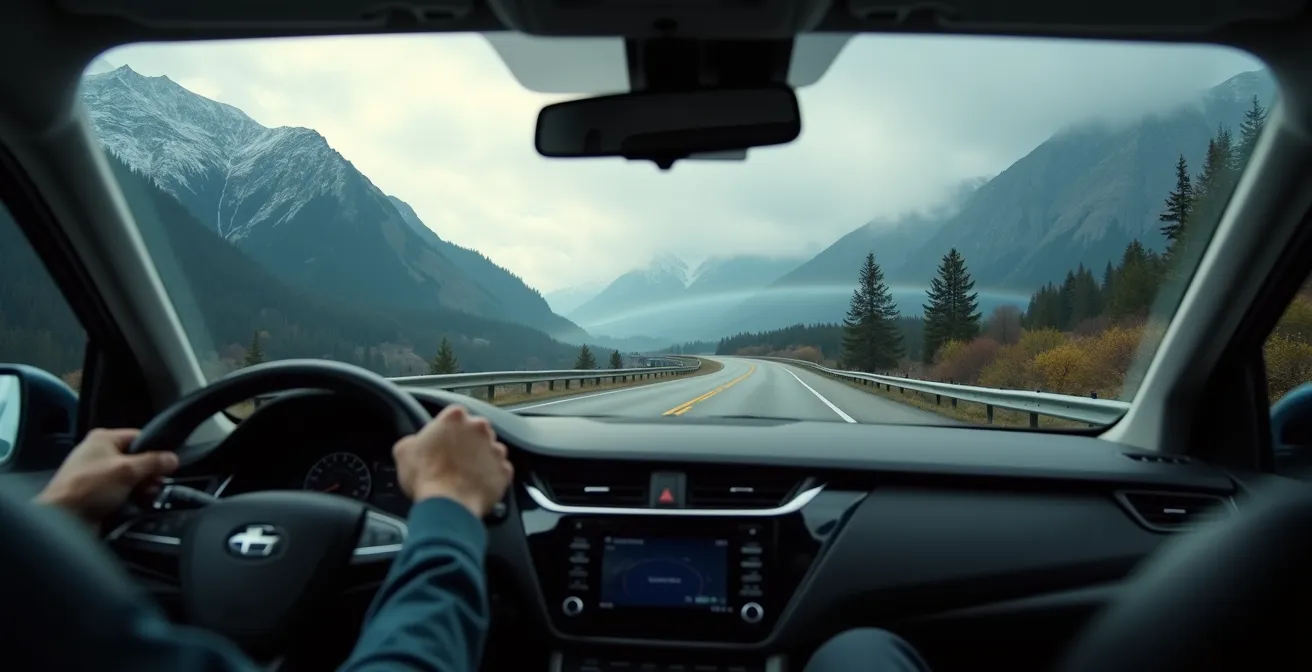
This perspective from behind the wheel underscores the reality of the drive: conditions can shift from wet asphalt to snow-covered roads in a matter of minutes. Your strategy must be one of constant awareness, not just passive driving. The drive itself is part of the challenge, demanding as much focus as any ski run or golf shot. Mastering the flow of information about the road ahead is as important as mastering the road itself.
Your Pre-Departure Weather Audit
- Check live cameras: Review the DriveBC website for real-time highway camera feeds, focusing on key checkpoints like Alice Lake and Cheakamus Canyon to see current conditions.
- Monitor official warnings: Check Environment Canada’s public weather alerts specifically for the Howe Sound region, which can differ significantly from Metro Vancouver.
- Verify road status: Before departure, confirm there are no active highway closures or major incident alerts on the DriveBC alerts page for Highway 99.
- Enable mobile alerts: Set up DriveBC mobile notifications on your phone to receive push alerts for any major incidents or sudden closures that occur while you’re en route.
- Cross-reference with resort: Check the Whistler Blackcomb “Mountain Cams” to see the real-time weather at the top, which is often completely different from the village.
Squamish Lunch Stops: Where to Refuel Between the Slopes and the Sea
The midpoint of your day—the transition from skiing to golfing—is a critical logistical pivot. Where you choose to eat in Squamish is not just about food; it’s a strategic decision that impacts your energy levels, your timeline, and your traffic-avoidance plan. This is the moment to refuel your body and reset for the back half of the mission. Your choice of lunch spot should be dictated by a “Fuel & Flow” framework: the right kind of fuel, served with the right speed, to keep your day flowing smoothly.
You have three primary strategic options, depending on your priorities:
- Fast Fuel: If time is your absolute priority, places like Mag’s 99, located directly on the highway, are your go-to. Known for its quick-service fried chicken and Mexican food, you can be in and out in under 20 minutes, maximizing your time on the golf course.
- Nutrient-Rich Fuel: If you’re feeling the burn from the slopes and need clean energy, The Green Moustache Organic Café offers nutritious smoothies, energy bowls, and salads to recharge you without a heavy, sluggish feeling.
- Decompression with a View: If you’ve built a time buffer into your schedule, The Watershed Grill offers a chance to decompress. Overlooking the scenic Squamish River, it allows you to mentally switch gears from the alpine to the fairway.
However, the most advanced strategy ties directly into the “Squamish Dinner Delay.” By opting for an early afternoon round of golf, you can use a local institution like Howe Sound Brew Pub for a relaxed, early dinner. This allows you to wait out the worst of the 4:00 PM to 6:30 PM southbound traffic. The brewpub’s location and offerings make it an ideal headquarters for this tactic. As a case study in strategic dining, Howe Sound Brewing offers excellent food, local beer, and views of the Stawamus Chief, turning your traffic-avoidance wait into an enjoyable part of the experience rather than a frustrating delay.
Where to Store Your Skis While You Golf in Squamish?
You’ve successfully navigated the highway and refueled your body. Now you face the most awkward logistical puzzle of the day: “Gear Tetris.” What do you do with a full set of damp, expensive ski equipment while you play 18 holes? Leaving it unattended in your car, even in a seemingly safe golf course parking lot, is a high-risk move. This is where you pay the “Transition Tax”—the time and effort spent managing your gear. Minimizing this tax is key.
Your primary solution lies in communication and courtesy with the golf course staff. Most pro shops are staffed by people who understand the unique multi-sport culture of the Sea-to-Sky corridor. They are often your best and only allies. Do not just show up and hope for the best. A proactive, polite phone call is essential. For instance, Furry Creek Golf & Country Club, known as “BC’s Most Scenic Golf Course,” is also the only pro shop between North Vancouver and Squamish, and its staff is accustomed to a wide range of customer needs. A place like this is a prime candidate for a storage request.
When you call, use a clear and concise script. Your goal is to present your situation not as a problem, but as part of an exciting local challenge they can help with. Here is a simple, effective script to follow:
- 1. Announce Your Arrival: “Hi, I have a tee time at [time] today under the name [Your Name].”
- 2. State the Situation Clearly: “I’m doing the Sea-to-Sky ski-and-golf challenge and will have my ski equipment with me.”
- 3. Make the Polite Request: “I was wondering if there is any possibility I could safely store my skis and boots in a corner of your back room or behind the counter while I play my round?”
- 4. Have a Backup Plan: If they can’t accommodate the request, ask, “In that case, could you recommend the most secure and visible place to park, ideally in direct sight of the pro shop?”
This approach transforms the staff from passive observers into active participants in your mission. More often than not, a friendly request will be met with a helpful solution, securing your gear and allowing you to focus on your golf game with peace of mind.
Epic Pass vs. Ikon Pass: Which Saves More Money on the Powder Highway?
While your Sea-to-Sky challenge is a single-day strike mission, a true logistics expert thinks about the bigger picture. The question of which season pass to own—Epic or Ikon—is usually debated in the context of a multi-day trip along BC’s famous “Powder Highway.” However, the strategic mindset applies even here. Your choice of pass can influence the cost-effectiveness and planning of this very day trip.
It’s a simple but crucial fact: Whistler Blackcomb is an Epic Pass resort. If you are an Epic Pass holder, your lift ticket for the morning is already covered. This significantly reduces the total cost of the day and simplifies your morning logistics, as you won’t need to line up at the ticket window. You can proceed directly to the lift, saving precious minutes that are vital to your tight schedule. This is a clear efficiency gain.
If you are an Ikon Pass holder, you’ll be paying for a full-price (or window-rate) day ticket at Whistler, which can be a substantial expense. While the Ikon Pass offers access to other incredible BC resorts like Revelstoke and Red Mountain (both on the Powder Highway), it provides no benefit for this specific Vancouver-based challenge. Therefore, if you are a local or frequent visitor planning multiple trips to Whistler throughout the season, the Epic Pass is the financially superior tool for this particular mission. Considering this before the season begins is part of the long-range planning that separates the successful from the stressed.
Key Takeaways
- Master the Clock: Your day’s success is dictated by beating traffic. Leave Vancouver before 5:45 AM on weekdays and plan a “Squamish Dinner Delay” to avoid the 4:00 PM-6:30 PM southbound gridlock.
- Target the Golden Window: Plan your trip for mid-to-late April, the specific period when Whistler’s deep snowpack and Squamish’s open golf courses perfectly align.
- Be a Weather Watcher: Use DriveBC and Environment Canada to monitor the highly variable Highway 99 conditions in real-time. Winter tires are mandatory and non-negotiable.
Architecture by the Water: The Best Route to See the Glass Towers
As your epic day concludes, you begin the final leg of the mission: the drive south back into Vancouver. If you’ve executed the “Squamish Dinner Delay” correctly, you’ll be cruising down the Sea-to-Sky Highway after 7:00 PM. The sun will be setting, the traffic will have thinned, and the city lights will begin to glitter ahead. This is your victory lap, and it offers one last, spectacular reward: the return view of the City of Glass.
The “best route” to see the architecture is, by default, the one you must take: over the Lions Gate Bridge and into the downtown core. But as you approach, you’re not just seeing a skyline; you’re seeing the bookend to your day’s journey. You started by escaping these very towers in the pre-dawn darkness, and now you return to them, mission accomplished. The cluster of glass high-rises in Coal Harbour and along the waterfront isn’t just a random collection of buildings; it’s the physical manifestation of the “Vancouverism” that made your adventure possible.
From the bridge, you get a panoramic view of the result of that urban planning: a city that seamlessly integrates dense living with immediate access to nature. The glowing towers stand as silent witnesses to your journey, reflecting the last light of the day off the Pacific. This final leg of the drive is a moment for reflection. It’s a chance to appreciate the unique landscape you’ve just conquered—from the alpine peaks of Whistler to the coastal fairways of Squamish, and back to the heart of one of the world’s most scenic cities. You didn’t just play two sports; you experienced the full spectrum of the Sea-to-Sky corridor in twelve epic hours.
Stop dreaming and start planning. Use this logistical framework to build your own perfect Sea-to-Sky itinerary. With precision timing and a focus on efficient transitions, you can conquer this iconic Canadian challenge and earn the ultimate bragging rights.