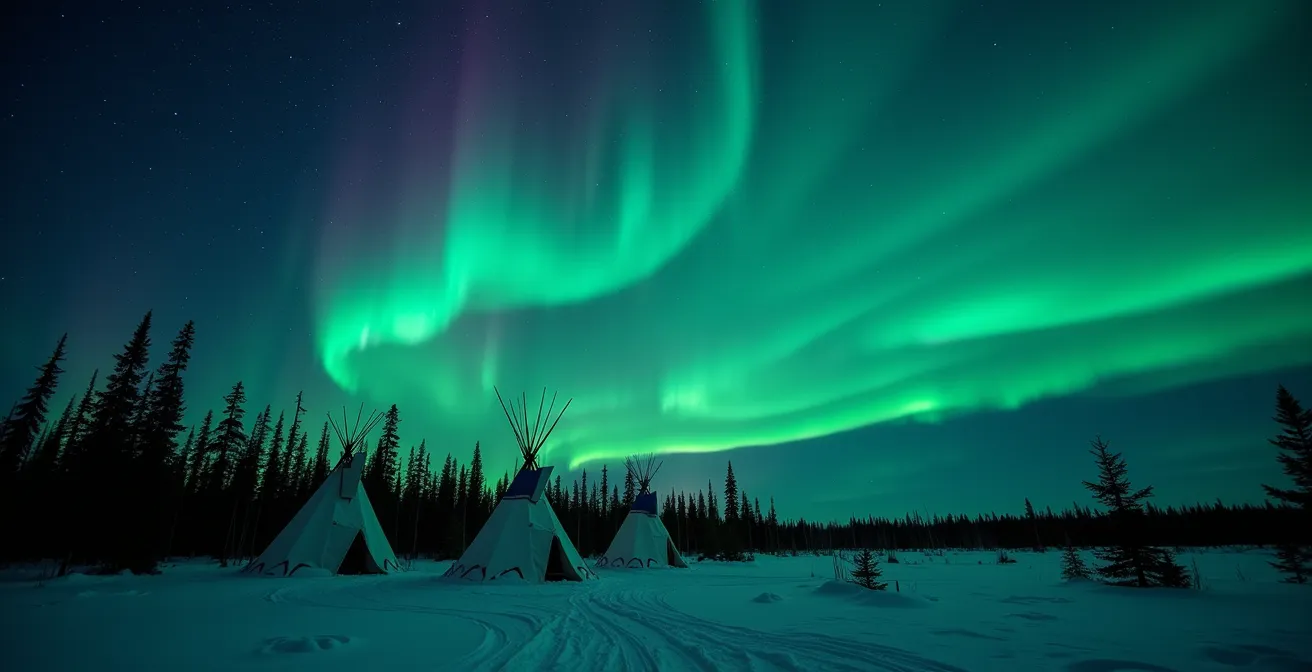
Most explanations of the Northern Lights present a false choice between science and myth. This guide reframes the Aurora not as a spectacle to be simply observed, but as a living dialogue. We explore how Canadian Indigenous knowledge systems offer a sophisticated framework for understanding the Aurora’s behaviour, sounds, and spiritual meaning—a wisdom that complements, and sometimes even anticipates, scientific discovery.
The night sky over Canada’s north is a canvas for one of nature’s most profound spectacles: the Aurora Borealis. For many, this celestial dance is a bucket-list item, a dazzling display of physics involving solar winds and atmospheric gases. We are taught that the vibrant greens and rare reds are merely collisions of charged particles with oxygen and nitrogen. This explanation, while scientifically accurate, tells only half of the story. It describes the “what” but completely misses the “who.”
For millennia, long before the advent of modern spectroscopy, the First Nations, Inuit, and Dene peoples of Canada have been in conversation with these lights. They are not seen as a passive phenomenon, but as active spirits, ancestors, or celestial beings. These are not quaint “myths” to be contrasted with “real” science; they are complex knowledge systems passed down through oral tradition, rich with ecological wisdom, spiritual protocols, and a deep sense of reciprocity. To truly understand the Northern Lights, one must be willing to look beyond the particles and listen to the stories.
This journey moves past the simple dichotomy of science versus legend. Instead, it weaves them together, showing how Indigenous perspectives provide a deeper, more holistic understanding of the spirits in the sky. We will explore what these lights mean, why they make sounds, and how a cultural traveler can engage with them in a way that is both breathtaking and deeply respectful.
This guide delves into the intertwined worlds of ancestral wisdom and scientific phenomena. Follow along as we explore the deeper meanings behind the lights, the protocols for viewing them, and the art of capturing their essence with respect and understanding.
Summary: The Spirits in the Sky: Indigenous Legends of the Northern Lights
- Ancestors or Spirits? How Different Nations Interpret the Aurora
- Why Is the Aurora Usually Green (and When Can You See Red)?
- Can You Hear the Northern Lights? The Science Behind the Crackling
- Why an Elder-Led Aurora Tour Offers a Deeper Connection
- Why Whistling at the Northern Lights is Taboo in Some Cultures
- Why You Need Trees or Mountains to Make Your Aurora Photo Pop
- The Historical Myth About “Totem Poles” That 60% of Tourists Believe
- Capturing the Aurora: A Beginner’s Guide to Night Photography
Ancestors or Spirits? How Different Nations Interpret the Aurora
In many Canadian Indigenous cultures, the Aurora is not an ‘it’ but a ‘they’. The lights are widely regarded as the spirits of the ancestors. This interpretation transforms the viewing experience from a passive observation into a potential communication—a living dialogue with those who came before. The specific nature of these spirits, however, varies significantly between nations, highlighting the diversity of Indigenous knowledge systems across Canada.
For example, some Cree communities hold a profound belief in this connection. According to Indigenous Cultural Documentation, “The Cree believe these to be ‘Wabanoon’ or the souls of their ancestors who are accessible through prayers and respectful engagement with the lights.” This isn’t a passive memory; it’s an active, ongoing relationship. Similarly, the Dene people of the Northwest Territories see the lights as the spirits of their departed kin, dancing in the sky realm. This belief fosters a deep sense of reverence and continuity between generations.
This spiritual connection is not just an ancient story; it is a living tradition actively shared with visitors today. A powerful example is found in the capital of the Northwest Territories.
Case Study: B. Dene Adventures Cultural Experience
In Yellowknife, a premier aurora-viewing destination, Bobby Drygeese’s B. Dene Adventures offers unique aurora tours that go far beyond simple sightseeing. Guests participate in traditional drumming, cook fish over an open fire, and, most importantly, sit with Elders. In these storytelling sessions, visitors learn specific Dene legends about the spirits in the Northern Lights directly from the knowledge keepers themselves, experiencing the culture as a living, breathing entity.
Understanding these interpretations is the first step toward a more meaningful encounter with the Aurora. It requires a shift in perspective, from seeing a scientific phenomenon to bearing witness to a gathering of spirits.
Why Is the Aurora Usually Green (and When Can You See Red)?
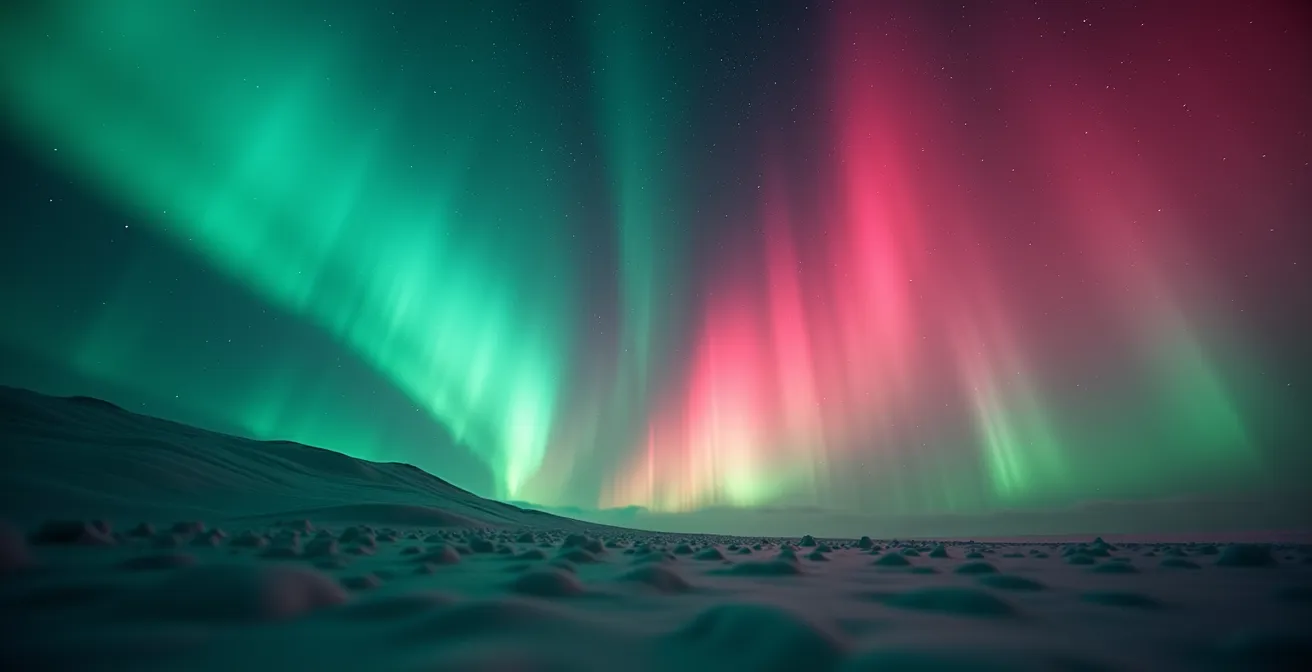
While Indigenous knowledge systems focus on the spiritual ‘who’ of the Aurora, Western science provides a compelling explanation of the physical ‘how’. The mesmerizing colours are a direct result of energy from the sun—the solar wind—colliding with gases in Earth’s upper atmosphere. The dominant colour, a vibrant and ethereal green, is the signature of a specific interaction: excited oxygen atoms.
When charged particles from the sun strike oxygen atoms at altitudes between 100 and 300 kilometres, the atoms release their excess energy as green light. This is the most common colour because our eyes are most sensitive to this part of the light spectrum, and this particular interaction is highly prevalent. But other colours are possible when conditions change. A rare and sought-after sight is the deep red Aurora. This occurs when solar particles hit oxygen atoms at much higher altitudes, above 300 kilometres, where the atmospheric composition is different. Pinks or crimson hues can also appear at the lower edges of the auroral curtains, produced by collisions with nitrogen molecules.
This scientific explanation doesn’t diminish the spiritual one; it enriches it. One can simultaneously appreciate the dance of excited atoms and the dance of the ancestors. The science describes the celestial mechanics, while Indigenous wisdom gives it meaning, proving that these two knowledge systems can coexist and create a more complete picture of this incredible phenomenon.
Can You Hear the Northern Lights? The Science Behind the Crackling
Perhaps one of the most intriguing and debated aspects of the Aurora is its sound. For generations, Indigenous oral traditions across the North have described the lights whispering, hissing, or crackling. To many scientists, this was long dismissed as folklore or an auditory illusion. However, both lived experience and emerging science suggest there is truth to this sensory ecology. Dene Elder Jonas Antoine, speaking to the CBC about an intense auroral experience, described it in deeply spiritual terms: “I was almost like in a spiritual world when this happened to me. I felt that I had a visitor. The visitor is something, is a great power that’s beyond us,” his words capturing the profound connection felt when the lights seem to speak.
This experience is echoed by others who spend their lives under the northern sky. Photographer Wayne Broomfield from Makkovik, Labrador, shared his own quest to hear the legendary sounds with the CBC in an interview about Northern Lights legends. He recounted the Inuit legend of spirits playing a game with a walrus skull, where the “crackling is when they’re running across the real-cold, frozen snow.” This ties the sound directly to the actions of the spirits, reinforcing the concept of a living, active presence.
Modern science is now catching up to this ancient knowledge. Researchers have proposed that during intense geomagnetic storms, the changing magnetic fields can induce electrical charges in the atmosphere near the ground, causing crackling sounds from objects like trees or even a person’s hair. This phenomenon, known as an acoustic anomaly, requires specific conditions that align perfectly with what Indigenous knowledge has taught for centuries: extreme cold, atmospheric stillness, and a powerful auroral display.
Why an Elder-Led Aurora Tour Offers a Deeper Connection
Seeing the Northern Lights is one thing; understanding them is another. While any trip to Canada’s north can offer a spectacular view, an Indigenous-led experience, particularly one involving Elders, provides a level of depth and connection that is simply unattainable on a standard tour. These experiences are not about just pointing a camera at the sky; they are about participating in a culture where the Aurora is part of a larger cosmic and spiritual family.
The value lies in the context. As Bobby Drygeese, owner of B. Dene Adventures, explained to Destination Canada, “Our aurora tours are unique because they include traditional drumming, cooking fish over a fire and the sharing of our language and culture. Guests love speaking with our Elders and hearing the Dene legends and stories.” This immersive approach transforms tourists into guests, inviting them into a worldview rather than just showing them a view. It’s an opportunity to learn the protocols, hear the stories tied to the specific landscape you are in, and feel the reciprocity that underpins the human-nature relationship in Indigenous thought.
For travelers, this also comes with a practical advantage. Indigenous communities are located in some of the world’s most reliable aurora-viewing locations. For instance, Yellowknife, a hub for Indigenous tourism, offers a remarkable success rate. According to Wanderlust Magazine, staying for three consecutive winter nights in the area gives visitors a 90% chance of seeing the Aurora. Choosing an Elder-led tour in such a location combines the highest probability of a sighting with the deepest possible cultural connection.
Ultimately, an Elder-led tour is the difference between watching a movie in a foreign language without subtitles and watching it with a director who explains every scene’s meaning. It’s an invitation to go beyond the surface and truly connect with the spirits in the sky.
Why Whistling at the Northern Lights is Taboo in Some Cultures
Engaging with the Aurora in a respectful manner involves more than just quiet appreciation; it requires understanding specific cultural protocols, or taboos. Among the most widespread of these in Dene and Cree traditions is the prohibition against whistling at the lights. To an outsider, this might seem like a quaint superstition. To a knowledge keeper, it is a critical rule of engagement based on the principle of reciprocity: the spiritual world must be shown respect to maintain a balanced relationship.
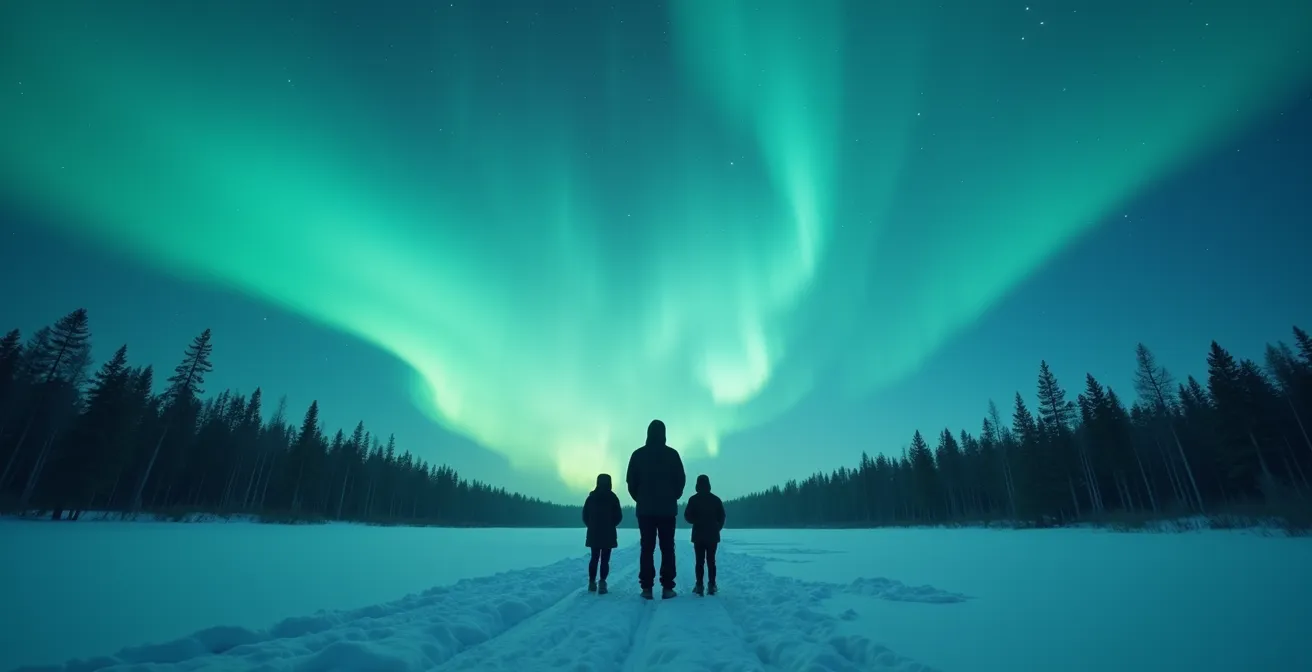
Whistling is believed to mimic the sounds of the spirits themselves. Doing so is seen as mockery or a challenge. According to these traditions, such an act could anger the spirits, who might then descend to take the whistler away. It is a sign of profound disrespect to a powerful force. This is part of a broader set of protocols that guide interactions with the Aurora. Other discouraged behaviours include pointing directly with a finger (a chin-point or open hand is preferred), shouting, or making sudden, disruptive movements. Each of these actions is seen as disturbing the ‘living dialogue’ and breaking the respectful silence that the moment demands.
These taboos are not meant to inspire fear, but rather to cultivate an attitude of reverence and humility. They are practical instructions for how to be a good guest in the presence of the ancestors. By observing these protocols, a visitor actively participates in the cultural worldview, showing that they understand they are in the presence of something sacred. It is an act of acknowledging that the relationship with nature and the spirit world is a two-way street.
Why You Need Trees or Mountains to Make Your Aurora Photo Pop
For many, capturing a stunning photograph of the Aurora is as important as seeing it. However, the most memorable aurora photos are rarely just of the sky. A great image needs context, scale, and a sense of place. This is where the Canadian landscape—its boreal forests, frozen lakes, and rugged mountains—becomes an essential character in the story. A foreground element doesn’t just make the photo more interesting; it anchors the celestial display to the terrestrial realm, echoing the Indigenous worldview of a connected cosmos.
In a place like Yellowknife, which according to Canadian Geographic can experience aurora visibility up to 240 nights per year, photographers have ample opportunity to perfect their compositions. Including a treeline, a mountain silhouette, or the reflection on a frozen lake gives the image a powerful sense of scale, emphasizing the vastness of the auroral curtain. It transforms a simple sky picture into an immersive environmental portrait. This is not just an aesthetic choice; it’s a narrative one. It shows the spirits dancing above a living, breathing land.
By consciously choosing foregrounds with cultural significance, a photographer can elevate their work from a simple snapshot to a respectful tribute. This practice acknowledges that the land itself is sacred and storied.
Action Plan: Composing Aurora Photos with Cultural Depth
- Frame the Aurora above culturally significant landmarks, such as an Inukshuk, to connect the sky to human heritage.
- Use traditional structures like community smokehouses or winter camps as foreground anchors to ground the scene in a living culture.
- Incorporate named peaks or specific landforms that hold significance for local First Nations, such as those in Tombstone Territorial Park.
- Compose with the vast boreal forest treeline to represent the living landscape as taught in Indigenous worldviews.
- Utilize frozen lake surfaces to create reflections that powerfully unite the sky spirits with the earthly realm.
A photograph that includes these elements tells a much richer story—one of connection, place, and the enduring relationship between the people and the sky.
The Historical Myth About “Totem Poles” That 60% of Tourists Believe
When thinking of Indigenous art in Canada, many visitors immediately picture the towering, intricately carved “totem poles” of the Pacific Northwest. There is a common and persistent myth that these poles are a universal symbol of Indigenous culture across the country. This is fundamentally incorrect. The artistic traditions of Canada’s Indigenous peoples are as diverse as its landscapes. The magnificent heraldic poles are specific to West Coast nations like the Haida, Nisga’a, and Kwakwaka’wakw. They are not part of the cultural heritage of the Dene, Inuit, or Cree peoples of the subarctic and arctic regions where the Aurora is most visible.
Confusing these traditions is more than a simple mistake; it erases the unique identity and artistic genius of the peoples of the North. Their art forms are deeply connected to their environment and cosmology, using materials sourced from the land. This includes the elegant flow of Inuit soapstone carving, the intricate detail of Dene moose-hair tufting and beadwork, and the beautiful geometric patterns of Cree birchbark and porcupine quill art. Each is a sophisticated knowledge system expressed through craft.
The Prince of Wales Northern Heritage Centre in Yellowknife provides an excellent education on this topic. It showcases authentic subarctic art forms specific to aurora-viewing regions, helping visitors understand and appreciate the distinct traditions of the North. The following table helps clarify these regional distinctions.
| Region | Traditional Art Form | Cultural Group | Materials Used |
|---|---|---|---|
| Pacific Northwest (BC) | Heraldic/Totem Poles | Haida, Nisga’a, Kwakwaka’wakw | Cedar wood |
| Arctic/Subarctic (NWT, Nunavut) | Soapstone Carving | Inuit | Soapstone, serpentine |
| Northern Forests (Yukon, NWT) | Moose-hair Tufting & Beadwork | Dene | Moose hair, beads, hide |
| Boreal Regions | Geometric Pattern Art | Cree | Birchbark, porcupine quills |
Understanding this diversity is a fundamental act of respect. It allows a traveler to see the art of the North not in the shadow of another region, but in its own brilliant and resilient light, much like the Aurora itself.
Key Takeaways
- The Northern Lights are not just a scientific event but are considered a ‘living dialogue’ with ancestors and spirits in many Canadian Indigenous cultures.
- Understanding cultural protocols, such as not whistling at the lights, is an act of reciprocity and respect for these spiritual entities.
- An Elder-led tour offers the most profound experience, combining prime viewing opportunities with deep cultural context and storytelling.
Capturing the Aurora: A Beginner’s Guide to Night Photography
Photographing the Northern Lights is a technical challenge, but it is also an ethical one. As a guest in the North and a witness to a sacred event, how you conduct yourself with your camera is as important as your F-stop and shutter speed. The goal is not just to take a photo, but to do so in a way that honours the place, the people, and the spirits you are there to see. This begins with a mindset of presence and respect, putting the experience before the exposure.
The first principle is to minimize your impact. The light from your camera’s LCD screen, your phone, or a headlamp can disrupt the night vision of others and is considered disrespectful during sacred moments like storytelling. It breaks the immersive atmosphere that is so crucial to the experience. An ethical photographer learns to work in the dark, prepares their settings in advance, and always puts human connection and cultural moments ahead of getting the shot. It is a profound sign of respect to put the camera down entirely when an Elder is speaking.
This respect extends to the land itself. The subarctic and arctic ecosystems are fragile. Always stay on designated trails to avoid damaging delicate flora that can take decades to recover. Following the principles of Leave No Trace Canada is non-negotiable. By approaching aurora photography with an ethical framework, you ensure that your memories are not created at the expense of the culture or environment you have come to admire. The best photograph is one that is captured with a clear conscience and a respectful heart.
Ethical Photography Guidelines:
- Always ask for permission before photographing Elders, guides, or other participants during cultural experiences.
- Turn off all camera flashes and headlamps, especially during storytelling, to show respect for both the people and the spirits.
- Avoid disruptive techniques like light-painting, which can spoil the natural view for everyone else.
- Stay on designated trails to protect the fragile subarctic ecosystem from damage.
- Practice the principles of Leave No Trace by packing out everything you bring in.
Begin your journey to see the Aurora not just as a photographer, but as a respectful guest, and you will come away with something far more valuable than a photo: a genuine connection.
Frequently Asked Questions About The Spirits in the Sky: Indigenous Legends of the Northern Lights
Why do some Indigenous cultures forbid whistling at the Northern Lights?
Many Dene and Cree traditions teach that whistling mimics the sound of spirits in the aurora. This could anger them or draw them down to take the whistler away, as it’s seen as mockery or disrespect to powerful spiritual entities. This is based on a foundational principle of reciprocity and respect for the spirit world.
Are there other behaviors to avoid when viewing the aurora?
Yes, many Indigenous cultures advise against pointing directly with a finger (use chin-pointing or an open hand instead), speaking loudly, or making sudden movements. These are all part of showing proper respect to the spirits and maintaining the sanctity of the experience.
What is the principle behind these taboos?
These rules follow the Indigenous principle of reciprocity—you must show respect to the natural and spiritual world to receive its gifts. Violating these protocols is seen as breaking that sacred reciprocal relationship between humans and the powerful spirits of the Aurora.