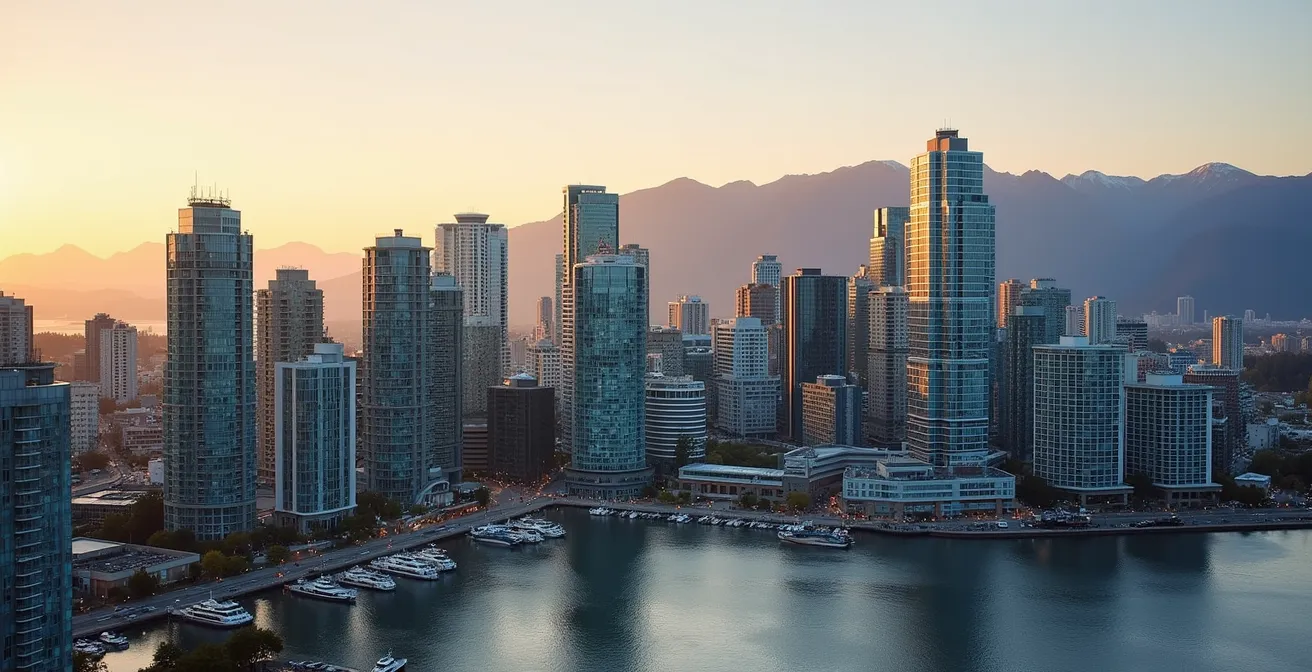
Vancouver’s iconic skyline is not merely an aesthetic choice; it’s the physical manifestation of a deliberate social contract balancing private development against a fiercely protected public realm.
- High-density “tower and podium” designs are permitted in exchange for significant public benefits, including protected mountain views and privately owned public spaces (POPS).
- The city’s evolution from an industrial port to a green metropolis was engineered through post-Expo ’86 planning that prioritized public access and livability.
Recommendation: To truly understand Vancouver, view its architecture not as individual buildings, but as participants in a city-wide agreement between the towers, the people, and the mountains.
To the first-time visitor, Vancouver’s skyline is a breathtaking declaration. Gleaming towers of aquamarine glass cluster along the waterfront, reflecting the sky and the sea, earning the city its well-known moniker: the “City of Glass.” The common narrative attributes this to a simple formula: a post-Expo ’86 development boom that pushed for high-density living while preserving the sublime mountain views. This explanation, while true, only scratches the surface. It presents a beautiful outcome as a happy accident of geography and economics.
But what if the reality is far more intentional? What if Vancouverism is not just an architectural style, but a social contract codified in concrete and glass? This perspective reframes the city’s urban form not as a collection of buildings, but as a meticulously negotiated agreement. It’s a philosophy where private developers are granted vertical density, and in return, they contribute to a vibrant, accessible, and fiercely protected public realm. This is a story of engineered livability, where every tower, park, and preserved facade is a clause in that contract.
This article deconstructs that contract. We will trace its origins along the shores of False Creek, analyze its most stringent clauses like the protected view corridors, and uncover the hidden public gardens born from private negotiations. We will explore how the city metabolizes its own history and how it now faces the challenge of upholding this delicate balance in the face of a changing climate. This is the story of how a visionary urban plan didn’t just build a city, but forged an identity.
To fully grasp the principles that shaped this unique urban landscape, this guide breaks down the core components of Vancouverism. The following sections will navigate you through the key policies, historical transformations, and public amenities that define the City of Glass.
Summary: Deconstructing the City of Glass
- Architecture by the Water: The Best Route to See the Glass Towers
- Why Vancouver Buildings Can’t Block the Mountain View
- Privately Owned Public Spaces (POPS): Hidden Gardens in Downtown Vancouver
- Gastown Brick vs. Yaletown Glass: A Tale of Two Neighborhoods
- Why the Living Roof on the Convention Centre Matters for the City
- How Heritage Laws Protect Old Facades in Modern Condo Projects
- How to Manage Vertigo Before Stepping onto the Edge
- Walking Stanley Park: Etiquette and Routes for the Seawall
Architecture by the Water: The Best Route to See the Glass Towers
The story of modern Vancouver is written in the curve of False Creek. What was once a landscape of polluted industrial lands and railway yards underwent a profound transformation, catalyzed by the 1986 World Exposition. Expo ’86 was not just a global fair; it was an act of urban alchemy. The city leveraged the event to scrub its industrial past and lay the groundwork for a new type of residential waterfront. This process is a prime example of architectural metabolism, where the city ingested derelict land and converted it into the energy for a new urban vision.
The best way to comprehend this shift is to walk it. A self-guided tour along the north shore of False Creek is a journey through the DNA of Vancouverism. Starting from the geodesic dome of Science World—an Expo ’86 icon—and heading west, you witness the philosophy unfold. You pass the dense but airy towers of Yaletown, built on former rail lands, their slim profiles designed to allow light and views to penetrate deep into the city. Further on, the Olympic Village, a more recent addition, showcases the evolution of the model, with its emphasis on LEED Platinum sustainability and a more textured, human-scale podium level.
This walk is a physical timeline. It contrasts the raw industrial heritage hinted at by Granville Island’s markets with the sleek, residential future that replaced it. Each tower you pass is not just a home but a testament to the city’s foundational decision: the waterfront belongs to the public. The continuous seawall path, the parks, and the sightlines are non-negotiable, a principle established right here, on these reclaimed lands. This journey ends at Canada Place, where the vision extends into the harbour itself, perfectly setting the stage for the next clauses in the city’s social contract.
Why Vancouver Buildings Can’t Block the Mountain View
If the public waterfront is the first article in Vancouver’s social contract, the protection of its views is the second, and arguably the most sacred. Vancouverism dictates that the sublime beauty of the North Shore mountains is not a luxury for a few, but a right for all citizens. This principle is not a gentle guideline; it is a rigid, geometrically precise policy known as the View Cone Protection. These 27 protected view corridors are invisible funnels slicing through the city’s airspace, dictating the height, shape, and placement of every new tower in the downtown core. They are the unseen hand sculpting the skyline.
This “curated viewshed” is a radical act of planning. It declares a natural landscape feature as a piece of inalienable public infrastructure, as vital as a road or a park. The policy creates the characteristic terraced effect of the Vancouver skyline, where buildings step down as they approach the water to preserve the mountain backdrop for observers in places like Queen Elizabeth Park. This is a direct trade-off: the city sacrifices immense potential development capacity to maintain its visual connection to the wilderness. An analysis by city staff suggested proposed amendments could unlock an estimated 215 million sq ft of additional building area, highlighting the immense economic value placed on this public good.
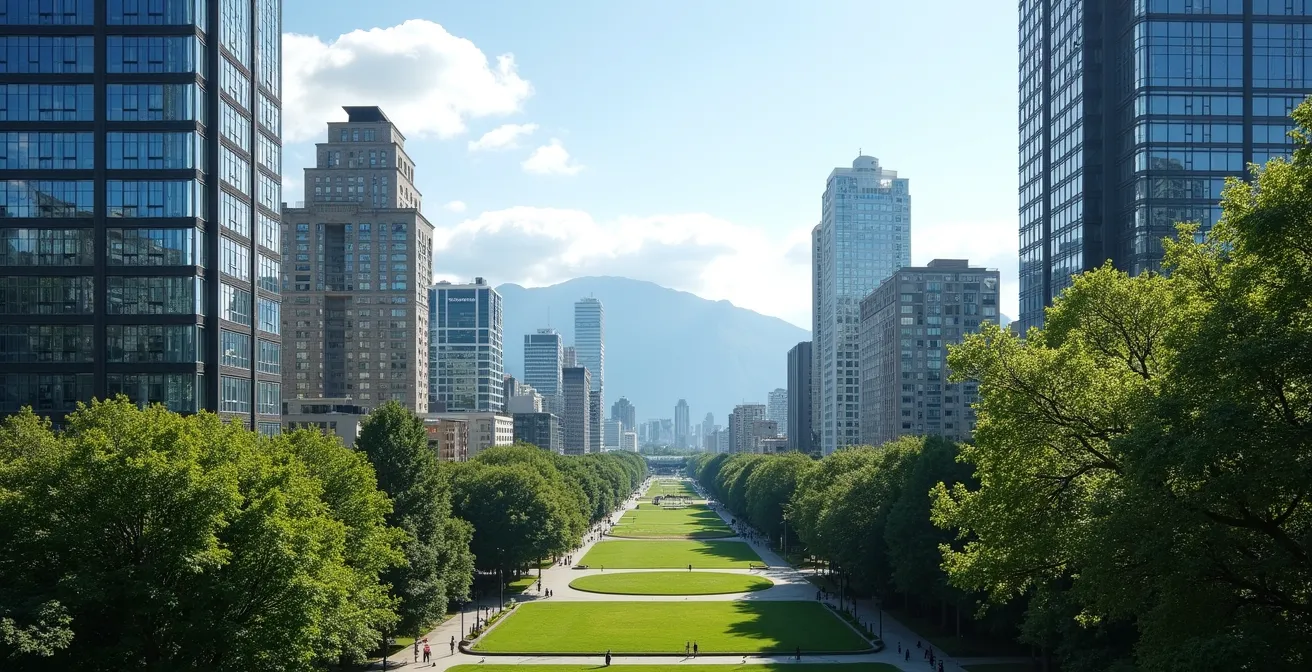
This is the core of the compromise. Developers can build high, but they cannot build anywhere. The slender, widely spaced forms of Vancouver’s towers are a direct result of developers maneuvering within these tight aerial confines. The “City of Glass” is, in many ways, a city shaped by what is not there—the empty space that is deliberately preserved. The glass itself becomes a tool, its transparency and reflectivity dematerializing the building masses and allowing the ever-present mountains to remain the true protagonists of the urban drama.
Privately Owned Public Spaces (POPS): Hidden Gardens in Downtown Vancouver
The “give-and-get” dynamic of Vancouver’s urban contract is most tangible at street level, in the city’s network of Privately Owned Public Spaces, or POPS. These hidden rooftop gardens, quiet plazas with water features, and art-filled courtyards are the direct result of negotiations between the City and developers. In exchange for permission to build with greater density or height—often by navigating the complex view-cone geometry—developers are required to design, build, and maintain spaces that are accessible to the public. This is the social contract in its most literal form: private profit funds public pleasure.
These spaces are crucial to the success of the high-density “tower and podium” model. They create a porous, pedestrian-friendly ground plane that mitigates the potential alienation of living surrounded by soaring towers. They are the semi-public “living rooms” of these new vertical neighborhoods. You might find a quiet reading spot in the HSBC Building Plaza, discover rotating sculptures in the TD Tower courtyard, or enjoy lunch in a hidden garden atop the Bentall Centre. These are not grand, monumental parks, but intimate, human-scale oases that make a dense downtown livable.
However, this model represents a fascinating and sometimes contentious hybrid. As they are privately managed, these spaces operate under different rules than city parks, a distinction that highlights the nuances of the public-private partnership. The following table, based on information from the City of Vancouver, illustrates the key differences:
| Feature | POPS | Public Parks |
|---|---|---|
| Hours | Usually 6am-10pm | Dawn to dusk or 24/7 |
| Security | Private security present | City bylaw officers |
| Activities Allowed | Limited (no protests/sleeping) | Most peaceful activities |
| Maintenance | Private management | Park Board |
Gastown Brick vs. Yaletown Glass: A Tale of Two Neighborhoods
To understand the revolution of Vancouverism, one must compare the city that was with the city that is. This story is perfectly encapsulated in two adjacent downtown neighborhoods: Gastown and Yaletown. Gastown, the city’s original core, is a district of Victorian brick and stone. Its architecture is robust, horizontal, and grounded. The buildings are low-rise, with ornate facades that speak of a 19th-century economy built on the Canadian Pacific Railway, logging, and the port. The streetscape is defined by its historic texture and its human scale, a legacy of a pre-modernist city.
Yaletown, just a short walk away, is its philosophical successor. Built upon the industrial railway lands cleared for Expo ’86, Yaletown is the first large-scale embodiment of Vancouverism. Here, brick warehouses are converted into trendy lofts, but they are dwarfed by the slender glass towers that rise above. This is the “tower and podium” model in its purest form. The podiums, often retaining a brick or warehouse-like character, house shops and restaurants that activate the street, while the light, transparent towers above accommodate thousands of residents without casting the oppressive shadows of a traditional concrete high-rise.
This juxtaposition is not just an aesthetic choice; it’s an economic and social one. It represents the city’s shift from a resource-based industrial hub to a post-industrial center focused on livability, technology, and the service economy. The late architect Bing Thom, a key figure in shaping the city, articulated this spirit perfectly:
It’s a spirit about public space. I think Vancouverites are very, very proud that we built a city that really has a tremendous amount of space on the waterfront for people to recreate and to enjoy. At the same time, False Creek and Coal Harbour were previously industrial lands that were very polluted and desecrated. We’ve refreshed all of this with new development, and people have access to the water and the views.
– Bing Thom
This quote captures the essence of the transition: a conscious act of urban renewal that replaced industrial desecration with public recreation, funded by a new model of high-density, view-oriented living.
Why the Living Roof on the Convention Centre Matters for the City
The Vancouver Convention Centre’s West building extends the city’s social contract from land and air to the very skin of its buildings. Its iconic living roof is more than just a green aesthetic; it is a powerful statement about the future of urbanism and a piece of high-performance ecological infrastructure. This is Vancouverism evolving, moving beyond simply accommodating density to actively regenerating the natural environment. It is the principle of “engineered livability” taken to its most ambitious and visible conclusion, creating a functioning ecosystem in the heart of the city.
Spanning six acres, it is the largest non-industrial living roof in North America and serves as a habitat for more than 400,000 indigenous plants and grasses. This is not a manicured lawn but a slice of a coastal British Columbia grassland, complete with four beehives that pollinate the plants. The roof is a living machine. It captures rainwater, treating it for use in the building’s greywater systems, and it provides a critical habitat for local birds and insects, creating an ecological bridge in a dense urban core.

Beyond its biodiversity, the roof is a key part of the building’s climate resilience strategy. The 16cm of soil acts as a natural insulator, a critical function in a city of glass. It dramatically reduces the energy needed for heating and cooling, with studies showing it is responsible for reducing heat gains in the summer by approximately 96 percent and heat losses in the winter by 26 percent. It is a working model of how future development can be designed not just to minimize harm, but to provide positive ecological benefits, proving that even the largest structures can contribute to the health of the city.
How Heritage Laws Protect Old Facades in Modern Condo Projects
Vancouver’s forward-looking identity does not require a complete erasure of its past. The city’s approach to heritage preservation is another “pragmatic compromise” written into its urban contract, a practice often referred to as “façadism.” This strategy acknowledges that as a young, rapidly growing city, Vancouver cannot afford to freeze its historic buildings in time. Instead, it allows for a form of architectural metabolism: the city preserves the historically or architecturally significant “skin” of a building while allowing a modern, high-density tower to grow from within or above it.
This approach can be seen across the city, from the famous Woodwards redevelopment, which integrates a full heritage building into a massive mixed-use complex, to the Telus Garden, where the brick facade of a 1920s building serves as the grand entrance to a contemporary office tower. As the Vancouver Heritage Commission has noted, “Façadism represents a pragmatic compromise between preserving city character and enabling development density needed for urban growth.” It is a solution that attempts to balance the memory of the streetscape with the economic and demographic pressures of the present.
For the architecture buff, identifying and analyzing these hybrid buildings is a fascinating exercise. It reveals the layers of the city’s history and the ongoing negotiation between past and future. The following checklist provides a framework for “reading” these buildings and understanding their role in the Vancouverism model.
Your Vancouverism Building Audit Checklist
- Podium Engagement: Assess the street-level interaction. Are there shops, public art, or inviting seating that contribute to the pedestrian experience?
- Tower Setback & Form: Observe the tower’s placement on the podium. Is it slender and set back to maximize light and views for its neighbours?
- Materiality & Glazing: Analyze the type of glass used on the tower. How does its reflectivity, transparency, or colour interact with the heritage materials of the facade?
- View Cone Alignment: From a known public vantage point, try to determine if the building’s height and massing respect a protected viewshed.
- Public Realm Contribution: Identify the “give-back.” Does the project include a hidden public garden (POPS), a preserved heritage element, or a water feature?
This compromise is not without its critics, who argue it can reduce heritage to mere decoration. Yet, it remains a defining and practical tool in the city’s planning kit, allowing Vancouver to evolve without completely severing ties to its architectural roots.
Key Takeaways
- Vancouverism is a deliberate social contract, not an accident of aesthetics, balancing private development with public good.
- The city’s iconic density is permitted in direct exchange for fiercely protected mountain views and the creation of public amenities like POPS.
- The future of this urban model depends on its ability to adapt, integrating new principles of sustainability and climate resilience.
How to Manage Vertigo Before Stepping onto the Edge
To truly understand the “City of Glass,” one must experience its defining characteristic: verticality. The entire urban model is built on embracing height, and for the urban explorer, engaging with this dimension is essential. For those unaccustomed to such elevations, this can be a daunting prospect. However, the city itself offers a natural, tiered progression to acclimate to the heights, allowing one to manage any feelings of vertigo and fully appreciate the panoramic rewards.
p>
A gradual ascent is the best strategy. You can begin in a controlled, seated environment like the Cloud 9 Revolving Restaurant, where the slow rotation and fixed viewpoint allow your senses to adjust. The next step could be the Vancouver Lookout, an enclosed observation deck that provides a solid sense of security with its indoor setting and robust railings. From here, the views are spectacular, but the experience is contained.
To introduce an open-air element, a visit to the Capilano Suspension Bridge is ideal. While the height is significant, the natural setting and the tangible feeling of the bridge underfoot can be grounding. For a more modern thrill, the Sea to Sky Gondola’s summit viewing platform offers breathtaking vistas with the security of a large, stable deck, some of which feature glass floors for a direct view down. The final step in this acclimatization journey is often the Grouse Mountain Skyride. The steep, swift ascent in a glass-walled cabin is an immersive vertical experience, delivering you to a viewpoint where the entire metropolitan region unfolds at your feet, a map of the very principles of Vancouverism you’ve been exploring.
Walking Stanley Park: Etiquette and Routes for the Seawall
The Stanley Park Seawall is the crown jewel of Vancouver’s public realm. It is the ultimate expression of the city’s social contract, a continuous 9km loop of publicly accessible waterfront that is arguably the most democratic and beloved space in the entire metropolitan region. It is here that the philosophy of Vancouverism—prioritizing public access and recreation over private ownership—finds its most complete and celebrated form. Walking, cycling, or skating the Seawall is a civic ritual, a shared experience that connects people from all walks of life to the city’s natural splendour.
The etiquette of the Seawall is simple and crucial for its shared success: stay in your lane. The path is clearly divided, with one lane for walkers and joggers and another for cyclists and skaters, typically with a counter-clockwise flow of traffic. This simple rule allows millions of users a year to coexist. The route itself is a masterclass in choreographed experience, offering constantly shifting views of the downtown skyline, the container port, the North Shore mountains, and the open waters of the Pacific. It is a living gallery of the city’s identity.
p>
Yet, this iconic piece of infrastructure is now at a critical juncture. The very forces of nature it celebrates are becoming its greatest threat. Climate change, rising sea levels, and more frequent, severe storms are battering the aging structure. Following significant storm damage in 2021 and 2022, a “wake-up call” on climate change, the Vancouver Park Board is facing a monumental challenge. The estimated cost to repair and adapt the Seawall to this new reality is staggering, potentially running between approximately $250 and $300 million. This is the next chapter in Vancouver’s social contract: how to preserve its most cherished public assets in an era of environmental uncertainty. The conversation is shifting from just public access to public resilience.
The next time you walk the streets of Vancouver, look up. See not just the shimmering glass, but the spaces between the towers, the preserved views of the mountains, and the life unfolding in the public squares at their feet. Ask yourself: what is the contract this building has made with its city? In those details lies the true, visionary genius of Vancouverism.