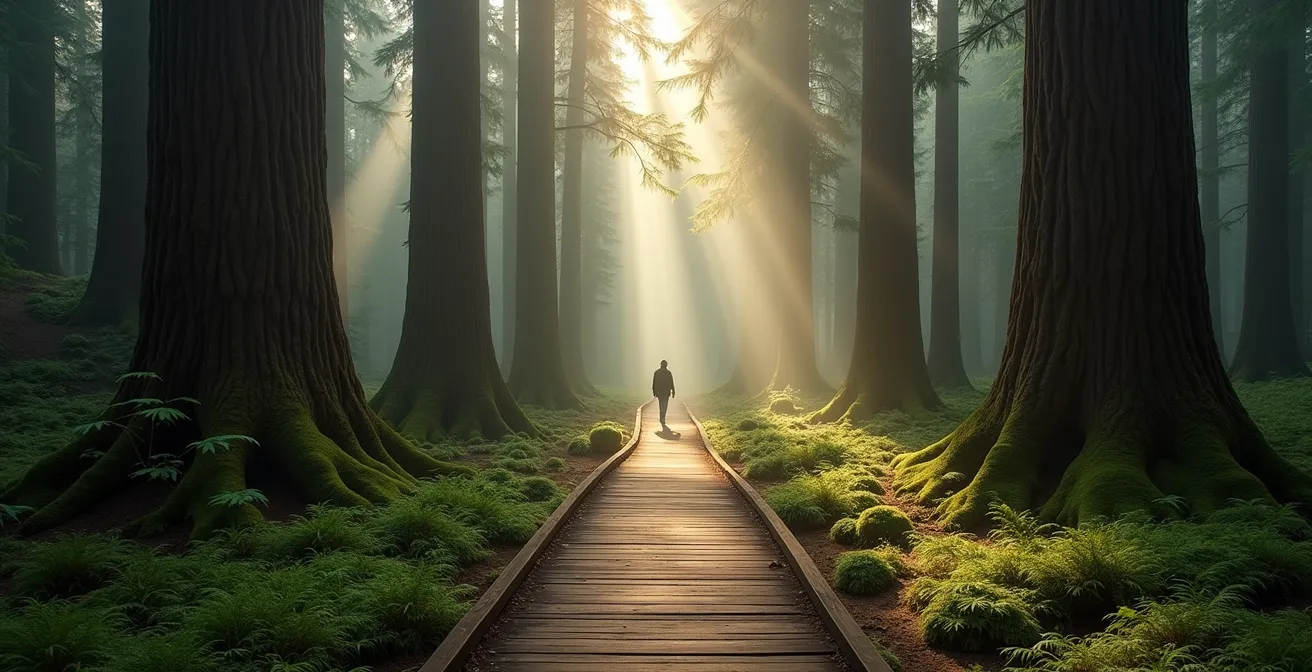
The secret to a meaningful visit to Cathedral Grove isn’t finding a secret parking spot; it’s shifting your perspective from tourist to forest steward.
- The massive fallen trees aren’t debris; they are the lifeblood of the forest, creating space and nutrients for future generations.
- Your biggest impact isn’t your footprint, but your choices—from the lens you use to the hotels you book.
Recommendation: Approach the forest with reverence. The goal is not to quickly see big trees, but to understand the fragile, interconnected ecosystem you have the privilege to enter.
The scene is familiar to anyone who has driven Highway 4 on Vancouver Island: a sudden slowdown, cars parked precariously along the shoulder, and a stream of people disappearing into the forest. This is Cathedral Grove in MacMillan Provincial Park, a world-famous sanctuary of ancient Douglas firs. For many, it’s a mandatory, hurried stop on the pilgrimage to Tofino, a place to snap a photo proving you’ve stood next to a giant. This approach, however, often leads to frustration—the very spiritual connection sought is lost in the shuffle of the crowds and the roar of the highway.
Most advice focuses on the logistical problem: go early, go late, visit in the off-season. While practical, this advice misses the fundamental point. The congestion is a symptom of a deeper disconnect. We treat the Grove as a spectacle to be consumed, rather than a living, breathing, and incredibly fragile ecosystem to be respected. The real challenge isn’t how to avoid the other visitors, but how to change our own behaviour to honour the forest itself. What if the key to a profound experience wasn’t finding a moment of solitude, but in understanding the profound fragility under your feet?
This guide offers a different path. It’s built on a conservationist’s perspective, where a visit is an act of stewardship. We will explore the hidden life in fallen giants, the ethics of capturing their scale without causing harm, and how your presence can actively support the protection of these irreplaceable forests. By shifting your mindset from consumption to conservation, you can find a connection that no crowd can diminish.
For those who prefer a visual introduction, the following video offers a beautiful immersion into the scale and atmosphere of the trails, perfectly complementing the conservation and logistical advice in this guide.
To help you navigate this conservation-focused journey, this article is structured to build your understanding step by step, from the ecology of the forest floor to the impact of your tourism dollars.
Summary: A Deeper Look into Cathedral Grove’s Ancient Forest
- Why Dead Trees Are More Important Than Live Ones in the Rainforest
- How to Photograph Giant Douglas Firs Without Trampling the Undergrowth
- Avatar Grove or Carmanah Walbran: Which Big Tree Site Justifies the Drive?
- The Footwear Mistake That Causes Slips on Rainforest Boardwalks
- Old-Growth Tourism: How Your Visit Can Support Conservation Efforts
- Green Certified vs. “Eco-Friendly”: How to Spot the Difference in Hotel Marketing
- Black Spruce or Balsam Fir: How to ID Trees by Their Needles
- Visiting the Great Bear Rainforest: Logistics for a Remote Adventure
Why Dead Trees Are More Important Than Live Ones in the Rainforest
Your first instinct upon seeing a fallen giant in Cathedral Grove might be one of sadness—a king has fallen. A conservationist, however, sees a throne being built. In the hyper-competitive world of a temperate rainforest, dead trees are the architects of the future. These massive logs, known as “nurse logs,” are life rafts for the next generation. Their decaying wood is a sponge for moisture and a slow-release fertilizer packed with nutrients. Seedlings that land on the forest floor are often outcompeted for light and resources, but those that sprout on a nurse log get a vital head start, their roots tapping into this rich, elevated nursery.
The impact of a fallen tree extends far beyond its own footprint. A severe windstorm on New Year’s Day in 1997 toppled many giants in the Grove. While a tragedy for those specific trees, the event was a blessing for the forest as a whole. Each fallen behemoth created a “light-gap” in the dense canopy, allowing sunlight to finally reach the forest floor. This explosion of light triggered a riot of new growth, increasing the biodiversity and structural complexity of the ecosystem. You are not walking through a static museum of old trees; you are witnessing a dynamic cycle of death, decay, and rebirth.
This cycle is what makes old-growth forests so resilient and biodiverse. Yet, this entire system is critically endangered. A stark analysis reveals that less than 1% of BC’s forests are the highly productive old-growth ecosystems like the one you see in Cathedral Grove. This rarity elevates your visit from a simple walk to a privileged moment with one of the planet’s most threatened habitats.
How to Photograph Giant Douglas Firs Without Trampling the Undergrowth
Capturing the immense scale of an 800-year-old Douglas fir is a primary goal for many visitors. Yet, the quest for the perfect shot is one of the greatest threats to the forest’s health. The ground beneath these giants is not just dirt; it’s a delicate web of shallow roots, fungi, and fragile undergrowth. Stepping off the designated boardwalk, even for a moment, causes root-zone compaction. This compresses the soil, squeezing out air and water channels, effectively suffocating the very trees you came to admire. The damage is cumulative and long-lasting.
Responsible photography is therefore not a limitation, but a creative challenge. It forces you to see the forest differently, moving beyond the simple “person-for-scale” shot. Instead of focusing on the entire tree, which is often impossible to capture from the trail anyway, look for details. Focus on the deep, puzzle-like bark, the texture of moss against wood, or the way light filters through the canopy. Use the boardwalks as leading lines to draw the viewer into the scene. Ethical photography is about telling the story of the forest, not just documenting its size.
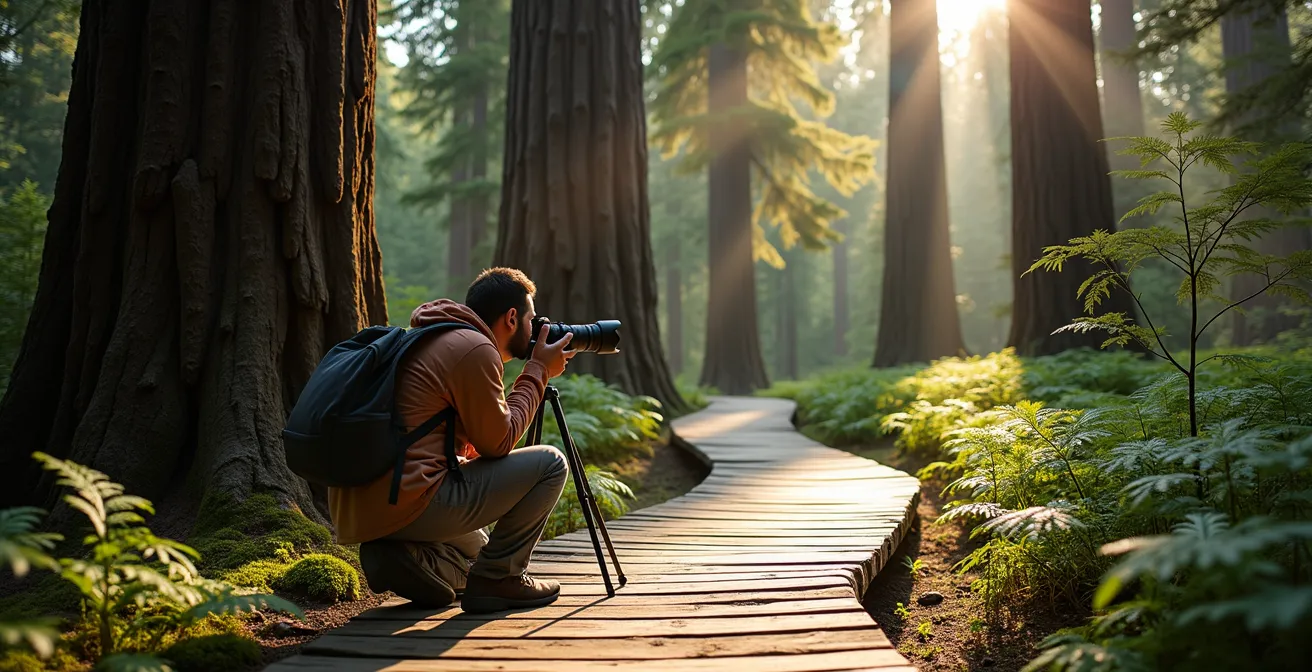
As the image above demonstrates, using the right gear from the right place is key. A telephoto lens allows you to isolate details high in the canopy, while a circular polarizer can cut the characteristic glare from wet foliage, making the greens richer and more vibrant. The most important tool, however, is your mindset: the forest’s health is always more important than your photograph.
Your Ethical Photography Checklist: Capturing the Grove Responsibly
- Stay on Boardwalks: Never step onto the forest floor. Protect the fragile root systems and undergrowth at all costs.
- Avoid Geotagging: To prevent social media-driven overcrowding of specific spots, avoid posting precise location data. Share the experience, not the coordinates.
- Use the Right Lens: Employ telephoto lenses (85-200mm) to capture canopy details or frame abstract shots from the designated trail.
- Manage Glare: Use a circular polarizer to manage reflections on wet leaves and bark, enhancing the natural colours of the rainforest.
- Practice Tripod Etiquette: Set up your tripod only on the boardwalks or designated viewing platforms, ensuring it doesn’t obstruct other visitors.
Avatar Grove or Carmanah Walbran: Which Big Tree Site Justifies the Drive?
For visitors with more time and a desire for a wilder, less-crowded experience, Cathedral Grove is just the beginning. Vancouver Island is home to other spectacular old-growth sites, notably Avatar Grove near Port Renfrew and the more remote Carmanah Walbran Provincial Park. Choosing between them depends entirely on your appetite for adventure and your vehicle’s capabilities. Avatar Grove, protected in 2012 after a powerful grassroots campaign, has become a symbol of modern forest activism. As Ancient Forest Alliance co-founder TJ Watt states, this place has had a profound impact.
Avatar Grove has become a catalyst helping to shape the fate of endangered old-growth forests across BC.
– TJ Watt, Ancient Forest Alliance Photographer and Co-Founder
This sentiment highlights that visiting these places is about more than just seeing trees; it’s about participating in a living history of conservation. While Cathedral Grove is a provincial park with a long history, Avatar Grove feels more raw and activist-born. Carmanah Walbran, by contrast, is a true backcountry experience, the site of major 1990s logging blockades that requires significant effort to reach.
Deciding which forest to visit requires a careful look at logistics. The following comparison breaks down the key differences to help you make a responsible choice that matches your preparedness.
| Criteria | Avatar Grove | Carmanah Walbran |
|---|---|---|
| Accessibility | Moderate – gravel roads, 2WD possible | Difficult – rough logging roads, 4WD recommended |
| Distance from Port Renfrew | 20 minutes | 2+ hours |
| Trail Infrastructure | Boardwalks (when open) | Natural trails, more rugged |
| Conservation History | Protected 2012 after grassroots campaign | Site of 1990s logging blockades |
| Indigenous Connection | Pacheedaht First Nation territory | Ditidaht and Huu-ay-aht territories |
| Cell Service | None | None |
| Best For | Families, shorter visits | Adventure seekers, backcountry experience |
The Footwear Mistake That Causes Slips on Rainforest Boardwalks
While your mind is on the towering giants above, a critical safety issue lies directly underfoot. The wooden boardwalks of Cathedral Grove, smoothed by the footfalls of over 300,000 visitors annually, become notoriously slippery in the damp rainforest climate. A thin, often invisible layer of moisture, algae, and fine debris creates a surface with all the grip of an ice rink. The most common mistake visitors make is wearing casual shoes, like runners or fashion sneakers, with flat, hard-soled bottoms.
These types of shoes are designed for dry pavement and offer virtually no traction on wet, organic surfaces. A slip and fall on the hard boardwalk can easily result in a sprained ankle or worse, abruptly ending your trip. The solution is simple: wear appropriate footwear. This doesn’t necessarily mean heavy-duty hiking boots, but it does mean shoes with a soft, grippy rubber sole and a deep lug pattern. These lugs act like the treads on a tire, channelling water away from the contact point and allowing the soft rubber to grip the wood’s texture.
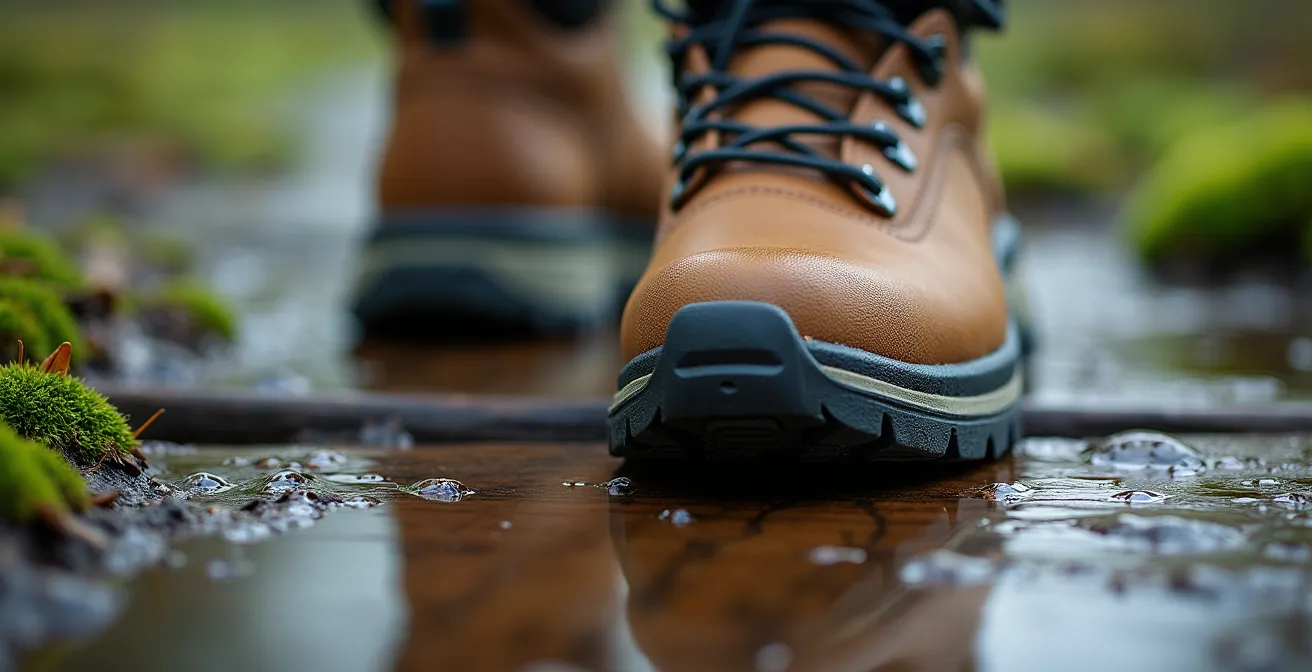
As this macro view shows, the interaction between a proper sole and the wet wood is a technical one. The deep channels create space for water to be displaced, while the flexible lugs conform to the micro-textures of the boardwalk. This small choice of what shoes to put on in the morning can make the difference between a confident, enjoyable walk and a painful accident. It’s a simple act of logistical self-care that respects the environment you’re in.
Old-Growth Tourism: How Your Visit Can Support Conservation Efforts
Your visit to Cathedral Grove can be more than a passive experience; it can be an active contribution to the protection of BC’s ancient forests. The very existence of accessible sites like this is a testament to the power of public opinion and tourism economics. The nearby town of Port Renfrew is a prime example. What was once a logging community has successfully rebranded itself, and now Port Renfrew thrives as ‘Canada’s Tall Tree Capital’. This economic shift demonstrates that living trees can be more valuable to a local economy than felled ones. By spending your money at local businesses that advocate for forest protection, you are voting with your wallet for a conservation-based economy.
However, your support can extend far beyond local cafes and galleries. It can become political and financial, helping to shape policy and fund the organizations on the front lines of the fight to save what little old-growth remains. Sharing your experience is powerful, but do so responsibly—focus on the feeling and the conservation message rather than simply adding to the social media noise with geotagged “trophy” photos. True support is about amplifying the cause, not just the location.
Here are concrete actions you can take to turn your inspiration into impact:
- Contact the BC Minister of Forests to express your support for permanent, science-based old-growth protection policies.
- Support organizations financially like the Ancient Forest Alliance, which are instrumental in research, advocacy, and public education.
- Choose certified accommodations that are members of networks like 1% for the Planet, ensuring a portion of your stay funds environmental causes.
- Book Indigenous-led tours where available. This directly supports First Nations economies and provides a deeper, more authentic understanding of the cultural significance of these lands.
- Patronize local businesses in gateway communities like Port Renfrew or Port Alberni that openly advocate for forest conservation.
Green Certified vs. “Eco-Friendly”: How to Spot the Difference in Hotel Marketing
Extending your conservationist mindset beyond the forest trail means making conscious choices about where you stay. The tourism industry is flooded with vague terms like “green,” “eco-conscious,” and “eco-friendly.” These are often marketing buzzwords with no verifiable standards behind them—a practice known as greenwashing. A hotel that proudly advertises its towel-reuse program as its sole green initiative is likely not a leader in sustainability. True sustainability is a deep, operational commitment, not a superficial marketing tactic.
To see through the greenwash, you must look for third-party certifications. These are rigorous, audited standards that verify a hotel’s claims. In British Columbia, a few key certifications indicate a genuine commitment. The “Green Key Global” program is a Canadian standard that rates properties on a scale of 1 to 5 keys based on their environmental performance. Biosphere Certification is an international standard aligned with UN sustainability goals. Furthermore, accreditation from Indigenous Tourism BC often signifies a deep commitment to both cultural and ecological sustainability.
Don’t be afraid to ask specific questions. Inquire about their water conservation measures, especially during Vancouver Island’s dry summers. Ask where they source their food and what percentage is local. Do they have a comprehensive waste reduction and composting program? Do they partner with or support local Indigenous communities? A truly sustainable operator will be proud and prepared to answer these questions in detail. A greenwasher will respond with vague generalities.
Black Spruce or Balsam Fir: How to ID Trees by Their Needles
A deeper connection with the forest comes from learning its language. Moving beyond the generic label of “big trees” and learning to identify the individual species transforms a walk into a conversation. Cathedral Grove is dominated by giants, but it is not a monoculture. The primary species are Douglas Fir, Western Redcedar, Grand Fir, and Western Hemlock. Learning to tell them apart is easier than you think and can be done by looking at three key features: bark, needles, and overall shape.
The star of the show is the Douglas Fir. On the south side of the highway, you’ll find the park’s largest specimens, with one measuring an incredible more than 9 metres in circumference. Its most defining feature is its deeply furrowed bark that looks like thick, interlocking puzzle pieces. Its needles are flat and arranged spirally around the twig. In contrast, the Western Redcedar has stringy, vertically peeling bark and its “needles” are actually small, scale-like leaves arranged in flat, elegant sprays. The Western Hemlock has a characteristic drooping leader at its very top, and its short, flat needles have two distinct white stripes on their underside. Finally, if you find a Grand Fir, gently crush one of its needles; it will release a sharp, pleasant citrus or pineapple scent.
Here is a simple guide to help you identify the main residents of the Grove:
- Douglas Fir: Look for deeply furrowed, puzzle-piece bark and flat needles arranged in a spiral.
- Western Redcedar: Identify it by its stringy, vertical bark strips and flat sprays of scale-like leaves.
- Western Hemlock: Notice the drooping leader at the tree’s top and the short, flat needles with two white stripes underneath.
- Grand Fir: Crush the needles to release a distinctive citrus scent; the needles are arranged in flat rows.
Key Takeaways
- A meaningful visit requires a shift in mindset from tourist to steward, focusing on respect over spectacle.
- The forest is a dynamic ecosystem; fallen trees (nurse logs) and the light gaps they create are essential for regeneration and biodiversity.
- Your choices—from footwear to photography techniques to where you spend your money—have a direct impact on the forest’s health and the local conservation economy.
Visiting the Great Bear Rainforest: Logistics for a Remote Adventure
To truly understand the value and vulnerability of an accessible place like Cathedral Grove, it is useful to contrast it with one of the wildest places on Earth: the Great Bear Rainforest. While Cathedral Grove is an “embassy” of the old-growth forest, the Great Bear is the kingdom itself. It is a vast, remote wilderness of 6.4 million hectares on BC’s central coast, accessible only by boat or floatplane. There are no roads, no boardwalks, and no casual visits.
Visiting the Great Bear is a major expedition, typically involving multi-day stays at Indigenous-led lodges and costing thousands of dollars per person. It requires booking 6-12 months in advance. This stands in stark contrast to Cathedral Grove, which is free, requires no booking, and can be experienced in under an hour. This extreme difference in accessibility is precisely what makes Cathedral Grove so important and so threatened. It is one of the few places where millions of people can experience the awe of an ancient rainforest without the immense cost and logistical barriers of a trip to a place like the Great Bear.
This comparison is not meant to diminish Cathedral Grove, but to elevate it. It is a gateway, an educator, and a crucial touchstone for the public. It carries the immense burden of representing an entire endangered ecosystem to the world. Understanding this context adds a profound weight to your visit and urgency to the need for its protection.
The following table starkly illustrates the difference in scale and commitment between visiting these two iconic British Columbia forests.
| Aspect | Cathedral Grove | Great Bear Rainforest |
|---|---|---|
| Access Method | Drive on Highway 4 | Floatplane or boat only |
| Cost | Free admission | $3,000-$8,000 per person |
| Duration | 30 minutes to 2 hours | 4-7 days minimum |
| Tourism Model | Self-guided, public park | Indigenous-led lodges |
| Conservation Scale | 301 hectares | 6.4 million hectares |
| Best Booking Time | No booking needed | 6-12 months advance |
Ultimately, treating Cathedral Grove with reverence is not just about protecting this small, 301-hectare park. It’s about practicing the ethic we must apply to all wild spaces. By visiting with intention, awareness, and a commitment to leave no trace, you honor the giants of the Grove and become an advocate for all the forests they represent. Apply this conservationist mindset to your next adventure.
Frequently Asked Questions About Sustainable Tourism on Vancouver Island
What certifications should I look for in Vancouver Island hotels?
Look for Green Key Global (Canadian standard), Biosphere Certification, and Indigenous Tourism BC accreditation for verified sustainable practices.
What questions should I ask hotels about their sustainability?
Ask about local food sourcing percentage, water conservation measures during summer restrictions, Indigenous community support, and specific waste reduction programs.
How can I identify greenwashing in hotel marketing?
Watch for vague claims like ‘eco-friendly’ without third-party verification, nature imagery without concrete actions, or reusing towels as their only green initiative.
Are dogs allowed in Cathedral Grove?
No, dogs and other domestic pets are not permitted on the trails in Cathedral Grove. This rule is in place to protect the extremely sensitive ecosystem, fragile undergrowth, and local wildlife.